The Center for Creative Leadership puts classroom teaching at a tenth of how managers actually learn to lead. The rest comes from the job itself and from the people around them. Attuned tells a new manager what actually drives each person they now lead, which is the difference between practicing on their team and guessing at it. Works alongside the course you already run, or as the whole program where there isn't one.
Managers drive at least 70% of the variance in team engagement. Below: what a program has to cover, and where the classroom runs out.
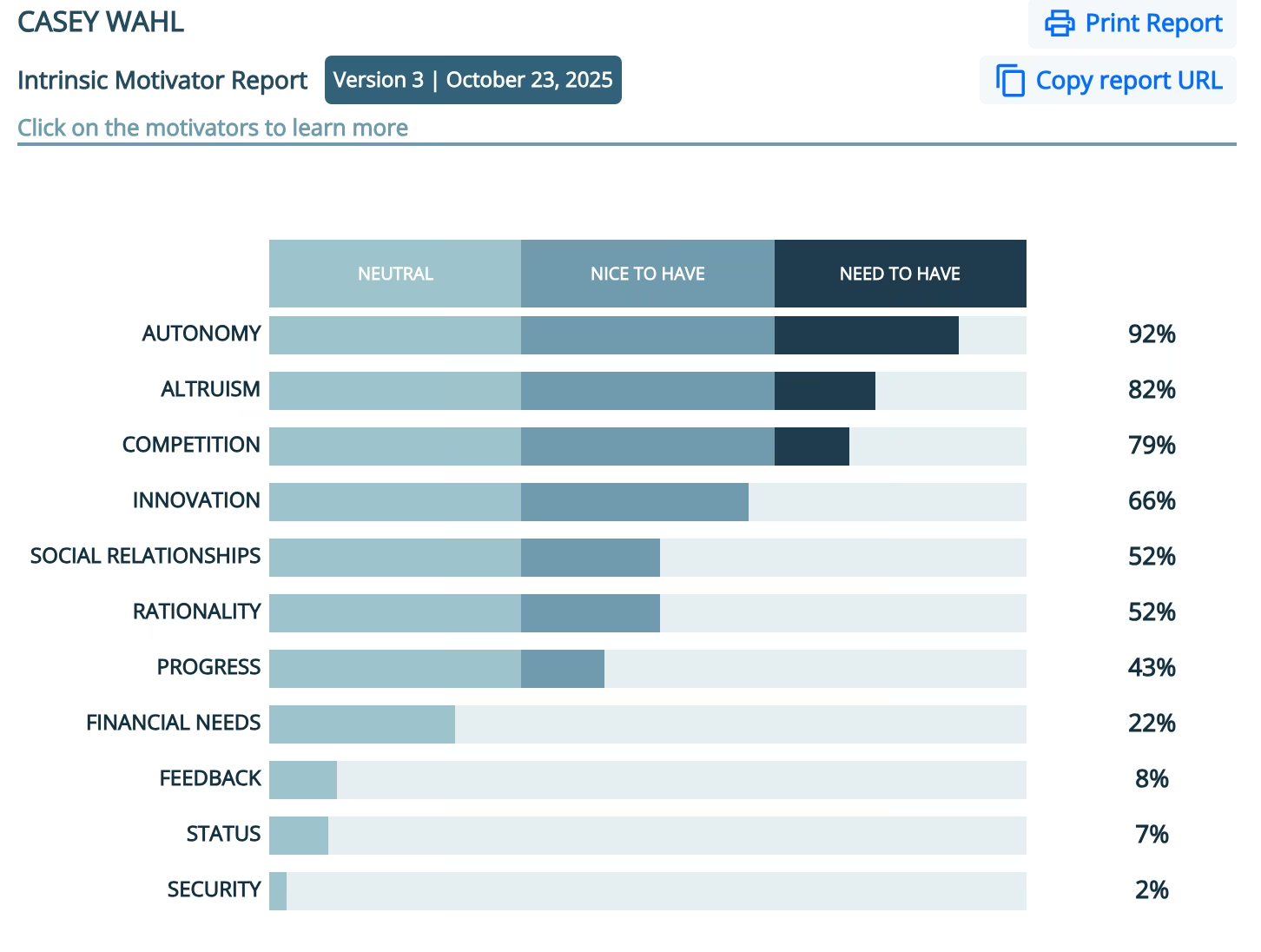
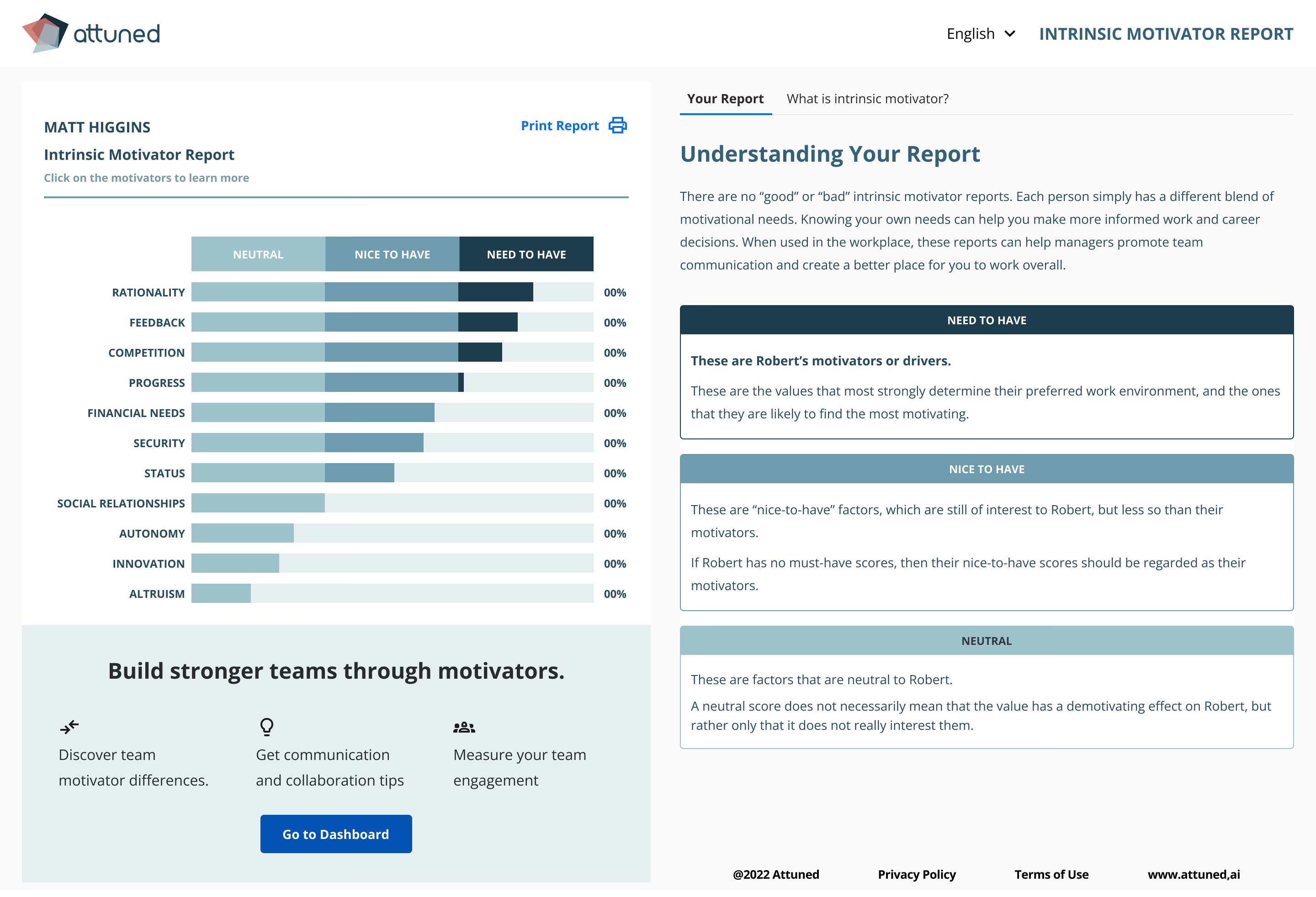
Every report ranks 11 intrinsic motivators, so a new manager knows what matters to each person before the first 1-on-1.
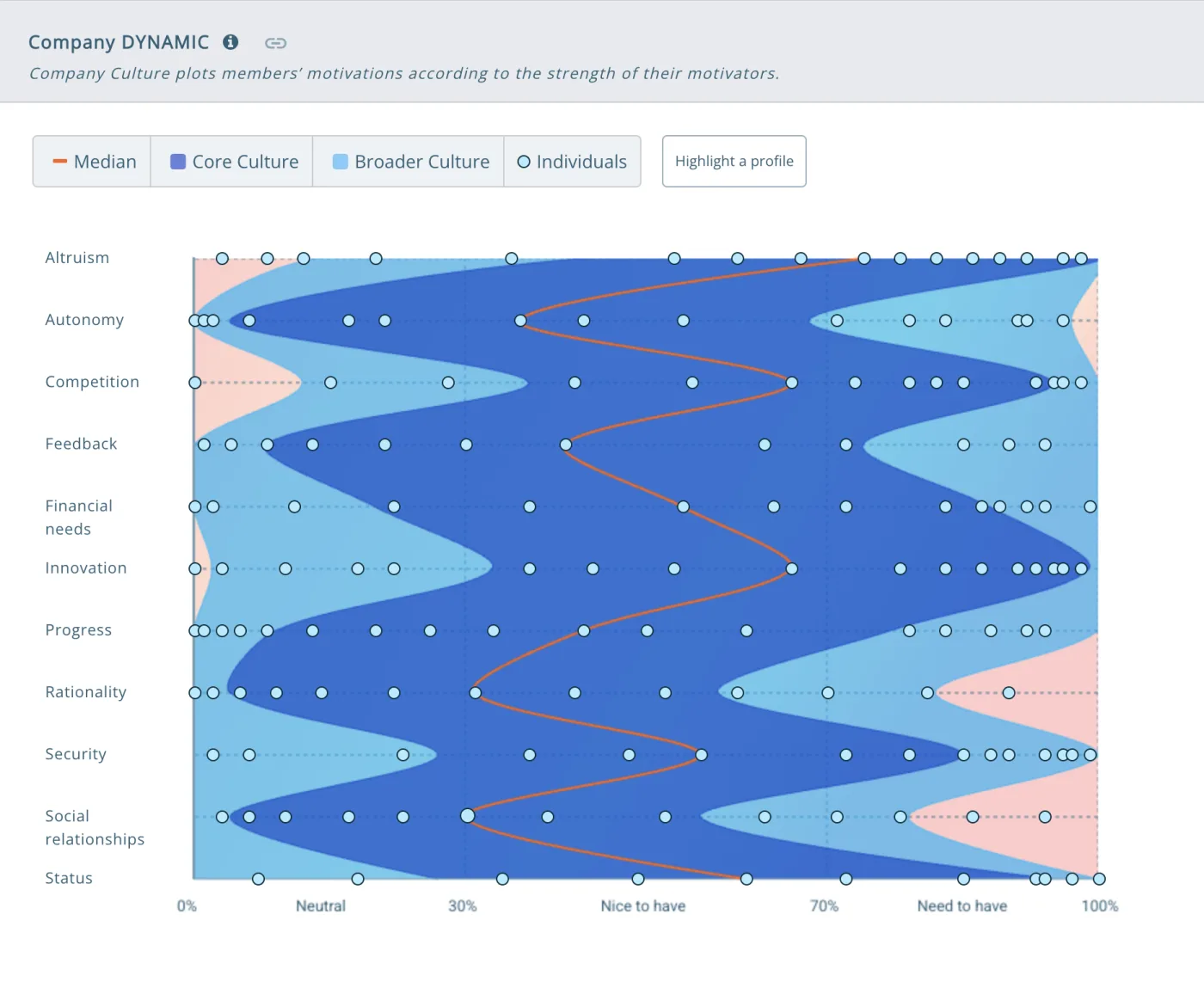
The team view shows where motivators align and where a new manager should expect friction.
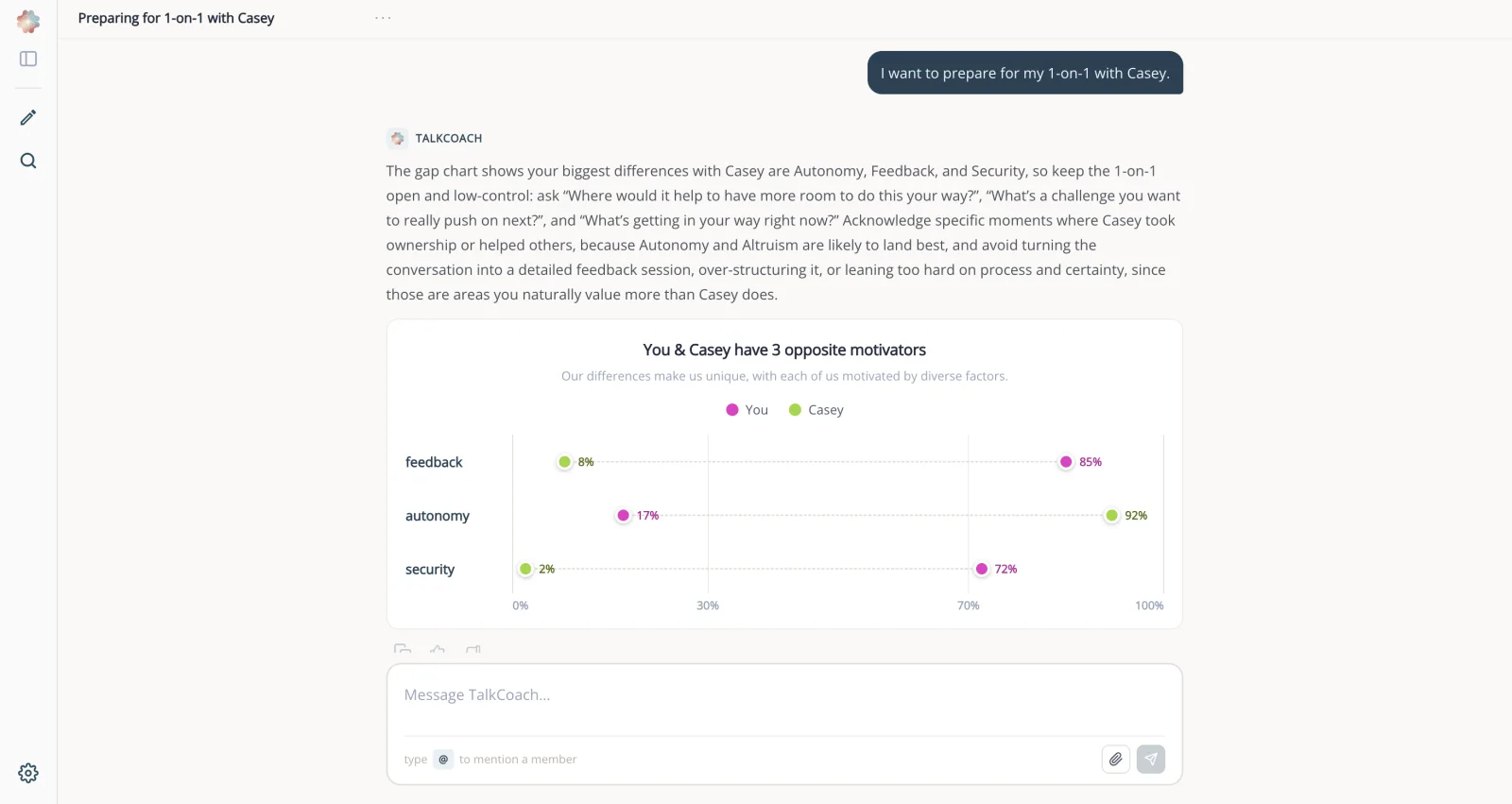
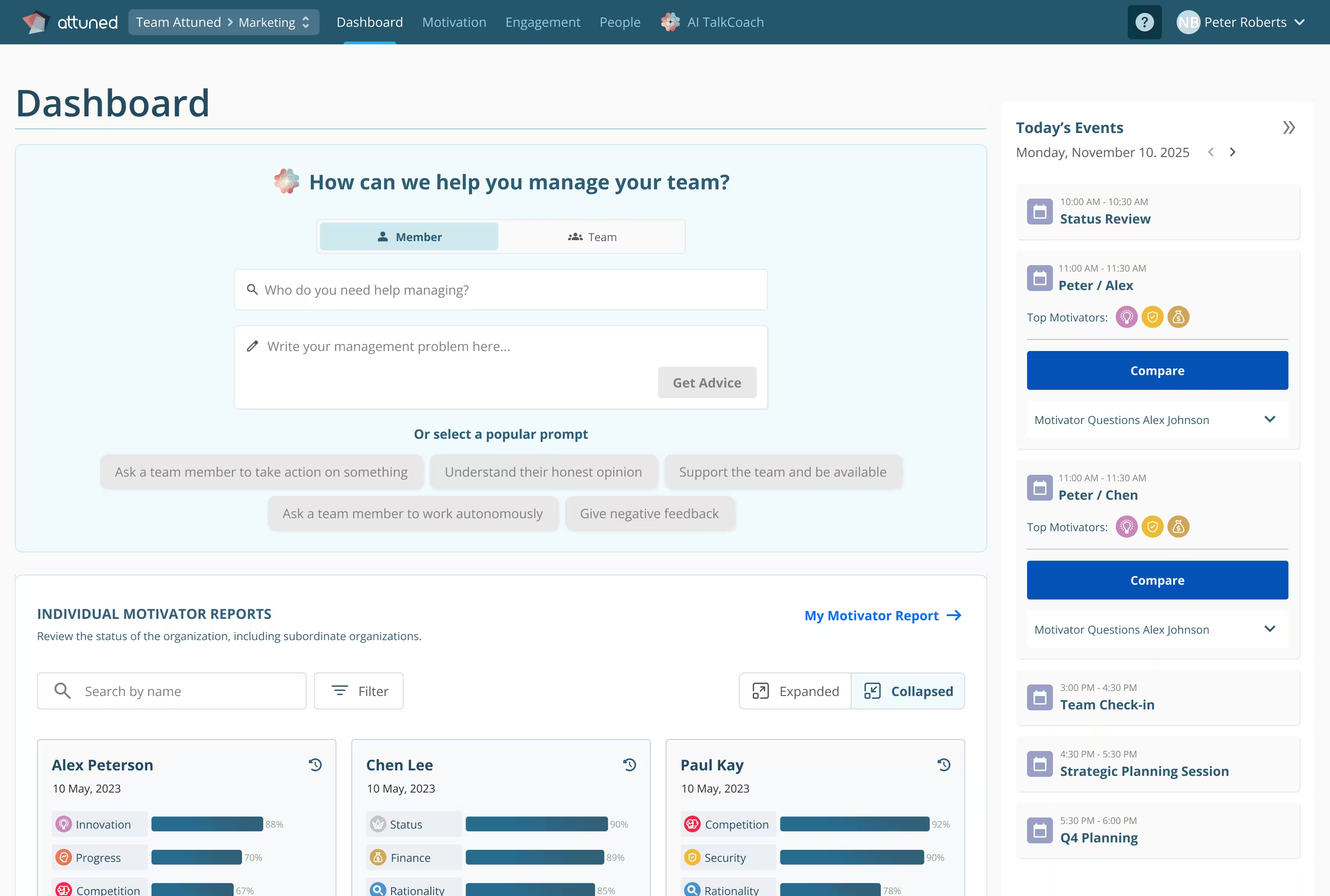
AI TalkCoach turns the theory into a script for the specific conversation happening on Thursday.
Program sponsors see whether manager training is changing anything on the team, quarter over quarter.
A new manager training program is a structured development path for people who have just moved from individual contributor into their first leadership role. A complete program covers eight areas: the identity shift, 1-on-1s, feedback, delegation, goal setting, difficult conversations, individual motivation, and reading team-level signals. It runs across the first 90 to 180 days rather than as a single workshop, and it pairs taught content with real practice on the manager's own team.
Attuned is the practice layer for that program: motivator data on the real team, blindspot flags, and a coaching prompt before each 1-on-1. It runs alongside a course you have already bought, or in place of one.
The people who get promoted into management are, almost by definition, excellent individual contributors. They shipped the most, closed the most, or fixed the hardest problems. Then on Monday the job changes completely: their output is now other people's output, and the instincts that earned the promotion start working against them.
The most expensive of those instincts is assuming that what motivates them motivates everyone. A manager driven by Autonomy gives a report who craves Security a vague brief and calls it freedom. A manager driven by Competition puts a leaderboard in front of someone motivated by Social Relationships and watches them quietly withdraw. Both managers are trying hard. Both are also generalizing from a sample size of one, and the sample is themselves.
of the variance in team engagement traces back to the manager.
the share of leadership development that comes from coursework and training.
Source: CCL, the 70-20-10 rule
intrinsic motivators scored per person, from Autonomy to Social Relationships.
Source: Attuned, the 11 motivators
possible motivator profiles per person across the 11 intrinsic motivators.
Source: Attuned, 11-motivator model
Head of L&D or People Development
"I can get budget for training. What I cannot get is evidence it worked."
VP or Director who just promoted three ICs
"They were promoted for being excellent at the job. Nobody told them the job changed."
Program pricing varies enormously, so here is the more useful number: the payroll whose engagement now depends on one person who has never managed before.
A typical first-time manager's span of control.
Payroll under that manager, at a $90,000 average salary.
The share of team engagement variance Gallup attributes to the manager.
So engagement across $540,000 of payroll now depends more on this one person than on any other single factor Gallup has measured, and that person has never managed anyone before. One regretted departure from a $90,000 report costs somewhere between half and twice that salary to replace, which puts a single avoidable resignation in the same range as the entire year of support. The budget question stops being whether you can afford to develop this manager, and becomes what leaving them to work it out is already costing.
Adding motivator data underneath a program you already run costs a fraction of the fully loaded cost of backfilling two of those six.
Illustration, not a benchmark: span of control and salary are inputs you should replace with your own, and the replacement-cost range is a common planning estimate rather than a measured figure. The 70% is Gallup, State of the American Manager.
Sequence matters as much as content. 1-on-1s come early because the 1-on-1 is the container every other skill gets practiced inside. The team-data module comes last, once the manager has enough context to act on what it shows.
Name the change explicitly in week one. The new manager's job is no longer personal throughput, and until someone says that out loud they'll keep grading themselves on the old scorecard while their team waits on decisions only they can make. Spend as much of this module on what to stop doing as on what to start, because the stopping is the part nobody thinks to give them permission for.
Teach a repeatable structure, a standing cadence, and the discipline of not turning the meeting into a status report. Give them a one-on-one meeting template they can use on Monday, and a plan for first 1-on-1s with a new team, which are a different conversation from the routine ones that follow. A bank of one-on-one meeting questions saves them from falling back on "so, how's everything going?"
Most new managers either avoid corrective feedback for months or deliver it as a surprise in a review, and they don't notice they've done either. Train the small, frequent, specific version, and rehearse giving difficult feedback in a role-play before the real thing arrives. The mechanics of how to give negative feedback positively are learnable, and most managers have never been taught them.
Delegation fails for emotional reasons more often than practical ones: they can still do the task faster themselves, and doing it feels like contributing. Teach the levels of delegation, how to hand over outcomes rather than tasks, and how to let a slower first attempt stand without stepping in to rescue it.
Translating company objectives into work a team can actually hold is a distinct skill, and it's the one most new managers assume they already have. Cover how to say no, how to sequence competing requests, and how to make the trade-offs visible so the team stops absorbing them silently.
Underperformance, interpersonal friction, pay, and promotion disappointment all need a script the manager has practiced. The goal is that their first genuinely hard conversation is not also their first attempt at one.
This is the module most programs skip, and it is the one that makes the other seven land. A manager who knows that one report is driven by Progress and another by Security gives the same news two different ways. Without that, they default to their own motivators and call it consistency. See our work on manager people skills for how this plays out in practice.
Engagement drift, unmet motivators and turnover risk are all visible well before someone resigns, but only if the manager knows which numbers to look at and what a move in one of them actually means. Teach the interpretation before you hand over the dashboard. Otherwise you've given a first-time manager a wall of charts and a brand new source of anxiety.
Plenty of companies already have the curriculum sitting in a Drive folder. These five steps are what turns it into a cohort that measurably manages better six months later.
Write down what should be different for the people these managers lead: regretted attrition, 1-on-1 consistency, the share of reports whose key motivators are being met. Baseline all of it before the first session, because a number without a starting point can't be read afterwards, and you won't get a second chance to collect it.
Roughly 70% of development comes from the job, 20% from coaching and peers, and 10% from formal training, per CCL's 70-20-10 rule. CCL's own reading is that well-designed coursework amplifies the other 90% rather than being wasted, so build the 90% first: a peer cohort that meets every two weeks, a mentor or an AI coach available before each 1-on-1, and live situations on the manager's own team as the homework. Everyone budgets for the workshop, which is the 10%, and then wonders why the other ninety percent never materialized.
Generic training produces generic managers. Before the program starts, have each team complete an intrinsic motivation assessment, so that when the new manager reaches the feedback module they're holding a real map of the actual people they're about to give feedback to, rather than a case study about a fictional underperformer named Dave.
Two days in a room gets remembered. The habit shows up somewhere around the fourteenth Tuesday, which is why the calendar matters more here than the content does. Run a short opening block on the role change and 1-on-1s, then sessions every two weeks through day 90 on feedback, delegation and motivation, then a lighter cadence to day 180 on team patterns and retention. Each session should require something the manager actually did since the last one.
Two quarters after the cohort ends, compare the team metrics you baselined in step one. If you use the Kirkpatrick model, most manager programs stop reporting at Level 1 (reaction) and Level 2 (did they learn it), because those are the easy ones to collect. The metrics that persuade a CFO live at Level 3 (are they behaving differently) and Level 4 (did the business change), and both of those are measured on the team rather than on the manager. Attrition and motivator satisfaction are Level 4 numbers. Cut the modules that moved nothing, and be honest that a happy-sheet score of 4.6 is not evidence of anything.
| Phase | Modules | Cadence | Homework on their own team | Metric | Where Attuned fits |
|---|---|---|---|---|---|
| Days 0–14 | The role change; running 1-on-1s | One short intensive | Book a standing 1-on-1 with every report | 1-on-1 coverage | Each report completes the intrinsic motivation assessment, so the manager walks into the first 1-on-1 already knowing what drives that person |
| Days 15–90 | Feedback; delegation; goal setting; individual motivation | Every two weeks, plus coaching between sessions | One real piece of corrective feedback; one genuine handover | Motivator satisfaction per report | AI TalkCoach supplies a per-person prompt before each 1-on-1, which is the coaching layer that covers the gaps between those sessions |
| Days 91–180 | Difficult conversations; reading team-level signals | Monthly, cohort-led | Act on one drift alert before it becomes a resignation | Regretted attrition; engagement trend | The team culture map plus alerts on unmet motivators give the manager turnover signals early enough to act on them |
CCL, the American Management Association and Coursera all sell versions of the first three rows, and they're genuinely good at it. Most teams end up blending the last two. The trade-off that actually decides it is whether the program can say anything specific about the people each manager leads.
| Format | Relative cost | Time to launch | Personalization | Measurable on the team |
|---|---|---|---|---|
| Build in-house | Low cash, high internal time | 1 to 2 quarters | High, if someone owns it | Only if you baseline first |
| External cohort course | Highest per head | Days | Low, generic case studies | Usually reaction scores only |
| Self-serve video library | Lowest per head | Immediate | None | Completion rates only |
| Blended, with team motivator data | Moderate | 2 to 4 weeks | Per person, from assessment | Motivator satisfaction and attrition |
Intrinsic motivators are stable, measurable, and unevenly distributed. Attuned scores 11 of them, including Autonomy, Progress, Security, Feedback, Status, Competition, Innovation and Altruism. There are more than 1.7 million possible motivator profiles per person, which is a formal way of saying that no single management style fits a whole team. You won't find two identical profiles on a team of seven.
This is why the same manager training produces wildly different results in different hands. The skills are teachable. Knowing which of your reports needs which version of the skill is information, and information has to be supplied.
Commercial aviation has a term for the equivalent problem. When a pilot moves from one aircraft type to another they earn a type rating, which means simulator hours and a check ride, because the instruments sit in unfamiliar places and the aircraft handles differently. Nobody suggests the pilot forgot how to fly. We promote our best engineer on a Friday, hand them six direct reports on the Monday, and file the congratulations card under development plan.
The State of Motivation Report 2026 tracked the intrinsic motivators of tens of thousands of Attuned users across four-plus generations, and found them shifting under AI and sustained economic pressure. Which means a first-time manager's mental model of "what people want at work" is usually inherited from a workplace that has already moved on.
Whatever drives the manager reads to them as simply what work is for. It's the single assumption most likely to cost them a good report in year one.
Generational shorthand is easy, and it flattens the individual. Our 2026 data tracks motivators across four-plus generations, and the average for any of them tells a manager remarkably little about the specific person in Thursday's 1-on-1.
A report who has stopped raising things is easy to file under low maintenance, and it's one of the clearer signs of quiet quitting. Motivator satisfaction tends to slide for a couple of quarters before anyone says a word out loud about it.
A course can tell a new manager that these blindspots exist. Data on the actual team is what tells them which one they currently have, and with whom.
The distinction your new managers need before the motivation module makes sense.
A 30 minute walkthrough of the motivator report, the team map, and how L&D teams wire them into an existing manager curriculum.
“We wanted to understand why they come to work and why they do the work that they do.”
Azon Recruitment Group An award-winning agency and one of Ireland's fastest growing talent businesses
Managers see what drives each report individually, so a taught skill has a concrete target from the first week.
An AI coach for managers covers the 20% that mentoring alone cannot staff at scale.
Motivator satisfaction and engagement trends give program sponsors a number that is not a happy sheet.
Tens of thousands of assessments across four-plus generations and multiple markets, with ongoing research at Goethe University.
A new manager training program is a structured development path for people who have just moved from individual contributor into their first leadership role. A complete program covers the transition itself, 1-on-1s, feedback, delegation, goal setting, difficult conversations, motivation and retention, and how to read team data. It normally runs across the first 90 to 180 days rather than as a single workshop, and it combines taught content with real practice on the manager's own team. The strongest programs also give the new manager information about the specific people they now lead, so the skills have somewhere concrete to land.
Most frameworks converge on five: planning and goal setting, organizing and delegating work, leading and motivating people, communicating including feedback and difficult conversations, and controlling or measuring results. For a first-time manager, the two that break soonest are delegation and motivation, because both require the manager to stop optimizing their own output and start optimizing someone else's. A new manager training program that teaches all five equally tends to underserve those two, so weight them accordingly.
The 70-20-10 model holds that roughly 70% of leadership development comes from on-the-job experience, 20% from relationships such as coaching and mentoring, and 10% from formal training. The practical implication for a new manager training program is that a two-day course is the 10%, so it will fail on its own. You need the 20% (a mentor, a peer cohort, or an AI coach the manager can use before each 1-on-1) and a deliberate 70% (real 1-on-1s, real feedback, a real team to practice on) wired into the program from day one.
Plan for 90 to 180 days of structured support rather than a fixed number of classroom hours. A workable shape is a short intensive in the first two weeks covering the role change and 1-on-1s, then practice and coaching every two weeks through day 90 covering feedback, delegation and motivation, then a lighter cadence to day 180 focused on team-level patterns and retention. Spacing matters more than total hours, because the skills only stick when the manager applies each one to a live situation on their own team between sessions.
Measure outcomes on the manager's team, not satisfaction with the training. Four indicators work well: regretted attrition on that team, the proportion of direct reports whose key motivators are being met, 1-on-1 consistency, and how team engagement moves in the two quarters after the program. Set a baseline before the program starts, because without it any later number is unreadable. Course completion rates and happy-sheet scores tell you the training was pleasant, which is a different question from whether the manager improved.
Because promotion rewards individual excellence and then requires a completely different skill set. The new manager keeps doing the thing that earned the promotion, which is personal delivery, and treats their team as an extension of their own working style. They assume what motivates them motivates everyone. Since intrinsic motivators vary enormously between people, that single assumption quietly produces most of the early damage: the wrong incentives, the wrong feedback, and the wrong work handed to the wrong person. The structural problem underneath it is that the Center for Creative Leadership puts 90% of leadership development outside the classroom, and most new managers are handed the classroom and left to find the other 90% on their own.
Eight modules cover the ground: the identity shift from doer to leader, running effective 1-on-1s, giving feedback that changes behavior, delegation and trust, goal setting and prioritization, difficult conversations, understanding what motivates each individual, and reading team-level signals such as engagement and turnover risk. Sequence them so 1-on-1s come early, because the 1-on-1 is the container every other skill is practiced inside. Leave the team-data module until the manager has enough context to act on what it shows.
Attuned can do either: supplement an existing curriculum, or serve as the whole program for teams that don't have one. Teams with an existing curriculum keep it and use Attuned as the practice layer between sessions, since the Center for Creative Leadership's own 70-20-10 model puts formal training at 10% of how managers learn to lead. Teams with no program at all often start with Attuned, because motivator data plus a coaching prompt before each 1-on-1 gives a new manager something to act on in week one, while a course booked for next quarter does not. Attuned is a people-science platform, so there are no courses or facilitators to schedule.
Six things, in rough order of urgency: that their job is now the team's output rather than their own; how to run a 1-on-1 that is not a status report; how to give small corrective feedback early instead of saving it for a review; how to hand over work and tolerate a slower first attempt; what each individual person on the team is actually motivated by, which is rarely the same thing that motivates the manager; and which team signals tend to precede someone resigning. Most of what else a new manager needs turns out to be a variation on one of those six.
Pair taught content with immediate practice on their own team, and space it out over months rather than days. A workable shape is a short opening block on the role change and 1-on-1s in the first two weeks, sessions every two weeks on feedback, delegation and motivation through day 90, then a lighter monthly cadence to day 180 covering difficult conversations and team-level signals. Give them a coach or a peer cohort for the gaps between sessions, because roughly 90% of what sticks comes from the job itself and the people around them rather than from the classroom. Set homework that requires a real conversation with a real report.
Attuned works alongside whatever curriculum you run, in-house or bought in, and covers the part a classroom cannot reach. Every team member completes a short assessment that scores 11 intrinsic motivators, from Autonomy and Progress to Security and Social Relationships, and the manager sees where each person's motivators are being met and where they are not. AI TalkCoach then suggests what to raise in the next 1-on-1 with that specific person, and alerts flag a motivator that has been unmet long enough to become a retention risk. The training teaches the skill; Attuned supplies the specific team context that makes the skill usable in week one.
Every new manager program eventually reaches the same wall: the content is sound, and the manager still has to guess what the person in front of them actually wants from work. Attuned removes the guessing, one report at a time.
Bring your existing curriculum. We'll show you where the motivator data slots in, and what changes on the team within two quarters. If it doesn't move your numbers, you haven't lost more than a quarter finding out.
See the motivator report, the team map, and AI TalkCoach against a real team structure.
Book a demo Read the 2026 researchNo pressure, no slide deck marathon.