TalkCoach is AI coaching built on the science of intrinsic motivation. It reads the gap between how your team member sees the world and how you do, and gives you the framing for the hard conversation, so the message you mean is the one that actually lands.
Built on 11 intrinsic motivatorsReads both sides of the conversationBuilt for the manager in the middle of the conversation
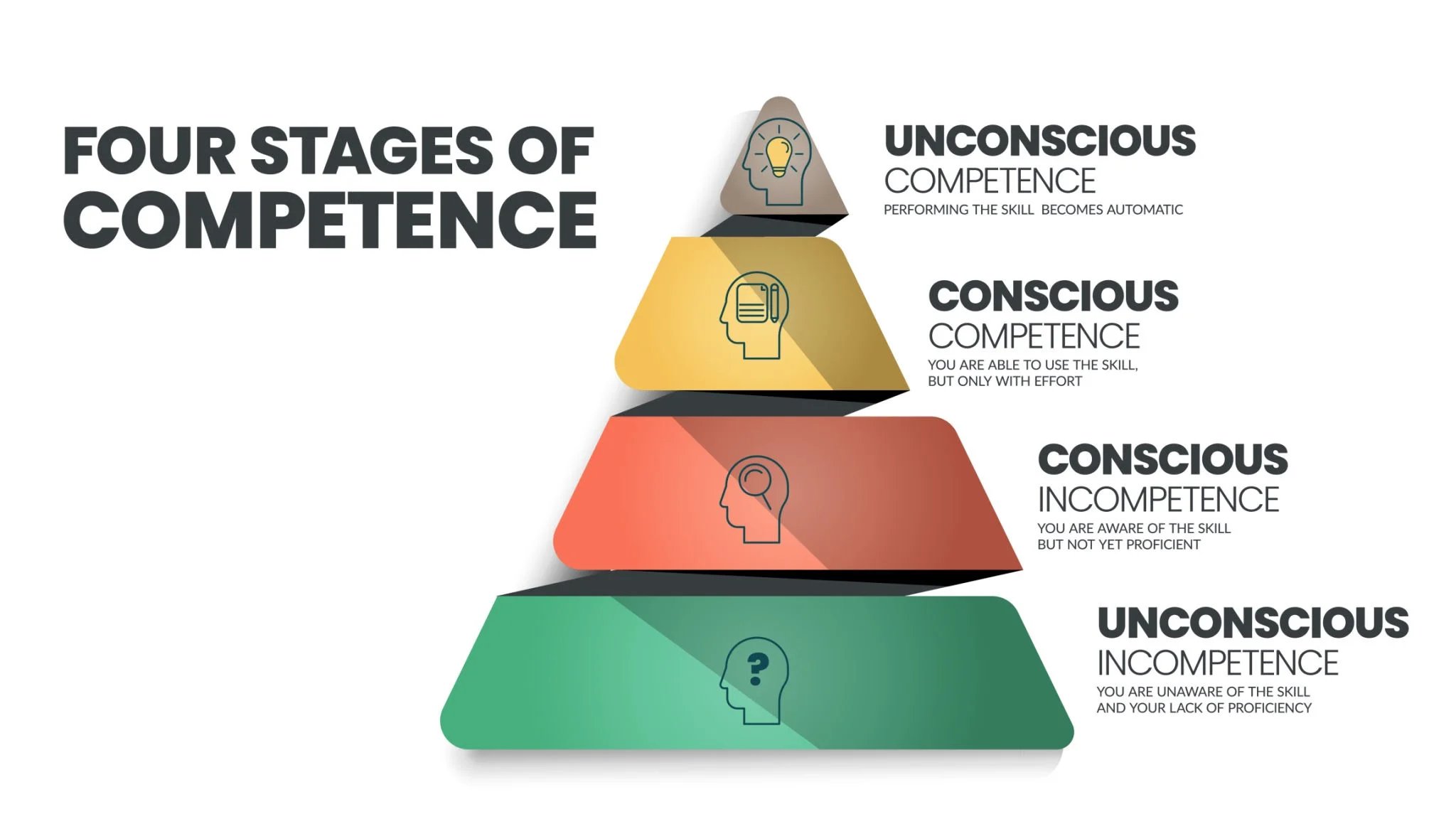
Most managers tumble off Unconscious Competence back to Unconscious Incompetence without ever feeling the air change. They just stop knowing they have stopped learning.
The Story
Twenty years of managing people, and I still missed the most important blindspot of all: my own.
I've been managing people for twenty years. Instinctually, without conscious thought, I'd assumed I had long ago crossed into earned wisdom. Recent events suggest I'm actually stuck a stage earlier, in that satisfying state where the muscle memory of management just works, right up until it does not.
I've been working with a talented, empathetic, customer-attuned member of our team for several years. Let's call her Gabriella.
I needed to move her from her previous role into a more product-focused position. She understood our product pain points better than almost anyone. I thought it was a brilliant managerial move: a new career chance for a dedicated team member, a steep learning curve, but the skill-to-role fit felt particularly well matched.
Then I got a frustrating surprise.
The Red Flag
She started using the word "alignment."
"We need to align on this." "Can we get alignment before I move forward?" "We should make sure everyone is aligned."
For someone with my motivational profile, driven primarily by Autonomy, Competition, and a startup-bred belief that moving fast is itself a form of care, that word snapped my neck like a flare shooting across a calm sky. Alignment had always struck me as a respectable-looking management tax: agreeable on its surface, ruinous in practice, the kind of work expansion you pay for in three additional weeks of calibration meetings. That afternoon, the flare meant we were about to spend three more such weeks when we should have been building.
My instincts, and my current disposition (sick kids, single dad), meant I would have been blunt. Statistical chance that I would be too blunt: very, very high.
The Mechanism
Management blindspots are specific gaps in how a manager perceives their team, caused by their own motivational profile.
On Attuned's platform we call these motivators: the underlying psychological needs that shape how people work, what makes them feel safe, and what drives their natural decision-making. Where Myers-Briggs assigns a personality type, motivators describe a value hierarchy: the small set of things a person is, often without quite knowing it, trying to optimize for in the work of any given week.
My motivators (Autonomy, Competition, Altruism) mean I find energy in ownership and speed. I am comfortable being wrong if I was decisive. Friction, especially persistent persnickety friction, feels like inefficiency.
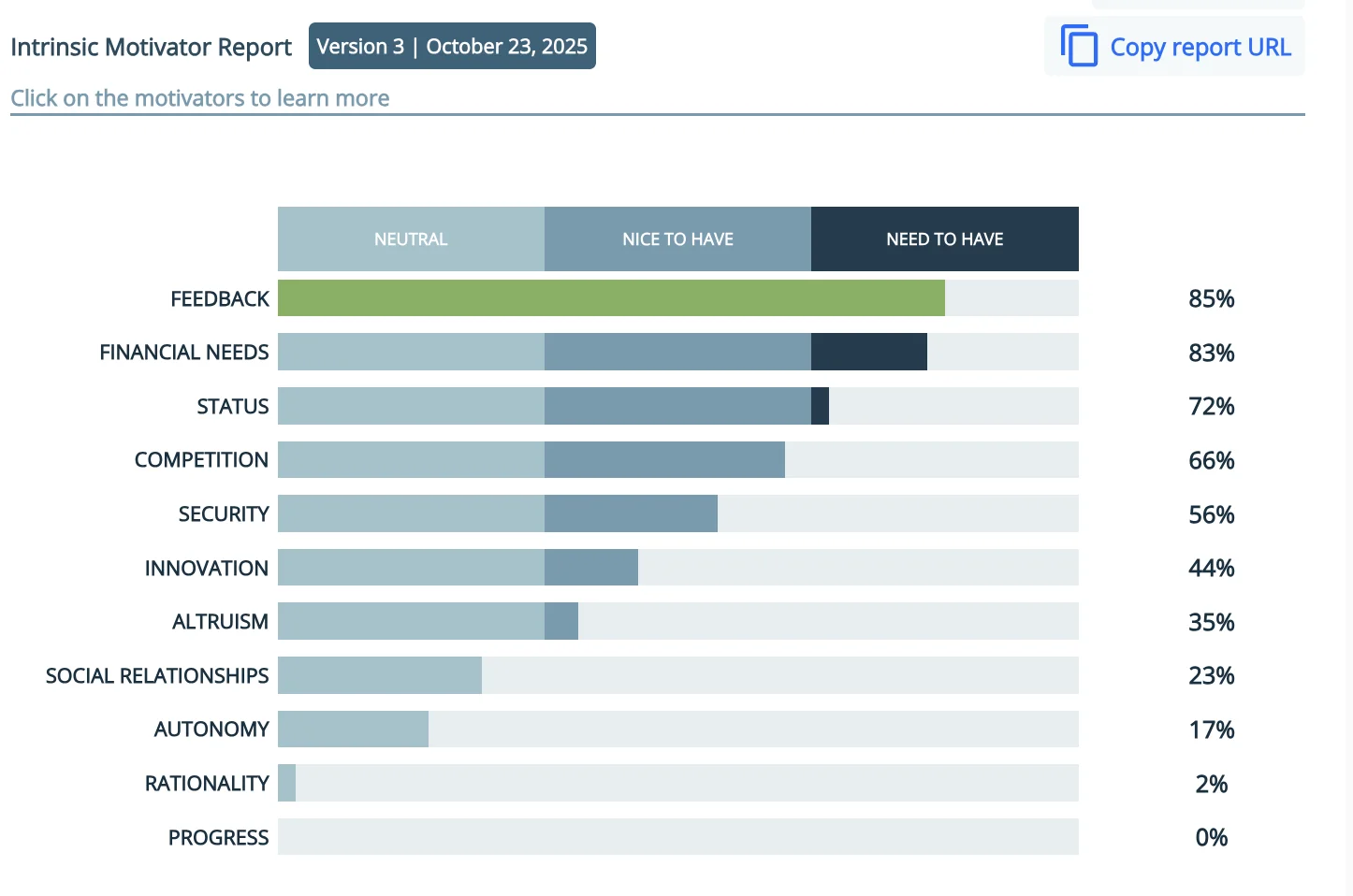
Gabriella's motivators are different. She is strongly driven by Feedback and Status. The status that mattered to her was the human kind: knowing where she stood, having her contributions be visible, picking up the small daily signals that confirm a person is doing well in their work. In her previous role those signals came naturally. Customers responded. The team relied on her. Her value was legible by the end of most days. In her new product role, especially early on, the signals went quiet. The feedback loops lengthened. Expectations became less defined. The ground under her feet, in her own description of it, started to feel uncertain.
Gabriella's Intrinsic Motivator Report. Feedback (85%) and Financial Needs (83%) sit at the top: exactly the signals that disappear in a new role with longer feedback loops.
When she said "we need to align," the request underneath the request was a different one: Am I about to do something wrong? Is anyone going to tell me before it's too late to correct?
My natural management read was utterly wrong. My own motivational blindspots, my internal construction of how the world should work, had blindspotted me. I'd been blindspotted by my blindspot.
There is a name, in instrument flying, for the illusion in which the cockpit reads true while the aircraft is in fact pointed at the ground: the somatogravic illusion. The dials are honest. The body feels level. The horizon turns out to have been somewhere else the whole time. A motivational profile, in its quiet and respectable way, produces something close to the same effect on the way one person reads another.
A note from instrument flying
The Tool
I turned to TalkCoach.
TalkCoach is our AI coaching tool, built on top of Attuned's motivator framework. You chat in context (the relationship, the tension) and it helps you think through what is actually happening and how to respond. I gave it just enough: Gabriella's transition, the "alignment" friction, my raw thoughts. It already had the background: our motivator reports, the gap between our motivational world-views, the shape of the situation.
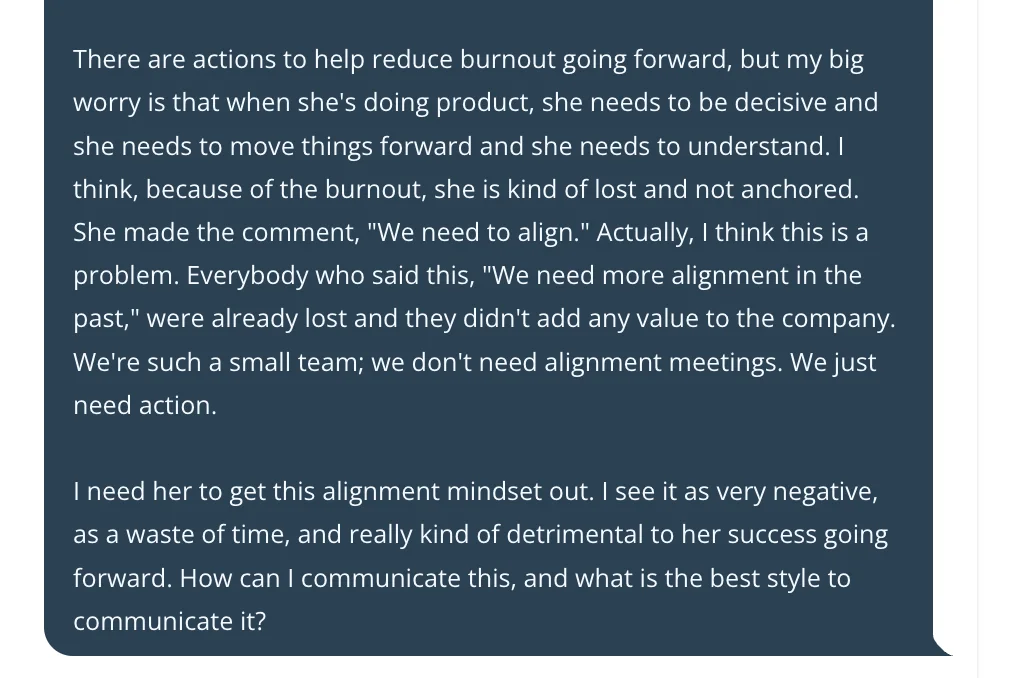
What I gave TalkCoach: my unfiltered, frustrated read of Gabriella's behavior and the "alignment" problem.
Our own product reoriented me completely. It made me think, "hey, this is really good. It really saved my managerial butt."
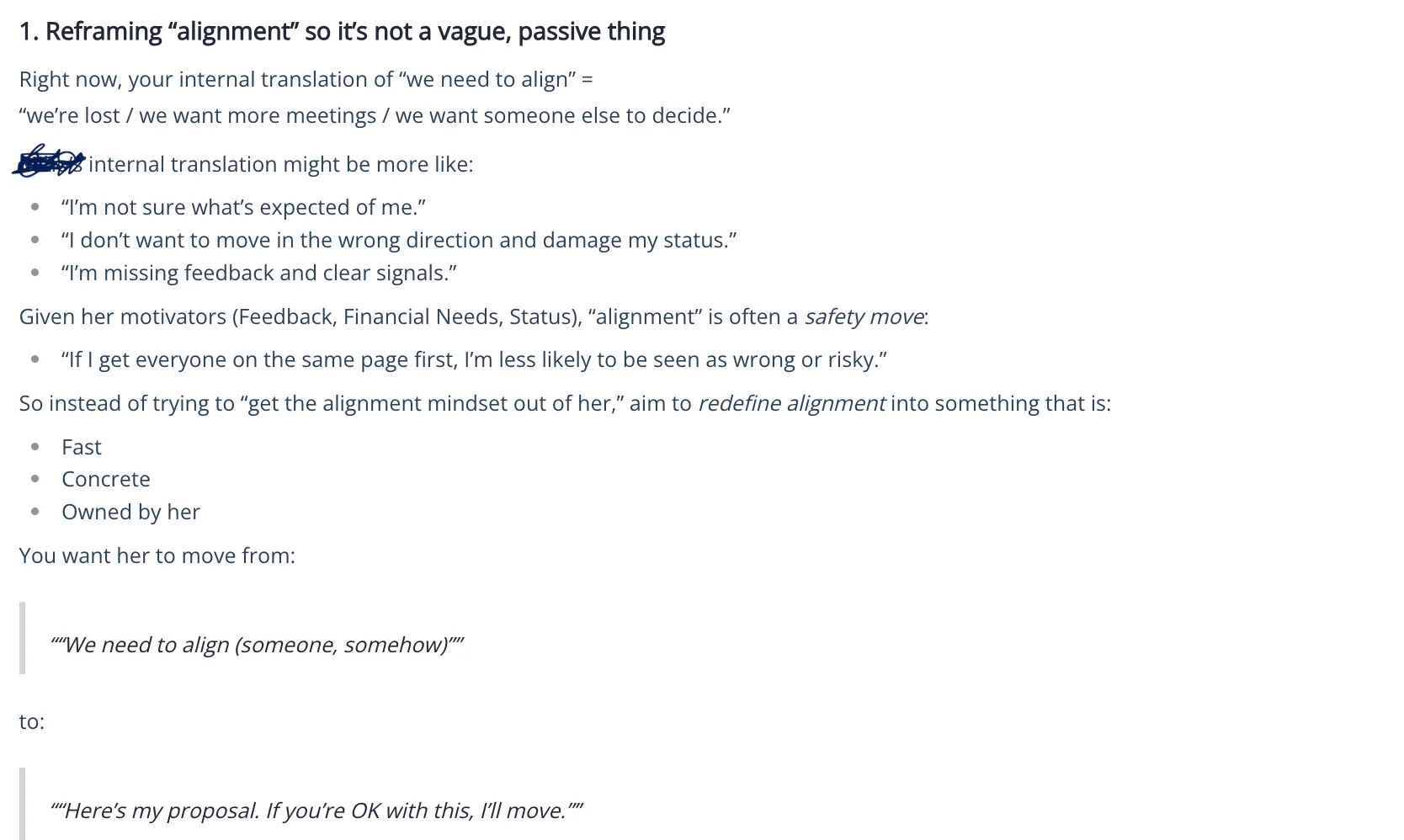
The insight, when it arrived, reorganized the whole situation. From Gabriella's vantage, the requests for alignment had been functioning as a safety behavior. Given her motivators, that request was a way of protecting her standing in a new role in which the risks felt large and the feedback signals had gone thin. The thing she actually wanted was help avoiding the slow accumulation of small wrong moves, the kind that become legible only after they have compounded into something harder to walk back.
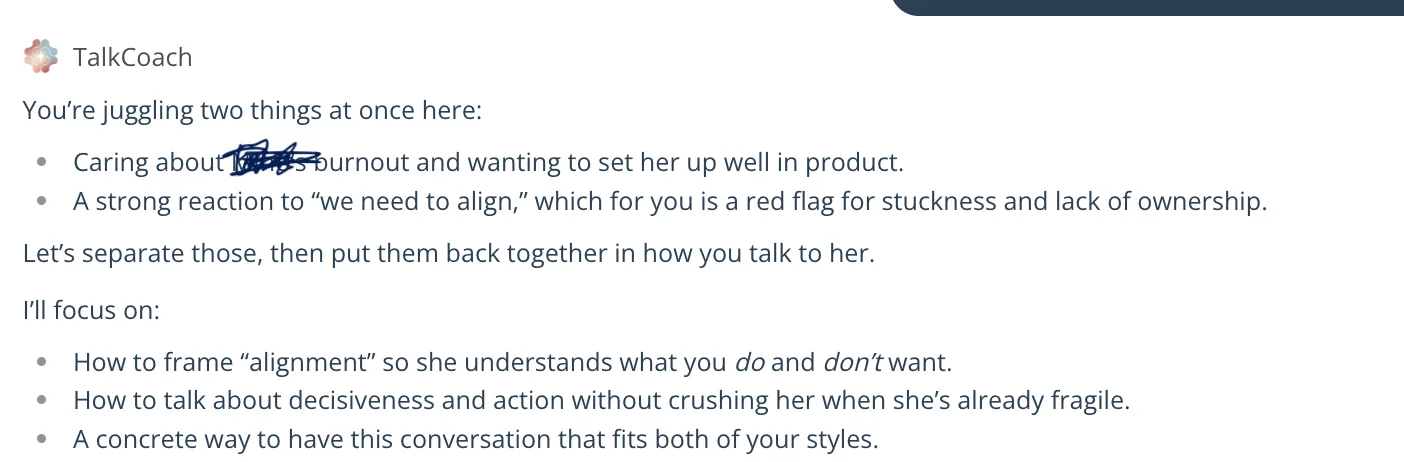
TalkCoach reframing "we need to align" as a safety behavior driven by her motivators.
TalkCoach suggested I leave the alignment impulse where it was and redefine, in practice, what alignment meant: make it fast, concrete, and owned by her. The shift it described was simple and precise. Move from "we need to align" to "here is my proposal; if you're OK with this, I'll move." The same underlying need, met cleanly, in a frame that allowed her to ratify the call rather than gate it.
On the question of how to have the conversation, TalkCoach was equally specific. I was carrying two things at once, it pointed out: a genuine concern for Gabriella in the middle of a difficult transition, and a real frustration with what I had been reading as passivity. The two had to be separated before either could be useful, or else the message I sent would arrive loaded with the frustration and almost none of the care. It told me to start with the care.
TalkCoach pointing out the two concerns I was tangling together: care for Gabriella, and frustration with what I was reading as passivity.
The Conversation
The framing TalkCoach suggested was something I would not have come up with on my own.
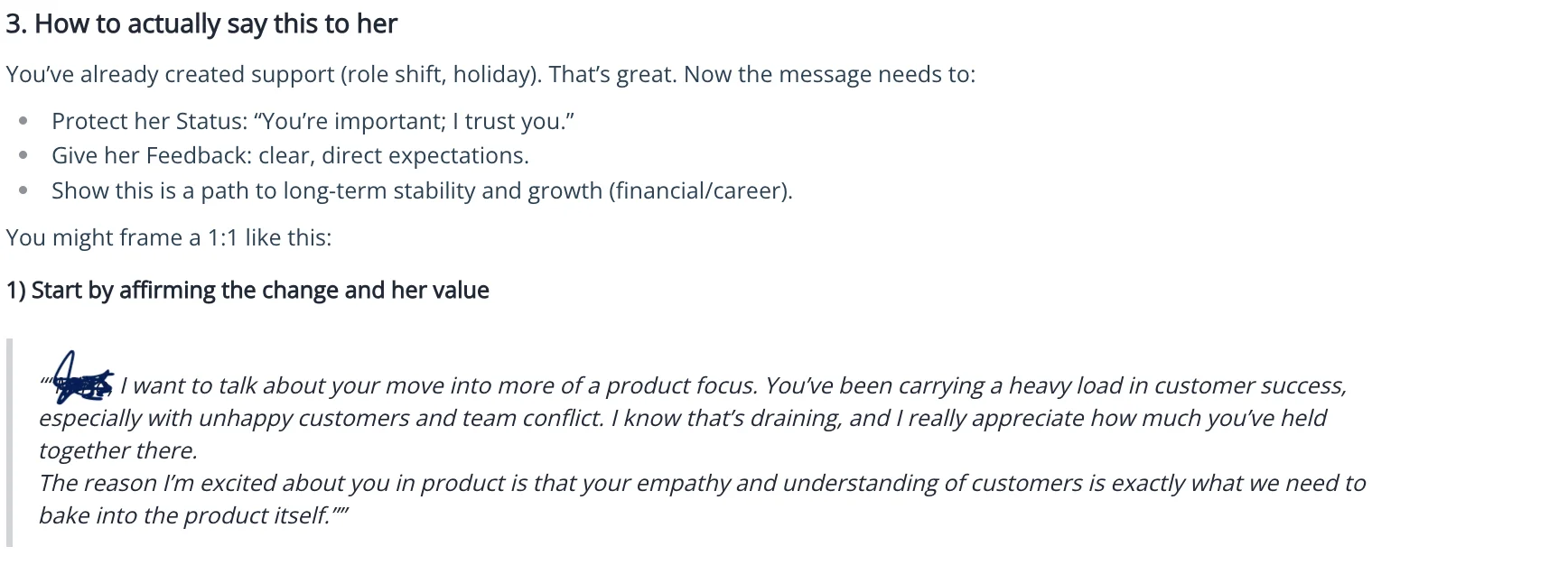
The three goals TalkCoach laid out for the 1:1, and the opening script I ended up using almost verbatim.
"Gabriella, I want to talk about your move into more of a product focus. You've been carrying a heavy load in your previous role, especially with the harder customer situations and the team dynamics. I know that's been draining, and I appreciate how much you've held together there. The reason I'm excited about you in product is that your empathy and your understanding of customers is exactly what we need to bake into the product itself."
Then: clear expectations, framed as signals of trust. "I trust your judgment. What I need to see now is more of your judgment in motion." The message I was trying to convey was that decisiveness, in this role, would build her standing further. A call made with 80 percent of the information was more valuable than the 100 percent that three additional weeks of consensus would eventually deliver. A wrong decision was something we would fix together, with her authorship intact.
I used TalkCoach's output nearly verbatim. In Slack. In my 1:1 notes. In how I framed her next projects.
Her change was immediate. Gabriella found her footing. Her output accelerated. The requests for "alignment" gave way to what I'd really been wanting: actual proposals, followed by action. She began to drive decisions rather than waiting for the weather to clear. Her confidence steadily returned, and with it the qualities that had made her such a great team member in the first place.
The tool that makes giving difficult feedback a little easier.
Book a 30-min call with Casey to see TalkCoach in action, or start with the 2026 State of Motivation Report. Both take less time than a single bad 1:1.
A misread direct report doesn't tell you they've checked out. They simply leave, or worse, stay quietly while their best work walks out the door with them. The numbers below are what that looks like across the workforce.
84%
Of employees experience mental withdrawal before handing in a resignation letter. The damage is done long before you know it's coming.
Gallup, State of the Global Workplace
1in 2
Employees who quit cite their manager as a primary reason. The single biggest predictor of retention is the quality of the relationship with their direct boss.
Gallup, "It's the Manager," 2019
$15K-$25K
Typical cost to replace a single individual contributor. For senior or specialized roles, this climbs well past one full year of salary.
SHRM / Center for American Progress
~10min
Time for each team member to complete the Attuned motivator assessment. Most teams are operational within a single week.
Attuned customer deployments, 2024–2026
How TalkCoach Works
From "I don't know how to say this" to a 1:1 that actually lands
Four steps. No HR degree required. The whole loop takes about a week to set up, and minutes to use the next time you have tough feedback to give or a conversation you're dreading.
01
Map Your Motivators
Take the ~10-minute assessment yourself first
You can't read someone else's motivators clearly until you know your own. Your profile across 11 intrinsic motivators is the lens you've been reading the world through your entire career, without seeing it.
02
Map Your Team
Each report takes the same assessment
Now you can see the gaps. Where your Autonomy is high and theirs is low. Where their Feedback is the load-bearing wall you've been treating as a partition. The gap is where the misreading happens.
03
Bring the Hard Moment to TalkCoach
Write what's actually frustrating you, unfiltered
TalkCoach already has both profiles in context. It reads the situation through their frame and yours, names the gap, and gives you the conversation framing, the specific language, the sequence. Use it nearly verbatim, like I did, or adapt.
04
Have the Conversation
Deliver the feedback that lands
Care arrives with the message instead of getting buried under your frustration. The hard thing gets said, and gets heard. The change is usually immediate, sometimes in the same conversation.
FAQ
Common questions from managers and team leads
What is TalkCoach and how is it different from generic AI chat?
TalkCoach is Attuned's AI coaching tool, built on top of our motivator framework. Unlike generic AI chat, it already knows the motivator profiles of you and your team. It reads behavior through both your frame and theirs, and gives you concrete conversation framing tailored to the specific gap between two people's motivators. The difference is having a coach who knows your team versus typing a generic prompt into a chatbot that has to guess.
Do I need to take an assessment first?
Yes. Each person takes a roughly 10-minute assessment that maps them across 11 intrinsic motivators: Altruism, Autonomy, Competition, Feedback, Financial Needs, Innovation, Progress, Rationality, Security, Social Relationships, and Status. TalkCoach uses those profiles as the basis for everything it tells you. Without them, you're back to generic advice.
How long does this take to roll out across a team?
Most teams are operational within a single week. Each person completes the assessment in about 10 minutes. After that, managers have motivator profiles for everyone and TalkCoach is ready to use the next time you have a 1:1, a difficult feedback moment, or a hire to brief in.
Is my motivator data private?
Yes. Individual reports are owned by the person who took the assessment. Managers see team-level patterns and the profiles of their direct reports. We do not sell or share data outside the customer organization. The platform is designed for psychological safety: people share their motivators because they choose to, and because doing so makes their working relationships better.
What does it cost?
Pricing scales by team size. For most teams, the annual cost is less than a single bad-feedback-induced departure. The fastest way to get a number specific to your team is to book a call with Casey and ask directly.
Can I try it before booking a call?
Yes. Start with the free 2026 State of Motivation Report, which is built on the same motivator data and gives you the underlying picture of what is driving today's workforce. Our motivator framework is documented at attuned.ai/motivators. Book a call when you want to see TalkCoach itself in action.
TalkCoach · AI Coaching for Managers
The tool that makes giving difficult feedback a little easier.
Map your motivators. Map the motivators of the people you manage. The next time a team member does something that frustrates you, ask: am I reading their behavior through my own frame, or through theirs? That single question is usually enough to surface a management blindspot before it does real damage. TalkCoach helps you ask it, and then helps you say the next thing.
I thought I was a wise manager. I was a stage-two manager who was moving fast. Sometimes fast and wise look identical, right up until you mess up a valued relationship that was simply in a tender moment. TalkCoach is the tool I wish I'd had ten years ago. Book a call and I'll show you what it can do for your team.
No pitch deck
No sales queue
30 minutes with the founder
Talk to Casey
Pick a time. No waiting for a callback, no sales queue. You'll talk directly to the founder about what is happening on your team and whether TalkCoach can help.