People Science · For Managers Fighting Disengagement

Barriers to Employee Engagement

Most barriers to employee engagement are unmet intrinsic motivators, and you cannot remove a barrier you cannot see. Below are the 8 most common barriers, what each one looks like on a real team, and how to remove it, starting with the drivers hiding under every low engagement score.

See the 8 Barriers ↓ Book a Call Directly →
Trusted by
Azon Recruitment Group
Growing Firms & Startups
Managers in 4+ Generations
attuned.ai · Every barrier, traced to its motivator
The barrier you see
Unmet motivator
What removes it
“My recognition isn't working”
Status
Praise in the currency they value
“They've quietly checked out”
Progress
A visible next challenge to own
“They push back on direction”
Autonomy
Hand them real ownership
“Steady performer, newly tense”
Security
Make the ground feel stable
Every engagement barrier traces back to a motivator the role stopped meeting. Attuned shows you which one.

What are the barriers to employee engagement?

The most common barriers to employee engagement are unmet needs that keep a person from bringing their full effort to the work. In practice, they fall into eight recurring patterns:

  1. Unclear expectations about what good work looks like.
  2. A manager who does not understand what drives the person.
  3. No recognition, or recognition aimed at the wrong thing.
  4. No sense of growth or progress in the role.
  5. Too little autonomy over how the work gets done.
  6. Weak psychological safety, so problems stay unspoken.
  7. Misaligned or unmet intrinsic motivators between the person and the role.
  8. Burnout from an unsustainable workload.

Underneath almost all eight sits a single root barrier: a role that fails to meet what a specific individual is actually driven by. That barrier is invisible on a standard engagement survey, which is why so many engagement programs spend a budget and move the number by nothing. The rest of this page walks through each barrier, what it looks like, and how to remove it, ending with how to measure the ones you cannot currently see.

Case Study · Azon Recruitment Group · Ireland

"Being able to get to the nub of people's underlying motivations has been very helpful."

Kevin Halligan, Associate Director, Azon Recruitment Group

A fast-growing firm hitting the engagement wall

Azon grew from a handful of people into an award-winning talent business. As it scaled, the firm hit the barrier every growing company eventually meets: too many people to read by instinct, and no shared way to see who was quietly disengaging.

Disengagement you could not see coming

"If an employee was engaged and looked happy, the assumption was they were fine, until you got the resignation," their HR team noted. The real barriers were invisible, so managers only found out a motivator had gone unmet once someone was out the door.

Made each person's real drivers visible

Attuned mapped each person across 11 intrinsic motivators, so managers could see where a role was failing to meet what an individual actually valued, and act on that specific barrier long before it turned into a leaving date.

Engagement up. Retention followed.

"A dramatic increase in the numbers of people we hire that we feel we've gotten right," reports Kevin Halligan, Associate Director. "We have really seen that benefit translating to earnings for our business."

From invisible to actionable: Azon's managers now see the barrier to a person's engagement while there is still time to remove it, rather than reading about it in a resignation letter. Read the full story →

Disengagement Is Expensive, and Mostly Preventable

The barriers to employee engagement are not a soft problem. They show up in turnover, output, and the manager most responsible for the outcome. Here is what the research says.

70%
Of the variance in team engagement traces back to the manager. The largest barrier, and the largest lever, is what the manager can see about each person.
Gallup, State of the American Manager
52%
Of voluntarily exiting employees say their manager or organization could have done something to prevent them leaving. Most disengagement is reachable in time.
Gallup
1 in 4
Employees strongly agree they receive the right amount of recognition for their work. Mistargeted recognition is one of the most common engagement barriers on this page.
Gallup / Workhuman
1.7M
Possible combinations of the 11 intrinsic motivators. It is why the same engagement program lifts one person and leaves the next one flat.
Attuned motivator model
$8.8T
The estimated cost of low engagement and lost productivity to the global economy in a single year. Disengagement is not a soft metric.
Gallup, State of the Global Workplace

Sound familiar?

A company-wide engagement program rarely moves a specific person. Here is how the barriers stay hidden, from two very different chairs.

The HR Leader Chasing a Flat Score

"We ran the survey, we ran the initiatives, and the engagement number barely moved."

You launched the perks, the recognition platform, the all-hands. The average score nudged, then settled back. The problem is that an average hides the very people it is meant to help: the survey tells you engagement is down without telling you which motivator is unmet, for whom, or what to do about it on Monday.

  • An annual survey that names the symptom and hides the cause
  • One engagement program applied to people who need opposite things
  • Budget spent on perks nobody on the team actually values
  • Regretted departures that the exit interview calls "preventable"
  • No way to prove which barrier is costing you which people
"We spent a quarter's budget on a recognition platform. Our most driven engineer told me, kindly, that what she wanted was harder problems, not another gift card."

The Manager Watching Someone Drift

"One of my best people has gone quiet, and I genuinely cannot tell you why."

You lead by what works for you. But the teammate who lit up on the big ambiguous project now does the minimum, and the one who wanted clear scope seems boxed in by the process you thought was helping. Everyone is trying, and you can feel a barrier you cannot name going up between the work and the person.

  • A strong performer whose effort has quietly dropped off
  • Reports who clearly need opposite things from the same role
  • Recognition that lands as pressure for the person who wants stability
  • Autonomy handed to someone who was actually asking for direction
  • You can feel the barrier, but you cannot see or name it
"I gave my most independent designer more support and watched her physically brace. The help was the barrier. I had planted myself between her and the work she wanted to own."

The 8 Most Common Barriers to Employee Engagement, and How to Remove Each One

Every barrier below has the same shape: an unmet need that pushes a person from involved to just present. For each one, here is what it looks like on a real team and the concrete, measurable move that removes it. Notice how many trace back to a motivator no one had measured.

1. Unclear expectations

Barrier · touches Security, Rationality

What it looks like: People cannot say what good work looks like this quarter, or why it matters. Effort scatters, priorities shift weekly, and on a remote or hybrid team the silence between updates lets the confusion grow unseen.

How to remove it: Write down the two or three outcomes that define success for each role, say the why out loud, and revisit both in every one-on-one. Fewer than half of employees strongly agree they know what is expected of them (Gallup), so clarity here is one of the cheapest engagement gains available.

2. A manager who cannot see what drives the person

Barrier · the root of most others

What it looks like: A manager motivates everyone the way they themselves like to be motivated. It works for the people who happen to match, and quietly demotivates the rest.

How to remove it: Give the manager a read on each report's intrinsic motivators, so they stop guessing. Managers account for about 70 percent of the variance in engagement, so this is the single highest-leverage barrier to remove.

3. No recognition, or the wrong kind

Barrier · touches Status, Altruism, Competitiveness

What it looks like: Good work goes unremarked, or the praise misses. A public shout-out lands as pressure for the private worker; a quiet thank-you underwhelms the person who values status.

How to remove it: Match recognition to what the person values. Only about 1 in 4 employees strongly agree they get the right amount, so aim it before you increase the volume.

4. No growth or progress

Barrier · touches Progress, Innovation

What it looks like: The role stopped teaching the person anything a year ago. They are competent, bored, and starting to look at the market for the challenge they are not getting here.

How to remove it: Give progress-driven people a visible next step, a stretch project, or a skill to build. For people lower in progress, protect the stability they value instead of pushing a ladder they never asked to climb.

5. Too little autonomy

Barrier · touches Autonomy

What it looks like: Every decision routes back through the manager. High-autonomy people feel micromanaged and stop bringing ideas; the check-ins meant to help read as a lack of trust.

How to remove it: Hand real decision rights to the people who are driven by autonomy, and keep clear direction for the ones who genuinely want it. Because the barrier is a mismatch, the fix has to be tuned person by person.

6. Weak psychological safety

Barrier · touches Security, Social Relationships

What it looks like: People agree in the meeting and vent in the hallway. Problems stay unspoken until they are expensive, and "any concerns?" gets a confident "no" right up until the resignation.

How to remove it: Respond to hard truths with curiosity, never punishment, and close the loop when someone raises something. Our guide on how psychological safety reduces turnover covers the specifics.

7. Misaligned or unmet intrinsic motivators

Barrier · the one under the other seven

What it looks like: On paper the job is fine, and the person is still flat. The role simply does not feed what they are driven by, and no perk laid on top will fix a motivator the work never touches.

How to remove it: Measure each person across the 11 motivators, compare that against what the role delivers, and reshape the work to close the biggest gaps. This is the barrier a survey cannot see and the one Attuned is built to surface.

8. Burnout and unsustainable workload

Barrier · touches Security, Rationality

What it looks like: Sustained overload wears engagement down to survival mode. Even people who love the work go quiet, cynical, and eventually numb to it, because there is no slack left to care with.

How to remove it: Treat workload as a hard constraint. Dedication does not refill the tank; slack does. Rebalance before people break, and watch for the motivator drift that shows up months before the burnout does.

The barrier under the barriers

Read the eight again and a pattern shows up: nearly every one is a specific intrinsic motivator going unmet for a specific person. That is why a company-wide fix disappoints. Raise autonomy across the board and you free the people who wanted room to run while unnerving the ones who wanted direction. The barrier is always personal, so the removal has to be too, and that starts with being able to see which motivator is starved for whom.
The Science Under Every Engagement Barrier

Engagement rises when work meets what a person is intrinsically driven by, and falls when it does not. This 5-minute video explains the difference between intrinsic and extrinsic motivation, and why the extrinsic fixes most companies reach for leave the real barriers standing.

Attuned · YouTube
Intrinsic vs. Extrinsic Motivation, and Why Perks Rarely Fix Engagement
Click to play, loads YouTube only after you click

You cannot remove a barrier you cannot see.

This is why engagement work so often disappoints. A survey tells you the score dropped. It does not tell you that the person behind it is starved for autonomy while the person beside them wanted the opposite. The barrier is a specific unmet motivator, and until you can see which one, every fix is a guess laid over a hidden cause.

How engagement erodes when a motivator goes unmet, and where Attuned intervenes
Diagram showing how employee engagement erodes when an intrinsic motivator goes unmet, and where Attuned intervenes to remove the barrier
52%
of voluntarily exiting employees say their manager or organization could have prevented it. The barrier was reachable; no one could see it in time. Gallup
Research Insight

Psychologist Adam Mastroianni has written that "How are you?" is a ritual question that expects a ritual answer. Both parties understand: what is being exchanged is a performance of connection, not connection itself. The annual engagement survey often works the same way. People fill it in on autopilot, the dashboard turns a reassuring shade of green, and the real barrier never appears on it at all.

Adam Mastroianni, Experimental History

Measure the motivator, then remove the barrier

A barrier becomes fixable the moment it is visible. When you can see that a member leads with Progress and their role has stalled, the move is obvious. When you can see another leads with Security and a reorg is spooking them, that move is obvious too. Attuned shows you which motivator is starved for which person, so you act on the specific barrier instead of the average.

It puts each member's motivators in front of the manager with specific guidance on what to change, and pairs naturally with our 1-on-1 coaching software and our intrinsic motivation assessment, so engagement work targets a named cause rather than a mood.

  • See which motivators each member leads with, and which are unmet
  • Spot the gap between what the role gives and what the person values
  • Get per-person guidance on which barrier to remove first
  • Catch the member who has quietly disengaged before they resign

There is a precise term in the plumbing trade for the undetected pressure loss that quietly empties a system while every surface gauge still reads normal. Unmet motivators drain a team the same way: the dashboard looks green right up until the person is gone. We note this. We do not dwell.

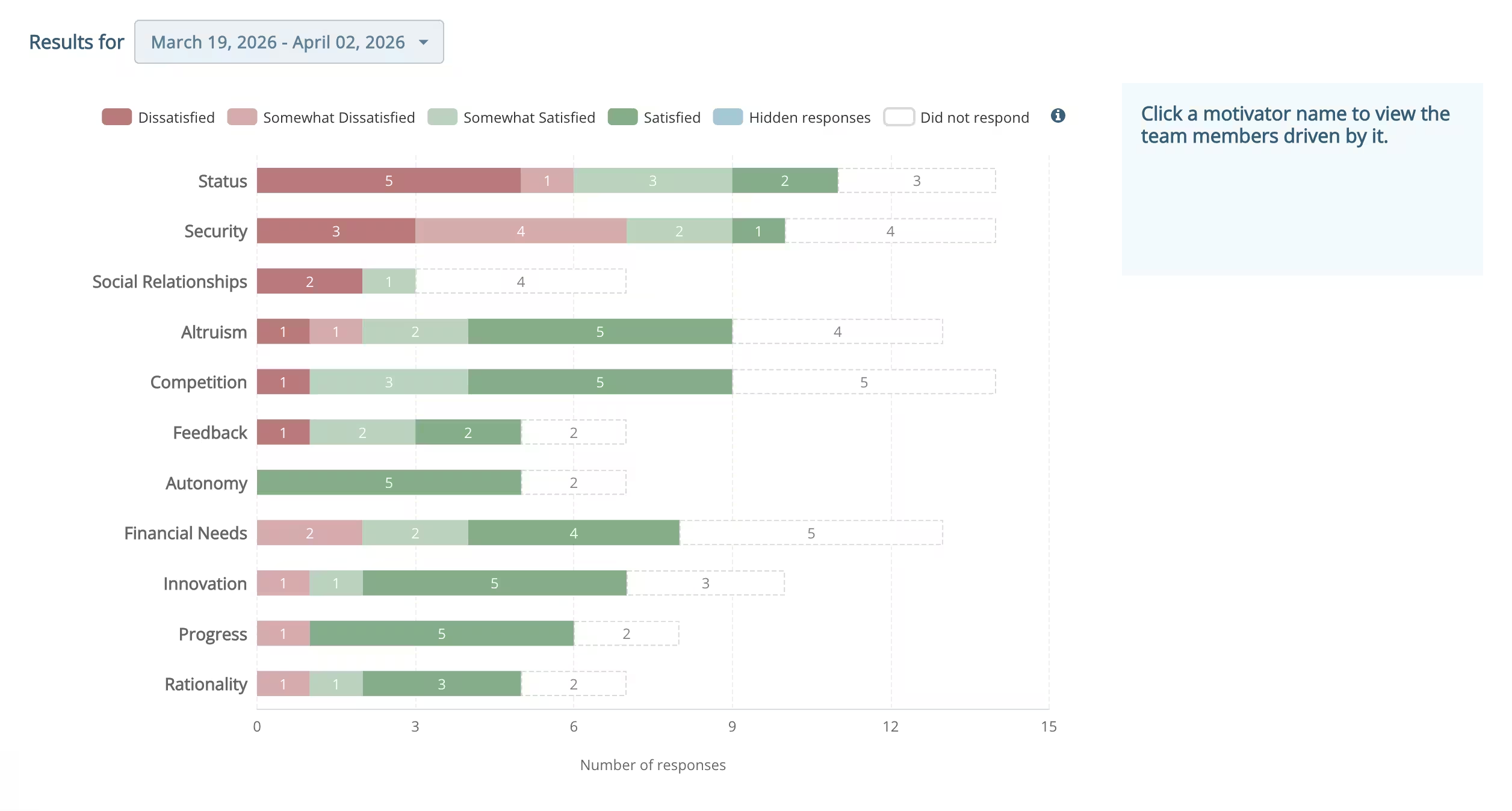
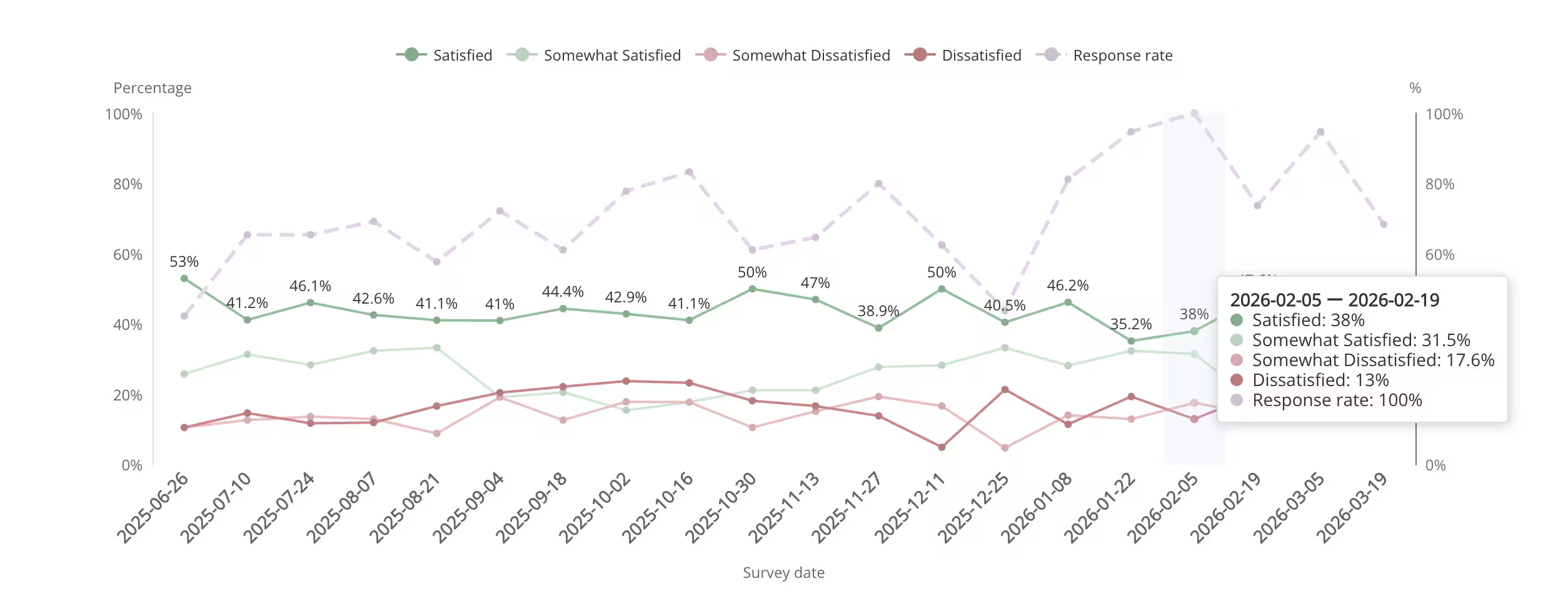
Motivator satisfaction over time, how Attuned flags the barrier before it becomes a resignation
Motivator satisfaction trend dashboard showing how Attuned flags a team member whose role is failing to meet what they value

4 Reasons Your Engagement Efforts Are Not Moving the Number

When a well-funded engagement program lands with a thud, it is rarely for lack of effort. It is usually one of these four, and each one comes back to acting without a clear read on the individual.

01

One program for opposite people

A single initiative cannot serve a Progress-driven person and a Security-driven person equally. Rolled out to everyone, it lifts the few it happens to fit and quietly demotivates the rest, who needed the opposite.

02

Perks aimed at the wrong motivator

Free lunches and gift cards are extrinsic rewards laid over an intrinsic problem. If the barrier is a lack of autonomy or growth, no amount of perk touches it, and the budget disappears with the number unchanged.

03

A survey that names the symptom

An annual score tells you engagement fell without telling you which motivator is unmet, for whom, or what to do on Monday. You are handed the temperature and nothing to treat the fever with.

04

Acting a quarter too late

The moment that matters is quiet: the week a strong performer starts to drift. Catch it early and it is a conversation. Catch it in the exit interview and it is a rehire. Attuned flags the motivator drift while there is still time.

How to Overcome Barriers to Employee Engagement

Removing barriers to employee engagement comes down to one shift: stop treating the team as an average and start managing each person against what actually drives them. Here are seven habits that turn a flat engagement score into a set of specific, fixable problems.

A generic engagement program vs. barriers removed per person
Engagement work Generic program Barriers removed with Attuned
What you act on One score for the whole team The specific motivator that is unmet, per person
The intervention Perks and all-hands for everyone The one change that removes this person's barrier
Recognition Same reward for everyone Aimed at whether they value Status, Altruism, or Autonomy
Timing Once a year, after the survey Continuous, flagged as a motivator drifts
Grounded in A benchmark and a hunch Validated science: 11 intrinsic motivators, 1.7M possible profiles

1. Measure the motivators first

You cannot remove a barrier you cannot see, so start by measuring what each member is intrinsically driven by. An intrinsic motivation assessment turns a vague low score into a named, addressable cause for each person.

2. Fix it per person, not per team

The same barrier has opposite fixes for different people. More autonomy frees one member and unnerves another. Once you can see who values what, you apply the specific change that removes that individual's barrier instead of a blanket policy.

3. Aim recognition at what they value

Recognition only lifts engagement when it lands. Public praise energizes the status-driven and mortifies the private worker. Match the reward to the motivator and the same gesture starts doing real work.

4. Build psychological safety

No barrier gets named on a team where honesty is risky. Respond to hard truths with curiosity, never punishment. Our guide on psychological safety and turnover covers the specifics.

5. Make it a weekly habit

Barriers are removed one conversation at a time. A consistent one-on-one, aimed at what the person cares about, catches drift while it is still a conversation. Our approach to one-on-one meetings lays out the cadence.

6. Close the loop

If a member raises something and nothing changes, they stop raising things, and the barrier goes underground. Note the action, do it, and refer back next time. Engagement work only compounds when the last fix visibly led somewhere.

7. Know when it needs a hard talk

Some barriers only come down through a difficult conversation. When that moment arrives, our guide to giving difficult feedback covers how to have it without breaking the trust you built.

The order that matters: measure, then act

Most engagement plans jump straight to the intervention: the perk, the program, the offsite. That is acting before you can see, and it is why so many of them fail to move the number. Flip the order. Measure what each member is driven by, find the specific motivator the role is starving, and only then choose the fix. A change aimed at a named barrier for a named person outperforms a company-wide initiative every time, and it usually costs far less.

Attuned People Science Team

From an invisible engagement problem to a named, fixable barrier, in under a week

Here is how a team goes from a flat engagement score no one can act on to a per-person map of exactly which motivator is unmet and what to do about it, without adding hours of work.

Step 0 · Start Here

Everyone completes a ~10-minute assessment. That's the whole setup.

No rollout plan. No IT project. Each member answers a simple set of questions, and Attuned automatically calculates their profile across 11 intrinsic motivators. Most teams are up and running within a week of signing up.

~10 minper person
11motivators mapped
1.7Mpossible profiles
Week 1ready to go

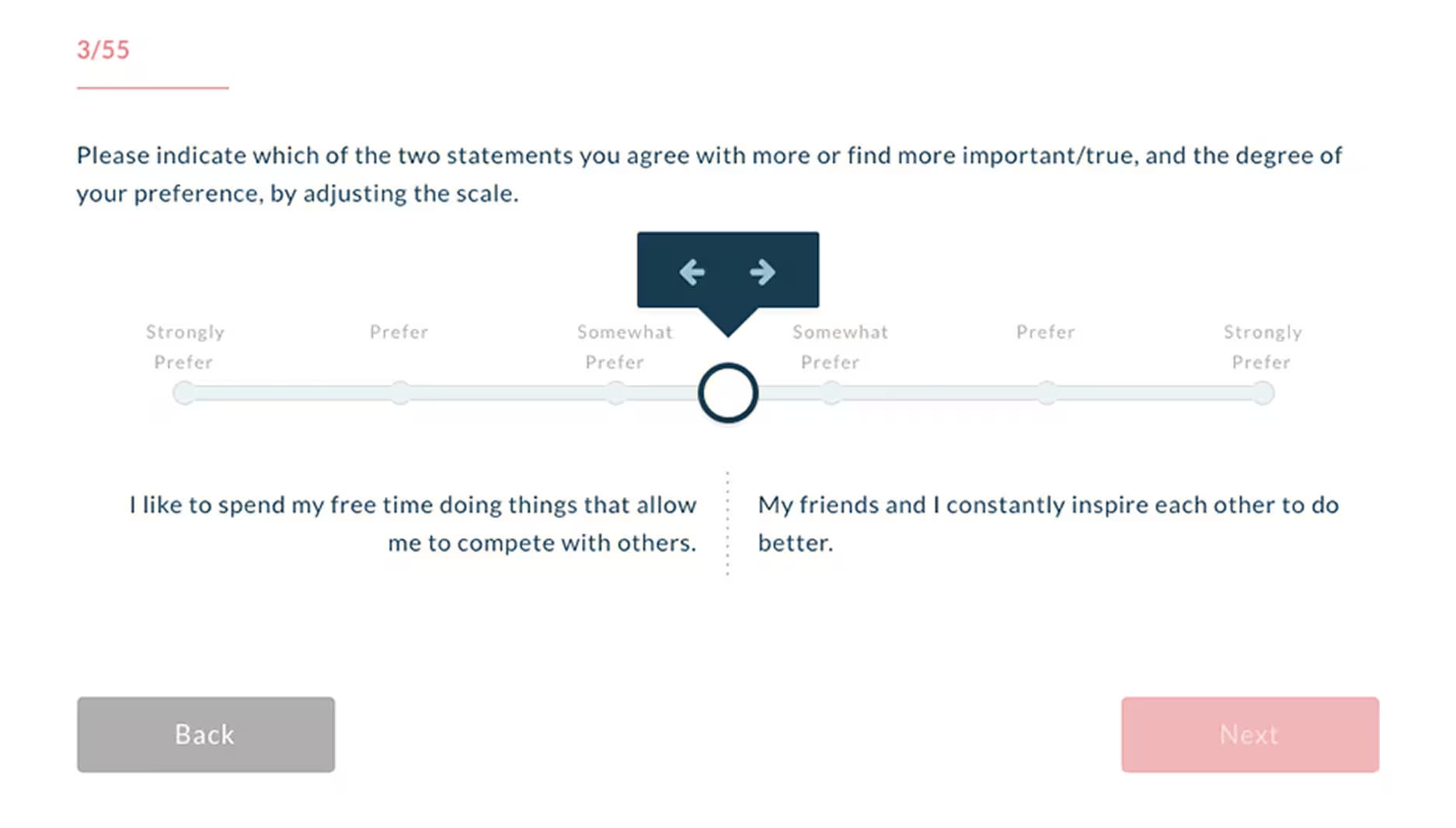
Slider-based questions, ~10 min

Attuned motivator assessment screen with slider-based questions

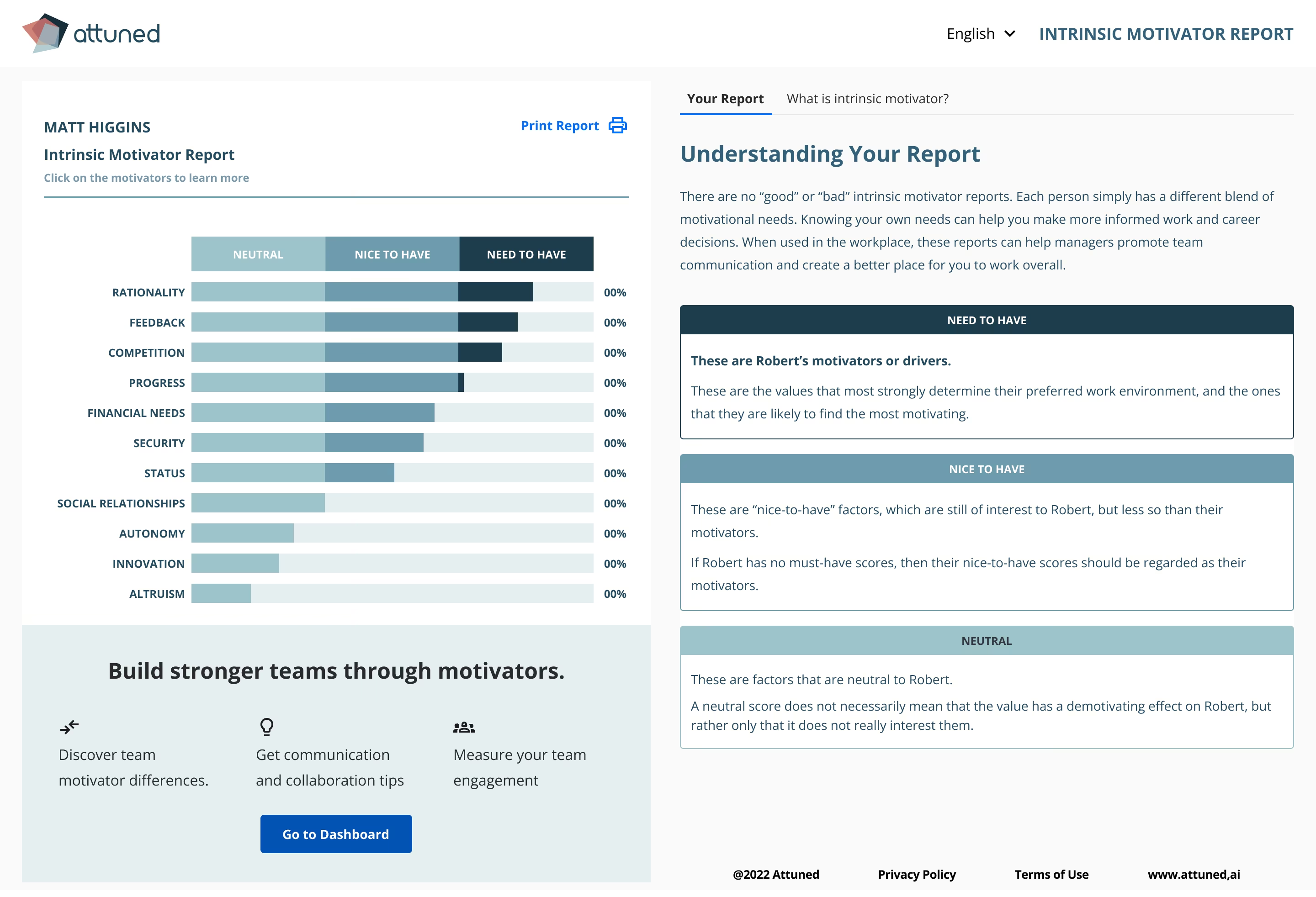
Motivator profile generated immediately

Attuned motivator breakdown showing an individual's intrinsic motivator profile and which motivators their role is failing to meet
01
See the Barriers

Turn a flat score into a map

Every member gets a profile across 11 motivators, and Attuned shows where their role is failing to meet what they value. The invisible barrier becomes a named gap you can point to: this person leads with Autonomy, and the role gives them almost none.

11 motivator dimensions Per-person barrier map
02
Coach Your Managers

Tell each manager what to change

The AI coach, TalkCoach, turns each profile into what to do about it: how to frame recognition, where to hand over autonomy, what to protect. A first-time manager gets the read on a person that a seasoned coach would give, without the seasoned coach.

AI coaching per person Concrete, per-person fixes
03
Close the Gaps

See where manager and member don't line up

A blindspot is the gap between how a manager assumes people are motivated and what actually drives each report. Attuned makes both visible, so a leader removes the real barrier instead of managing everyone the way they themselves like to be managed.

Manager-member gap map Guidance on what to change
04
Remove Them in the 1-on-1

Make every check-in remove a barrier

Barriers come down one conversation at a time. Attuned turns a vague "how's it going?" into a check-in aimed at the motivator that is starved, and pairs with our approach to giving difficult feedback when a barrier needs a harder talk.

Targeted 1-on-1s Harder conversations, handled
05
Keep Your People

Catch the drift before they leave

Attuned tracks motivator satisfaction over time and flags a growing gap between what someone values and what their role delivers, before it shows up in the work. Most departures start as a barrier you could have removed two months earlier.

Early-warning drift alerts Continuous tracking
Ready to see the barriers you are working blind against?
Turn a flat engagement score into a per-person map of what to fix, in under a week.
No IT project. Your team is profiled and your managers know which barrier to remove for each person before Friday.
Book a Call Directly →
Book a time that works for you · No callback queue

How a Growing Firm Removed the Barriers It Could Not See

Azon Recruitment Group grew from a small team into an award-winning business by making its engagement barriers visible. Once managers could see what drove each person, they removed the specific barrier in front of it. Engagement rose, retention improved, and earnings followed.

Azon Recruitment Group team, a fast-growing firm that removed its barriers to employee engagement with Attuned

More on Removing the Barriers to Engagement

Reading from the Attuned team, starting with the State of Motivation Report most leaders open first, plus practical pieces on motivation, turnover, psychological safety, feedback, and what makes a manager worth staying for.

A list of engagement barriers is easy to find. Seeing yours is the hard part.

You can read a hundred articles on why employees disengage for free. What you cannot Google is which specific motivator is starved for which person on your team this quarter. That is the part Attuned does, and it is the part that actually removes the barrier.

Up and running in a week

A ~10-minute assessment. No IT project, no training required. Your whole team can be profiled within days of signing up.

Per person, not per average

11 intrinsic motivators mapped for each member, drawn from 10,000+ assessments across 4+ generations. You act on the individual, not a benchmark.

An AI coach that says what to change

TalkCoach turns each profile into the concrete fix for that person's barrier, so a first-time manager gets guidance a seasoned coach would give.

GDPR-compliant by design

Lawful basis, data minimization, individual access rights, and the right to be forgotten. Your people own their motivator data.

Barriers to Employee Engagement: Common Questions

What are the barriers to employee engagement?
The most common barriers to employee engagement are unclear expectations, a manager who does not understand what drives the person, missing or mistargeted recognition, no sense of growth or progress, too little autonomy, weak psychological safety, unmet intrinsic motivators, and burnout from an unsustainable workload. Underneath almost all of them sits one root barrier: a role that fails to meet what an individual is actually driven by. People are engaged when the work satisfies their intrinsic motivators and they disengage when it stops, so the practical job is to find which motivators each person leads with and where their role is falling short.
What is the biggest barrier to employee engagement?
The biggest barrier is the one you cannot see: a mismatch between what an individual is driven by and what their role gives them. Two people in the same job can be worlds apart, because one is powered by autonomy and the other by security or status. When a manager cannot name what a specific person values, every engagement fix becomes a guess. Gallup has found that managers account for about 70 percent of the variance in team engagement, so the single largest lever is giving each manager a clear read on what drives each of their people.
How do you overcome barriers to employee engagement?
You overcome barriers to employee engagement by making the invisible ones visible, then fixing them per person. Measure what each individual is intrinsically motivated by, compare it against what their role currently delivers, and act on the specific gaps: clarify expectations where they are fuzzy, aim recognition at what the person actually values, open room for autonomy or growth where those motivators are starved, and protect psychological safety so people tell you the truth early. A generic engagement program treats the team as an average; removing barriers works when each fix is matched to the person it is meant to reach.
How do you measure employee engagement barriers?
Annual engagement surveys tell you engagement dropped, rarely why or for whom. To measure the barriers themselves, map each person across their intrinsic motivators and track the gap between what they value and what their role provides over time. Attuned does this with a roughly 10-minute assessment that scores each member across 11 motivators, then shows managers where a role is failing to meet a person's top drivers. That turns a vague low score into a specific, addressable barrier, and it flags the drift months before it shows up as a resignation.
How do you improve employee engagement?
You improve employee engagement by managing each person against what actually motivates them rather than rolling out one program for everyone. Start by measuring intrinsic motivation across the team, give every manager a per-person read on what to protect and what to change, and hold regular one-on-ones aimed at each individual's real drivers. Gallup research also found that about 52 percent of voluntarily exiting employees say their manager or organization could have prevented their departure, which means most disengagement is reachable well before it becomes turnover if you can see it in time.
How does Attuned help remove barriers to employee engagement?
Attuned measures each member across 11 intrinsic motivators, drawing on a model with more than 1.7 million possible profiles and over 10,000 assessments across four-plus generations. It shows managers exactly where a role is failing to meet what a person is driven by, and its AI coach, TalkCoach, tells the manager what to change for that specific individual, from how to frame recognition to where to hand over more autonomy. Instead of a company-wide engagement initiative that treats everyone the same, managers get a per-person map of the real barriers and a concrete, measurable fix for each one.
Is Attuned GDPR-compliant?
Yes. Attuned operates under GDPR principles for any EU or UK data subject: lawful basis, data minimization, individual access rights, and the right to be forgotten. Users own their motivator data and choose what is shared with their organization. This landing page itself uses consent-gated cookies, so analytics and marketing scripts only load after you accept them. See our Privacy Policy for full details.
People Science for Managers

Reading about barriers is a start.
Seeing yours is the edge.

We have spent years studying what drives people at work, and helping the leaders who manage them remove the barriers standing between their people and their best effort. It fits into your week rather than adding to it.

Our expertise is people science: what drives individuals, how an unmet motivator quietly pulls someone out of the work, and what a manager needs to see to keep the people they want to keep. We have brought it to fast-growing firms like Azon, and we would like to bring it to yours.

No pitch deck
No callback queue
Real conversation
Proven with Azon Recruitment Group
A fast-growing firm that made its engagement barriers visible, lifted retention, and saw it translate to earnings.
Book a Call Directly
Pick a time that works for you. No waiting for a callback. No sales queue.
Book a Time → Read the State of Motivation Report Or read the full Azon case study →
Book a time that works for you. No callback queue.
See the barriers you are working blind against. Find which motivator is unmet, per person.
Book a Call →