The one-on-one meeting is the highest-leverage half hour on a manager's calendar, and the easiest to waste. This guide covers what a one-on-one meeting is, how often to hold one, a repeatable agenda, and 45+ questions to ask, plus the one thing no template fixes: the same words land differently on different people.
Or grab the 30-minute one-on-one agenda template ↓
A one-on-one meeting (also written 1-on-1 or 1:1 meeting) is a recurring, private conversation between a manager and one direct report, held on a regular cadence, where the point is the person rather than the project.
A status update asks "where are the tasks?" A one-on-one meeting asks "where are you?" The difference is the whole game. In a good 1-on-1 you surface blockers before they calcify, trade feedback in both directions, support someone's growth, and build the trust that makes them want to stay. The best managers treat it as the direct report's meeting, not their own: the report sets most of the agenda, and the manager listens more than they talk.
Everything downstream, how often you meet, what the agenda looks like, which questions you ask, follows from that one shift in purpose. Get the purpose right and the mechanics fall into place. Get it wrong and you have a weekly status meeting wearing a one-on-one's clothes.
The one-on-one is where most of a manager's real impact on engagement and retention actually gets delivered. The research is unusually consistent on this point.
For the fuller picture on what keeps people, see our State of Motivation Report 2026 and the guide to preventing unwanted employee turnover.
Weekly is the safe default. The right cadence depends on tenure, autonomy, and how much change the person is absorbing right now. When in doubt, meet more often: it is easier to shorten a one-on-one than to rebuild trust you let lapse.
| Cadence | Best for | Watch out for |
|---|---|---|
| Weekly (30 min) | New hires, recent role changes, anyone going through something hard, most individual contributors. | Letting it drift into a status update because it comes around so often. |
| Every two weeks (30–45 min) | Senior, highly autonomous people with a strong track record and a stable remit. | Missing early signals; a two-week gap can hide a lot. |
| Monthly or ad hoc | Rarely the right answer for a direct report. Reasonable for skip-levels. | Too infrequent to build trust or catch problems before they harden. |
One rule outranks the cadence itself: do not cancel. A shortened one-on-one is fine. A skipped one tells the person, more loudly than any words, that the relationship is the first thing to go when you get busy. Protect the slot.
A good one-on-one meeting agenda is a loose frame, not a script. Here is a durable 30-minute structure. The proportions are the point: the direct report owns the middle, and the manager listens more than they steer.
Land as humans first. A genuine "how are you, really?" resets the register from task-mode to person-mode. Skip the ritual version of this question (more on that below).
Hand the floor over. "What is on your mind this week?" Whatever the direct report brings goes ahead of your list. If they have nothing, your questions fill the space, but the default is theirs.
Light-touch on status; heavy-touch on obstacles. The most valuable question you can ask here is "what is slowing you down that I could remove?"
Rotate through career, development, and feedback in both directions. Ask for feedback on yourself out loud, and mean it. See giving difficult feedback for the hard cases.
Name who does what by when, on both sides. Write it where you will both see it before next time. A one-on-one with no follow-through teaches people to stop bringing things.
One-on-one: [Report] & [Manager] · [Date] 1. Check-in: How are you, really? 2. Their agenda first: What is on your mind this week? 3. Progress & blockers: What is slowing you down that I could remove? 4. Growth & feedback (both ways): One thing I could do differently to support you? 5. Action items: Who does what, by when. Running log / notes: Last time's action items:
Keep a shared, running doc so nothing resets to zero each week. If you are meeting a team for the first time, the opening sequence is different: see first one-on-ones with a new team.
The format of a one-on-one meeting shapes what gets said. A few defaults that consistently make the conversation better, in the room and remotely:
The best one-on-one meeting questions are open-ended, rotate over time, and match the moment. Steal these directly. Group them so you are not asking a growth question in the middle of a crisis, or a crisis question during a calm week.
Most one-on-ones do not fail loudly. They quietly decay into something less useful. Here are the four most common failure modes and the fix for each.
If you could get the same information from a project tool, it is not a one-on-one. Fix: move status to async, and protect the live time for the person.
Every skip tells the person where they rank. Fix: treat the slot as immovable, and reschedule rather than cancel when you truly must.
If you are speaking more than half the time, it is your meeting, not theirs. Fix: ask, then wait through the silence. The best answers come after the pause.
The question that opens up one person makes another shut down. Fix: tune the conversation to what each person is actually trying to optimize for. That is the next section.
We go deeper in the top 5 reasons 1-on-1 meetings fail, drawn from a founder's two decades of running them.
You can run the perfect agenda, ask the perfect questions, and still watch the conversation miss. Because a one-on-one meeting runs on two nervous systems, not a script, and they are optimizing for different things.
Take one question: "So, how's it going?" To a person high in Feedback, that is an open door, they will walk through it and tell you what is actually wrong. To a person high in Autonomy, the same question reads as a manager fishing, and they close the door politely. Same words, opposite result. The agenda did nothing wrong. The read did.
The anthropologist's version of this: "How are you?" is a ritual question that expects a ritual answer. Both parties understand that what is being exchanged is a performance of connection, not connection itself. Most one-on-ones open with exactly this handshake, both people say the lines, and five minutes evaporate before anyone says a true thing. The fix is knowing which person in front of you experiences the ritual as warmth and which experiences it as a stall. After Adam Mastroianni, on the rituals we mistake for contact
This is why two managers can read the same 1-on-1 guide, use the same template, and get opposite outcomes. What varies is not their diligence. It is whether they can see what the person across the table is trying to get out of the conversation, their intrinsic motivators, and adjust the framing before the words leave their mouth.
A misread direct report does not announce that they have checked out. They keep attending the one-on-one, give you the ritual answer, and quietly start updating their resume. The agenda cannot catch that. Reading the person can.
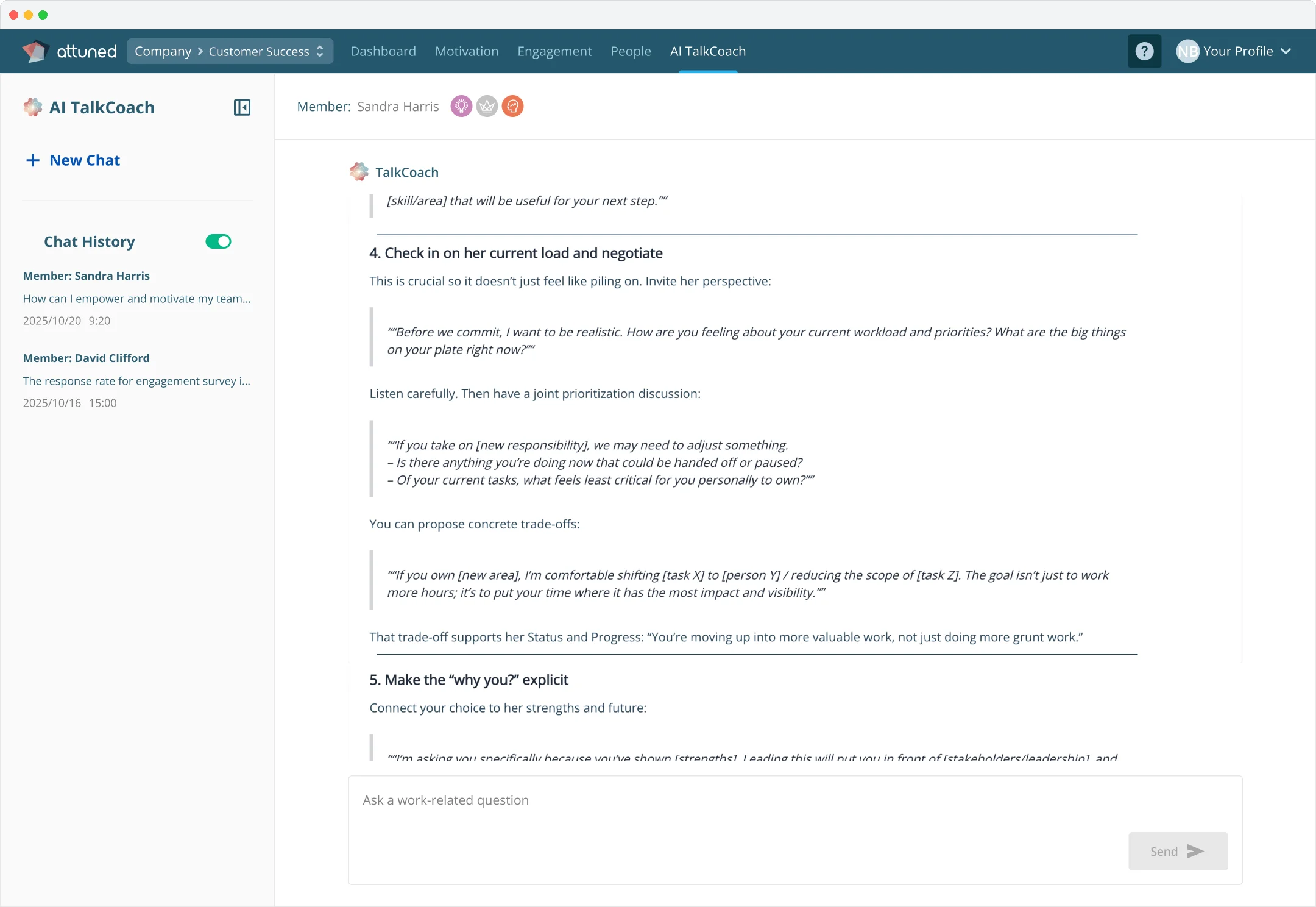
This is the gap Attuned's 1-on-1 coaching software was built to close: it maps the motivators of both people in the room, then tells you how to frame the hard thing so it lands the way you meant it.
Bonuses and titles matter, but they are not what keeps the best people engaged for the long run. This short video explains intrinsic versus extrinsic motivation, and why the same conversation works on one person and bounces off the next.
A guide gets you a good agenda. Software gets you the read on the person. Here is the loop, about a week to set up and minutes to use after that.
You answer questions across 11 intrinsic motivators: Autonomy, Competition, Altruism, Feedback, Status, Security, Progress, Social Relationships, Rationality, Innovation, Financial Needs. The result is the lens you have been managing through all along.
Now you see each person's profile next to your own. Where your Autonomy is high and theirs is low. Where their Feedback is structural and you have been treating it as optional. The gap is where the one-on-one goes wrong.
Native Google and Microsoft calendar sync recognizes every one-on-one on your schedule and surfaces that person's motivator gap and tailored conversation starters, one click from the event itself.
TalkCoach already has both profiles in context. Describe what you need to say; it hands you framing and a sequence tuned to the specific gap between you and them. Adapt it, or use it nearly verbatim.
"TalkCoach is the tool I wish I'd had ten years ago. It really saved my managerial butt."Casey Wahl, Founder & CEO, Attuned
Read the long version: 2,880 hours leading 1-on-1s, the ugly and the beautiful →
A great agenda gets you into the room. Reading the person is what makes the next thirty minutes count. The next one-on-one you are dreading is the one to bring.
Map your motivators. Map the people you manage. Then, the next time someone gives you the ritual answer, you will know whether the door is actually open, and how to say the true thing so it lands.