TalkCoach by Attuned · AI coaching for managers

How to give negative feedback in a positive way

Positive feedback is feedback that lands: specific, shaped around what actually drives the person, and framed so they leave ready to change. TalkCoach maps what drives each person on your team, then drafts the exact words for your next hard conversation.

Trusted by Autoliv, Hitachi, Nissan, and 100+ enterprise teams

The short answer

What does it mean to give negative feedback positively?

To give negative feedback in a positive way means delivering a hard message that is clear and respectful enough to act on, without draining the person's motivation to try.

What makes it positive is the result: the person understands exactly what to change, and still wants to. That takes two things: being specific, and knowing what actually motivates the person in front of you. Attuned's framework names 11 intrinsic motivators, and TalkCoach reads them before it helps you find the words.

The reframe

Separate the care from the frustration, then lead with the care

Most feedback goes wrong because two things arrive tangled together: what you want for the person, and how annoyed you are in the moment. Untangle them first. The rest gets much easier.

Lead with care

Open with what you want for them, not what they did wrong. It sets the message up to be heard as investment rather than a verdict.

Be specific

Name the behavior and its impact, not a trait. "The deck missed the pricing slide" is fixable. "You are disorganized" is just a bruise.

Frame it as trust

Correction reads as respect when it comes with belief that they can do better. You give the hard note because you expect more, and you say so.

How TalkCoach helps

TalkCoach does all three in one pass. It reads the person's motivator profile next to yours, then drafts the exact wording so the care leads, the note stays specific, and the correction lands as trust rather than a verdict. You are not left guessing which of the three you skipped.

A smoke alarm that shrieks every time you make toast teaches the whole house to pull the battery. The one you trust is the one that stays quiet until something is genuinely on fire. Vague, constant criticism works the same way.

TalkCoach in action

How to give negative feedback in a positive way: examples

Three moments every manager hits. On the left, the version you are tempted to send. On the right, what TalkCoach drafts once it knows what drives the person. The note under each rewrite names that person's top motivators, the things that genuinely drive them, so you can see why the wording fits.

Scenario 1 · Work that is not good enough
You're tempted to say

"This isn't your best work."

TalkCoach drafts

"Section two states the conclusion but skips the evidence. Add the three data points behind it and it will hold up in the review."

A precise fix they can act on today. Speaks to their top motivators: Feedback (wanting clear input to improve) and Rationality (logic they can follow).

Scenario 2 · Not looping people in
You're tempted to say

"You need to communicate better."

TalkCoach drafts

"I heard about the vendor change from the client, not from you. A one-line heads-up on calls like that keeps me from being caught flat-footed."

One concrete request, easy to say yes to. Speaks to their top motivator: Social Relationships (staying connected to the team).

Scenario 3 · Too negative in meetings
You're tempted to say

"You're being too negative in meetings."

TalkCoach drafts

"In the last two standups you opened with what would not work. Your caution catches real risks. Lead with the risk, then the version you would back, so the room has somewhere to go."

Credits the strength before redirecting it. Speaks to their top motivators: Status (being respected for their expertise) and Innovation (championing better ideas).

Not sure how the message will land with your person?

That is exactly what TalkCoach is for. Bring one real situation and we will show you how it works on your team.

Book a 20-minute call with Casey

What TalkCoach actually does

It turns what drives each person into the words that reach them

TalkCoach does not guess. It works from a real map of what drives you and what drives the person in front of you, then shapes the feedback to fit them.

How the motivator assessment powers every suggestion

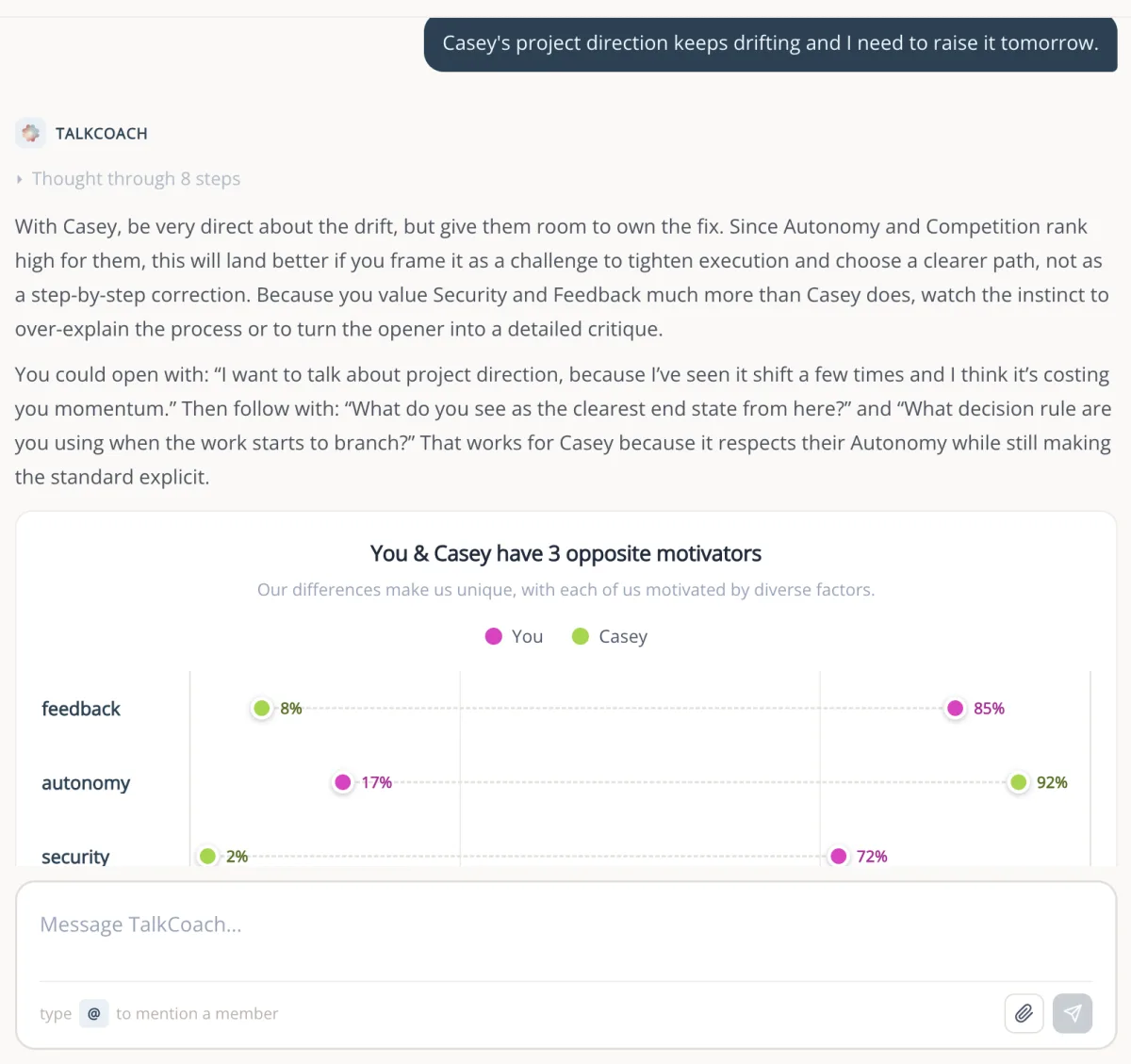
Everything runs on the assessment. In about 10 minutes, each person ranks their 11 intrinsic motivators from strongest to weakest, and that ranking becomes their profile. TalkCoach lays your profile next to theirs, finds where you diverge, for example your Competition against their Security, and shapes the feedback to fit their profile rather than yours. That gap is the reason one sentence can motivate one person and shut another down.

Map your own motivators

You answer about 10 minutes of questions that rank your 11 intrinsic motivators from strongest to weakest. That ranking is your profile.

Map the person

Each report takes the same assessment, so you work from what actually drives them rather than assuming it matches you.

Bring the moment to TalkCoach

Describe the frustrating situation in a sentence. TalkCoach reads it through both profiles, names the gap between you, and drafts the framing, the exact language, and the order to say it in.

Have the conversation

Use the draft or make it yours. Specific, kind, and built to land the way this particular person needs to hear it.

The founder's story, first-hand

One word used to snap my neck every time she said it: "align."

A few years ago I promoted someone brilliant, Gabriella, into a product-focused role. She kept asking to "align." I move fast, and for me moving fast is how I show I care: I get people unblocked and give them room to run. So I read her request as friction, a brake on momentum.

TalkCoach showed me what I had missed. Her new role had much longer feedback loops, and "align" was simply how she asked for the feedback she needed to feel safe moving. Her motivator profile said it plainly. Mine had been shouting over it.

So I changed one small thing. Instead of debating every check-in, I started saying: "Here is my proposal. If you are good with it, I will move." My message never changed. Only the framing did. She became one of the most decisive people on the team.

This is the short version. The full account of the blind spot TalkCoach caught is in Giving difficult feedback.

Questions managers ask

Giving negative feedback, answered

The answers below are the principles. TalkCoach is how you apply them to a specific person, in the moment you actually need the words.

How do you say a negative comment in a positive way?

Lead with the specific behavior and its impact, not a label. Instead of "you're careless", name what happened: "the invoice went out with the wrong total, and the client noticed", then hand the person a clear next step. TalkCoach phrases that step in the tone that fits their motivator profile, so the same correction reads as respect rather than an attack.

How do you turn negative comments into positive?

Reframe the comment as information the person can use. "This is sloppy" becomes "these three fields are missing, add them and it is ready." This is exactly what TalkCoach does: it turns a raw, frustrated thought into a specific next step, tuned to what actually drives that person.

How do you communicate negative feedback effectively?

Separate your care from your frustration before you speak, and lead with the care. Be specific about the behavior, tie it to impact, and frame the correction as trust. TalkCoach compares what drives you against what drives them, then shapes the message to fit their profile.

How do you give negative feedback to an employee?

In private, promptly, and about behavior rather than character. Describe what you observed, why it matters, and what good looks like next time, then ask for their read. TalkCoach drafts this from the employee's motivator profile, so a Security-driven report and a Competition-driven report each get the same message shaped to fit them.

Is the feedback sandwich a good technique?

Usually not. Burying criticism between two compliments teaches people to wait for the "but", and the real message gets lost in the padding. TalkCoach skips the sandwich: it drafts feedback that is warm and direct at once, naming what works and what needs to change, in the language that fits the person's motivators.

Your next hard conversation

Walk in knowing exactly what to say

On a 20-minute call, Casey will take one hard conversation you are dreading and show you how TalkCoach turns it into feedback that lands, on your actual team.

Book a call with Casey

20 minutes. One real feedback moment. No slide deck.

Book a 20-minute call
Leave the call with the exact words to use, drafted for your team.
Book a 20-minute call with Casey