What is an AI coach for managers?
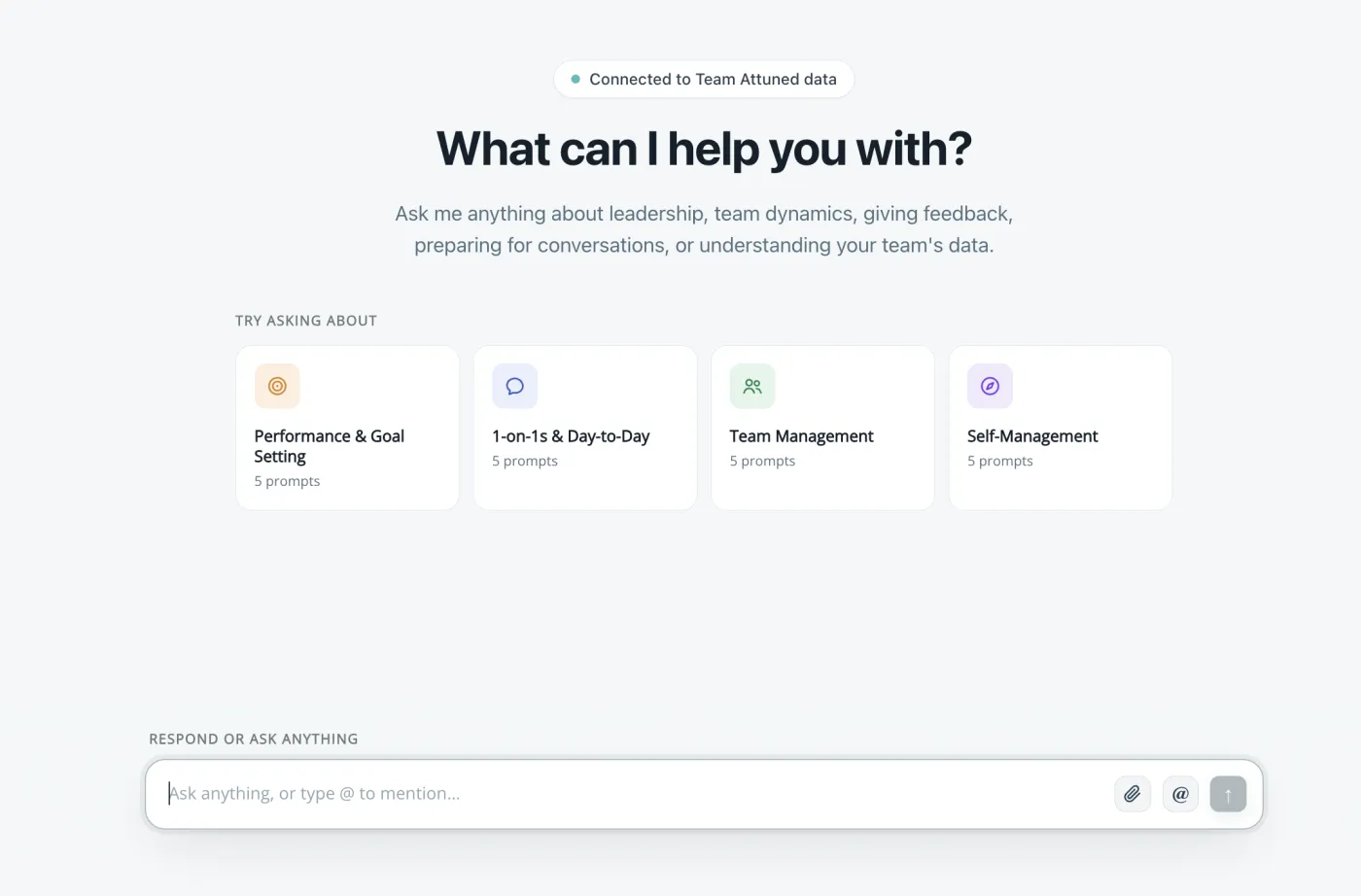
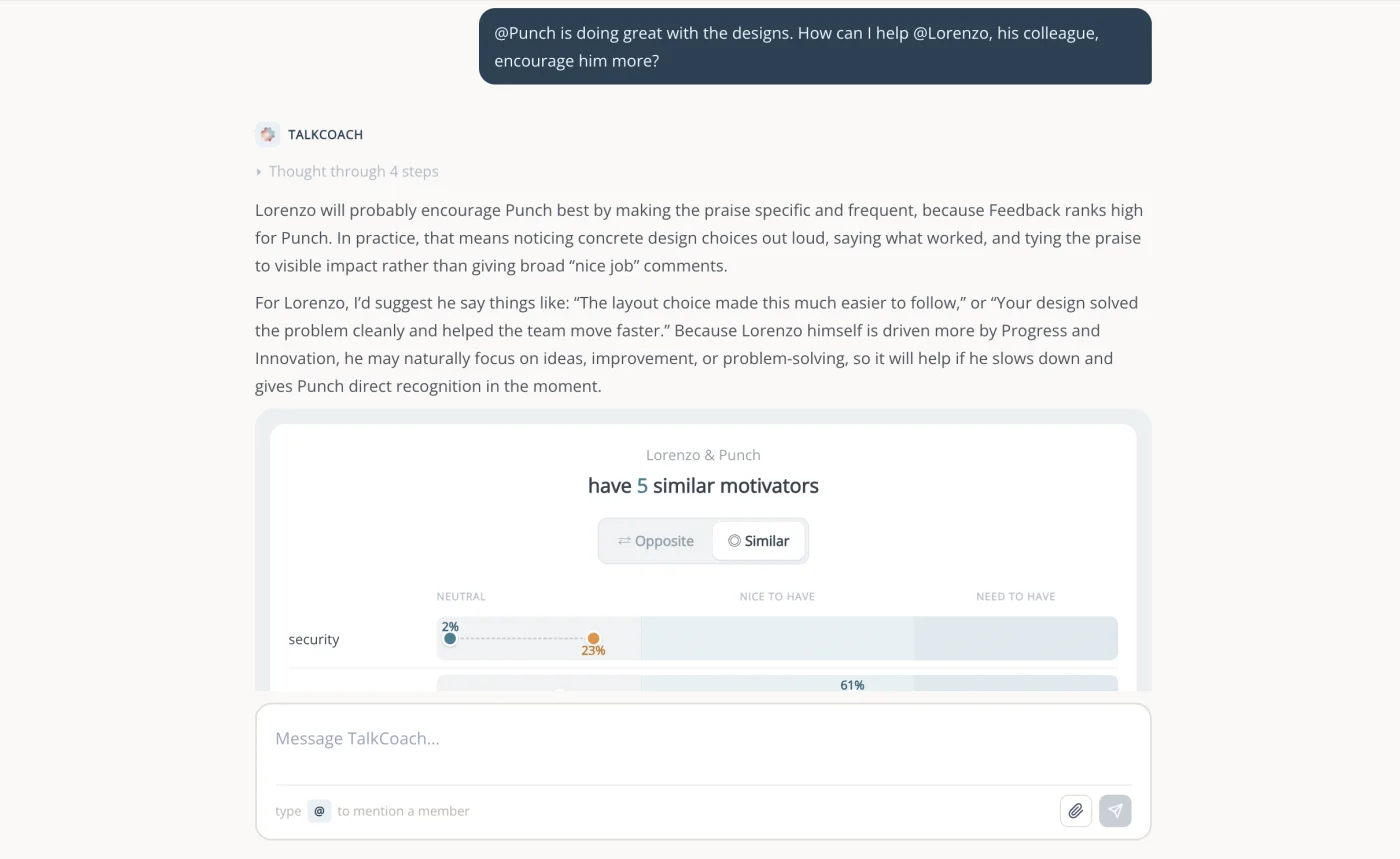
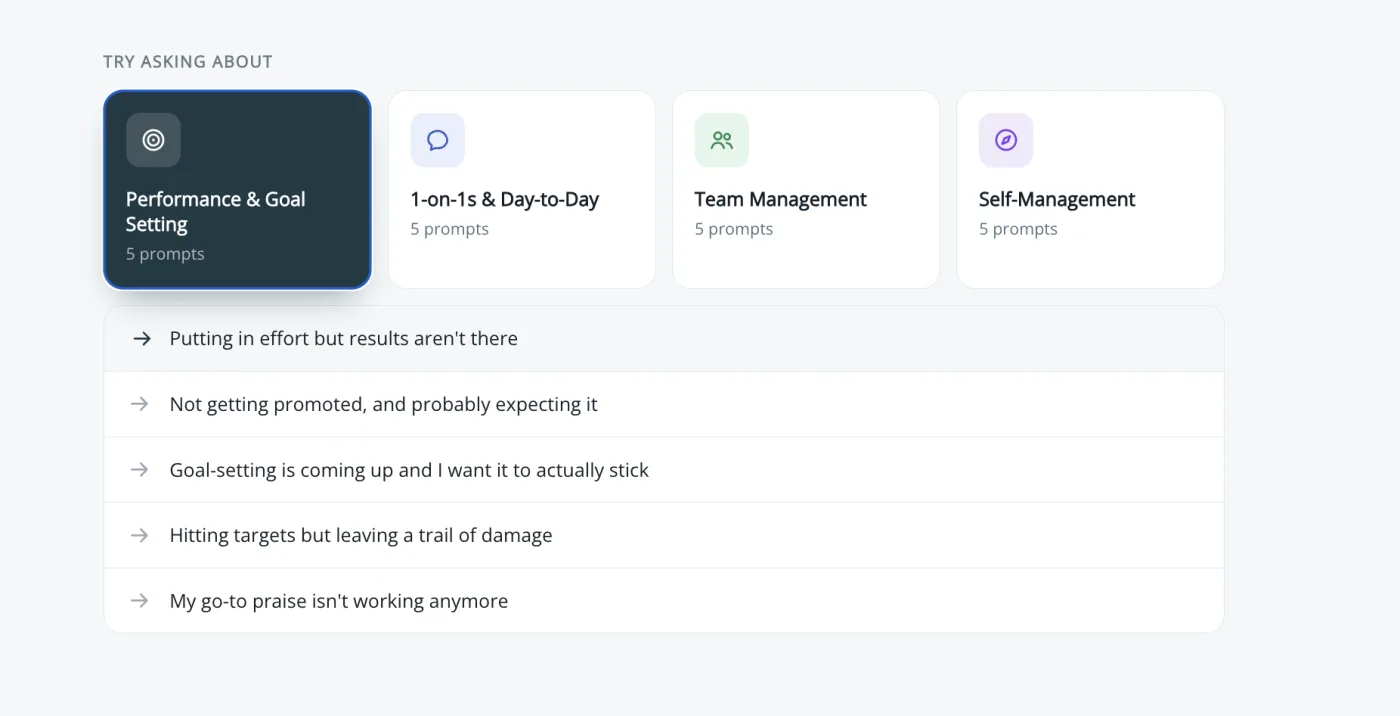
An AI coach for managers is software that gives a manager on-demand, situation-specific coaching: what to open a 1-on-1 with, how to frame hard feedback, how to handle friction between two people, and what to do when engagement slips. The useful ones are built on real data about the people involved, so the advice fits the person rather than the average. Attuned TalkCoach reads each report’s intrinsic motivator profile, the directional differences between the manager’s motivators and each report’s, and how motivator satisfaction has moved, then turns that into guidance for the specific person and moment.
How is Attuned TalkCoach different from ChatGPT or a generic AI coach?
A generic AI coach only knows what you type into it, so it returns advice that fits anyone and no one in particular. TalkCoach is connected to your team’s Attuned data: the 11 intrinsic motivators measured for each report, the directional differences between how you and they are wired, and how their motivator satisfaction has moved. The more useful comparison is human coaching. An external coach costs several hundred dollars per manager per month and usually reaches the top few percent of your managers. TalkCoach is priced as software, so every manager gets one.
What data does TalkCoach use to coach me?
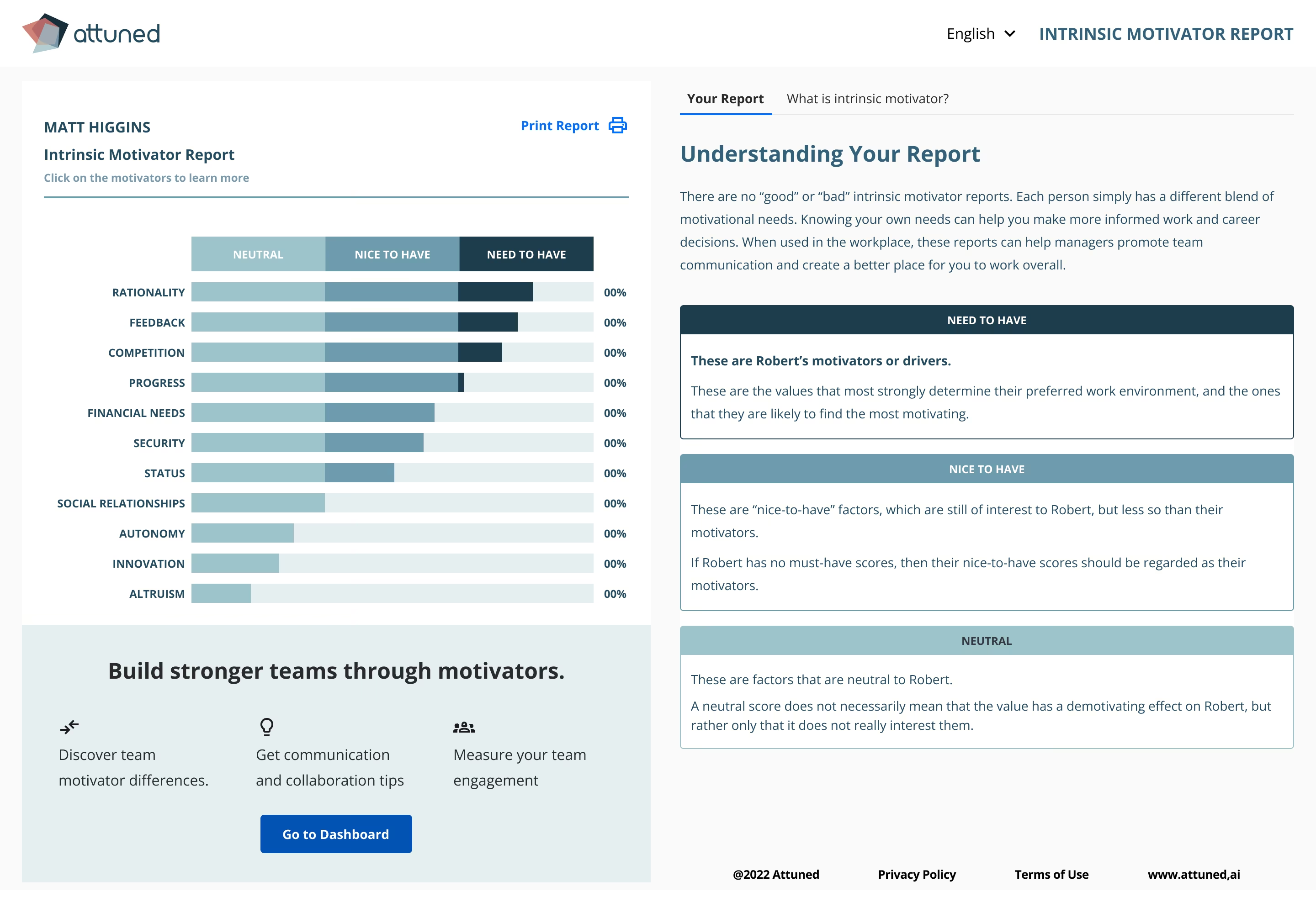
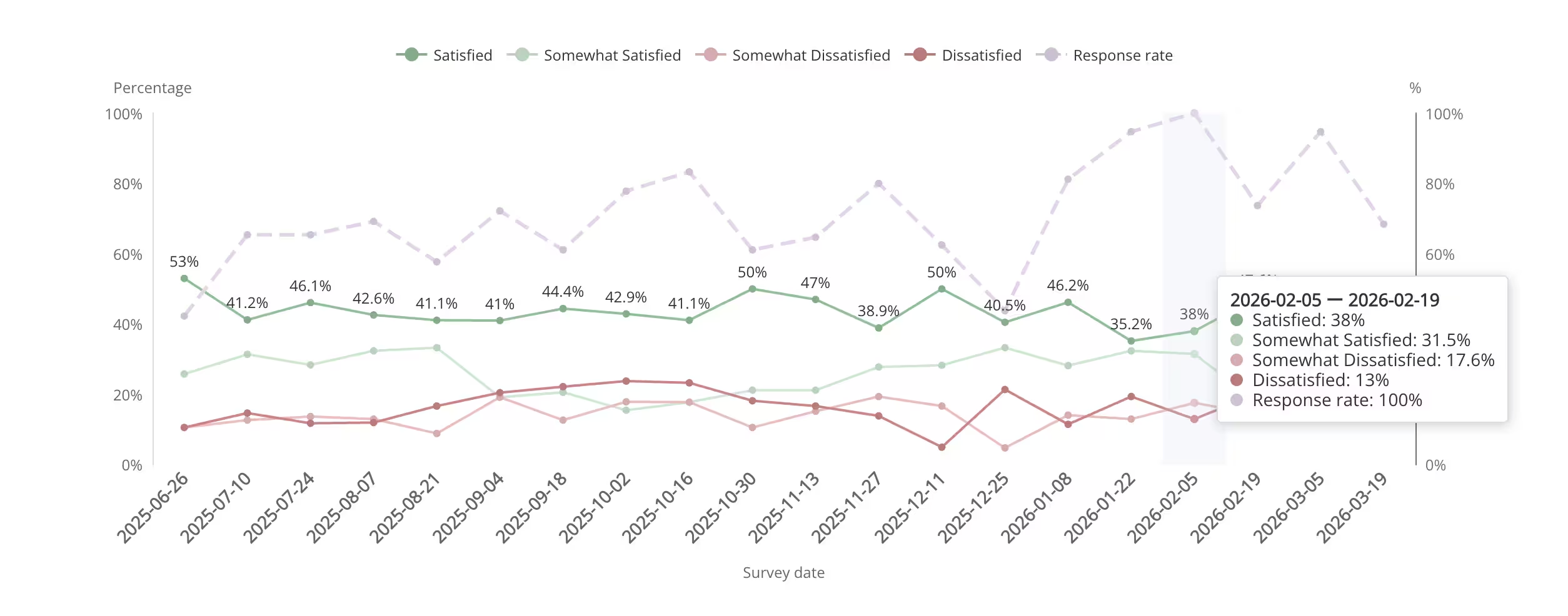
Three sources, all generated inside Attuned. First, each report’s intrinsic motivator profile from a roughly 10-minute assessment across 11 motivators, taken once. Second, the comparison between your motivators and each report’s, which shows where they diverge and in which direction. Third, the motivator-satisfaction trend over a consistent window, which shows which motivators moved. TalkCoach does not infer personality, strengths, weaknesses, or how someone receives criticism from a motivator profile, and it says so when a question needs data it does not have.
Can my manager or HR read my TalkCoach conversations?
No. Coaching conversations belong to the manager having them. They do not appear to that manager’s own manager, to HR, or in any reporting view, and there is no admin setting that turns this on. A People team sees adoption and rollout progress. It does not see what anybody asked.
Is TalkCoach used to make decisions about employees?
No. The coaching is aimed at the manager, and nothing it produces attaches to the employee. Motivator data carries no performance meaning, is not a hiring filter, and never becomes a rating. People own their own motivator data and decide what their organization sees of it.
What happens when TalkCoach cannot answer from the data?
It says so, and explains what motivator data can and cannot support. Ask it what one of your people has for blind spots, or whether someone is about to resign, and it will decline and reinterpret the question into something the data can actually speak to, such as where an interaction between the two of you is likely to land wrong. When a motivator-satisfaction reading is based on too few responses, it tells you the sample is thin rather than reading a trend into it.
Does TalkCoach send messages or book meetings on my behalf?
Only after you confirm. Nothing is sent, booked, rescheduled, or changed without an explicit confirmation from the manager. TalkCoach drafts and proposes; you decide. Calendar support is Google Calendar today.
How does TalkCoach sit next to our engagement survey platform?
Side by side, answering different questions. Survey platforms are built for the organization-level read: a score, a theme, a trend line across departments. TalkCoach is built for the single manager deciding what to say on Thursday. You will keep both, because a quarterly result has never told anyone which sentence to open with.
Does this mean another survey for our people?
The motivator assessment is roughly 10 minutes and each person takes it once, and that single sitting is the reason every later answer is about a specific person rather than managers in general. Motivation satisfaction is a separate, much shorter recurring pulse, because how someone feels about their work in March is not answerable from a survey they took in January. Attuned runs that pulse, so there is no cadence for your People team to administer or chase. It reports at team level with a minimum of three respondents, so individual answers stay unattributable.
Can TalkCoach help with performance reviews?
It helps you prepare for the conversation. Hand TalkCoach your notes and it tells you which points are likely to land for that person and which will read as noise, and where the framing you have chosen fights what they value. The written record stays yours. You keep the substance, the ratings and the final wording, and nothing the coach said appears anywhere in the file.
Who needs a seat, and can we start with one team?
Everyone TalkCoach reads needs a profile, so a seat covers each person on the team, not only the manager. Pricing is per user, per year, billed annually. The floor is three people on a team, which exists to protect the satisfaction pulse: with fewer than three respondents, individual answers become easy to attribute, and the candor goes with it. Starting with one team is the normal way in, and if you want to start smaller than a team, talk to us about a pilot.
Do we need to be an Attuned customer first?
Yes, in the sense that TalkCoach reads Attuned motivator data and cannot work without it. TalkCoach is included on
every Attuned team plan, starting with Basic at $99 per user per year, which covers the assessment for everyone, the motivator profiles and real-time satisfaction tracking. If you are already an Attuned customer, your people have taken the assessment and TalkCoach reads what you already have. If you are new to Attuned, the assessment comes with the plan rather than as a separate purchase.
What if someone declines the assessment, or does not share their profile?
Then TalkCoach has nothing to work from for that person, and it says so rather than filling the gap with generic advice. People own their motivator data and choose what is shared with their organization, and that choice is real, which means a manager can have a team where some people are covered and some are not. TalkCoach coaches on the ones it has data for, and for the rest it is honest that it is guessing like anything else would be.
Does it work with Outlook, Teams, or Slack?
Attuned integrates with both Google Calendar and Outlook. TalkCoach’s own booking and rescheduling, where it finds a slot and puts the 1-on-1 back on the calendar, works with Google Calendar today, so an organization on Microsoft 365 gets the cadence flagging without the one-click booking for now. TalkCoach itself opens in the browser alongside the rest of Attuned. If a Teams or Slack surface is a requirement for your rollout, tell us on the demo, because that is the kind of thing that shapes what we build next.
What record exists of what TalkCoach advised?
Conversation content is held as customer data under the
Privacy Policy, and it is not exposed to the manager’s own manager or to HR through any reporting view. On accountability the position is simple: the manager owns every decision they make. TalkCoach never writes into an employee’s record, never files anything, and produces no rating or note that becomes part of a performance file on its own. If a decision is later challenged, what stands is the manager’s reasoning and the documentation they wrote themselves.
Which AI processes our data, and is it used to train models?
To generate coaching, TalkCoach transmits customer data to foundation model providers and other external AI services. Attuned applies de-identification where that is reasonably feasible, and states plainly that complete anonymization cannot be guaranteed, because it cannot. Improving and maintaining the service, including its AI features, is one of the listed purposes of use, so we are not going to tell you your data is walled off from the product it powers. Both points are written down rather than left to a sales conversation: see
Privacy Policy section 7.2 for the AI processing and section 5 for the purposes of use. If your review needs the current provider list or a specific contractual commitment, ask us and we will put it in writing.
What if someone’s motivators change?
They do, slowly. Intrinsic motivators are stable enough month to month that a profile keeps its usefulness, and big, emotionally significant events reorder them over time, often without the person noticing. Attuned is built to keep that picture current rather than to freeze it. Separately, satisfaction moves much faster than the ranking does, and that is the part TalkCoach tracks continuously, so you see what has changed for someone long before their underlying profile shifts.
Is Attuned TalkCoach GDPR compliant, and where does our data live?
For anyone in the EEA or UK, Attuned processes personal information on one or more of three legal bases: performance of a contract, legitimate interests, and consent where the law requires it. Data is processed and stored in Japan and in other countries where Attuned and its service providers operate, with safeguards applied to cross-border transfers. You have rights of access, correction, deletion, restriction and objection, exercisable through the privacy contact. Data is retained while we provide the service, and deletion or anonymization is carried out on an explicit written request from the customer. Personal information is encrypted in transit and access is limited to authorized personnel. All of this is itemized, along with the full purposes of use, in the
Privacy Policy, sections 5 through 11. Send your reviewer straight there rather than waiting for a call.
When can we get TalkCoach?
TalkCoach is in early access. We are onboarding a small number of accounts at a time rather than quoting a rollout week we cannot yet hold to across every environment. Book a demo and we will tell you where you sit in the queue and what your specific setup would need.