

Herzberg’s Two-Factor Theory Explained in 3 Minutes
Imagine a support team that has finally sorted out its late-shift rota. People know when they are working, and last-minute changes are rare. Yet one colleague still describes the job as “the same queue, every day.”
The rota fix may have done exactly what it needed to do. It has not necessarily changed what the person finds interesting about the work. Herzberg’s two-factor theory helps managers notice that difference.
Start with the three-minute explanation, see an example of job enrichment, or jump to questions for your next one-on-one.
The three-minute explanation
Frederick Herzberg’s theory distinguishes two sources of job attitudes: hygiene factors, associated with dissatisfaction, and motivators, associated with satisfaction. In the model, removing a cause of dissatisfaction does not automatically create satisfaction with the work itself. The APA’s definition.
| Group | What it concerns | Common examples |
|---|---|---|
| Hygiene factors | The conditions surrounding a job | Pay, company policies, supervision, working conditions, relationships and job security |
| Motivators | The content and experience of the work | Achievement, recognition, the work itself, responsibility, advancement and growth |
“Hygiene” is a historical label, not a reference to office cleanliness or a judgment that these issues are minor. A confusing pay process or an unpredictable schedule can be a serious problem.
Think of the theory as two separate questions: What is making this job difficult to tolerate? What makes doing it satisfying? A person can care about a task while being unhappy with the conditions around it. Equally, a well-run workplace can still contain a dull job.
The diagram shows the model’s distinction, with original workplace examples. It is a conceptual guide, not an employee scorecard.
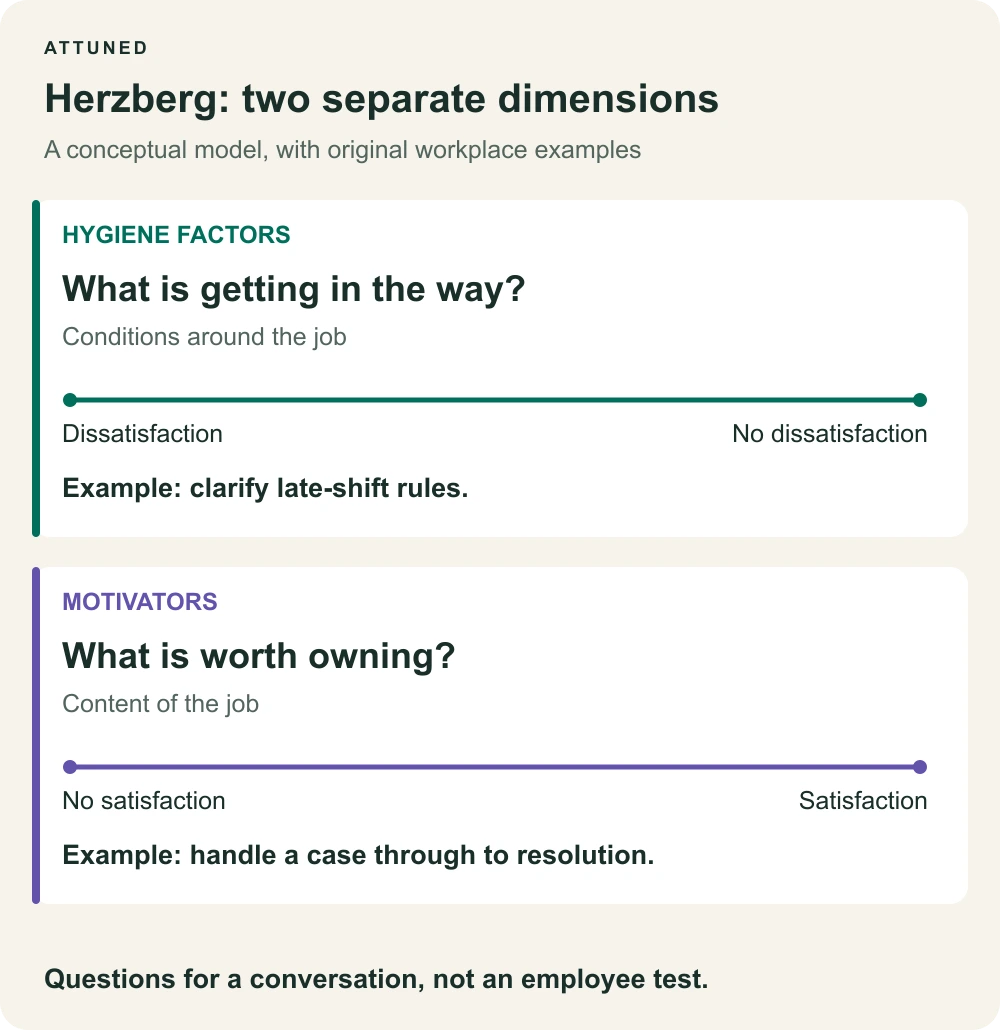
Herzberg and his colleagues developed their account from people’s descriptions of good and bad experiences at work. Their book, The Motivation to Work, connects the argument to job enrichment: changing a job’s content to offer more meaningful achievement and responsibility. The publisher’s overview.
Change what the person can own
Return to the support team. Ask the colleague what “the same queue” means. Suppose they explain that they collect details about refund requests, pass them to a supervisor, and rarely hear how the cases end.
A manager might respond by giving them more requests to process. That increases the amount of work while leaving the experience much the same.
Another option is to discuss ownership of one type of case from first contact to resolution. Which decisions could the person make? Which refund limits still require approval? What training and access would they need? How would they hear whether the customer’s problem was resolved?
This is an original example of applying the idea of job enrichment. It is not a claim that taking ownership will motivate everyone. The colleague might prefer developing technical expertise, or might say that the unpredictable rota remains the more pressing issue.
If they want to try the change, agree on a small scope and make room for it. For example, remove an equivalent share of routine queue work during a two-week trial. Responsibility needs the authority, time and support to carry it; otherwise the proposed opportunity may simply become an extra burden.
At the review, ask what was more satisfying, what was harder, and whether the arrangement should continue. Do not count acceptance of more work as proof of higher motivation.
Does Herzberg’s theory mean pay cannot motivate?
Pay belongs in the hygiene category in the model. Turning that classification into “money never matters” goes further than a manager should take it.
A meta-analysis by Judge and colleagues found a small positive association between pay level and overall job satisfaction. It did not establish that a particular raise causes a particular response. Pay satisfaction and satisfaction with the whole job are also different measures. Read the researchers’ abstract.
In practice, listen to a concern about pay on its own terms. Ask what is unclear or troubling, explain the process and what you can change, and follow through. An interesting assignment does not settle a question about missing pay, inconsistent treatment or an unexplained decision.
The same applies in the other direction: addressing a pay concern does not tell you whether someone wants more responsibility, better feedback or different work. Have that conversation too.
Where the theory has limits
The neat division is useful to explain, but it is not an uncontested law. A study by Dunnette, Campbell and Hakel across six occupational groups challenged the theory’s clean separation of satisfaction and dissatisfaction. The original study’s abstract.
The original accounts of work experiences were not a randomized test of the changes you might make to your team’s jobs. Neither a historical category nor one conversation establishes what will work for a particular colleague.
Use the distinction to widen the conversation. If someone says recognition feels unfair, explore why. Is the problem being overlooked, unclear evaluation criteria, or praise without useful feedback? You do not need to settle which category owns the complaint before responding to it.
Questions for your next one-on-one
Choose the question that fits what the person has already told you.
| What you want to understand | A question to ask | A possible next step |
|---|---|---|
| A recurring source of frustration | “What keeps making this job harder than it needs to be?” | Pick one specific process to clarify or repair. |
| Work worth continuing | “Which part of a recent case did you most want to see through?” | Explore whether they could own more of that part. |
| Responsibility without authority | “Where are you accountable for an outcome but unable to make the decision?” | Clarify decision limits and escalation support. |
| Whether a change helped | “What improved, and what became harder during the trial?” | Keep, adjust or end the change together. |
Finish with one agreement: the change, the person responsible for it, and a date to review it. If you cannot make the change requested, say so and explain what happens next.
For more ideas about the experience of work, read five ways to cultivate intrinsic motivation on your team.
If you want a structured way to discuss individual priorities, Attuned’s motivation assessment uses its own 11-motivator framework. Those categories should not be treated as a one-to-one translation of Herzberg’s two groups or a test of his theory.