People Science · For Managers & HR

Team Effectiveness Assessment: 28 Questions, Scored in Your Browser

This is a free team effectiveness assessment you can run today. It has 28 statements across seven dimensions, built on Google's Project Aristotle, Richard Hackman's team conditions and Patrick Lencioni's model, and it scores itself when you press the button. Your individual answers never leave this page. Below it: how to run it with a real team, and the one dimension a team survey is built to miss.

Start the Assessment ↓ Book a Call Directly →
Free, ungated
About 10 minutes
from Attuned, which has mapped what motivates 10,000+ people
What a scored result looks like: an illustrative team of seven
Average of 1 to 5 per dimension

Swipe to see every score →

DIMENSION SCORE Dependability 4.4 Structure & clarity 4.1 Psychological safety 3.9 Impact 3.8 Meaning & direction 3.6 Conflict & commitment 3.3 Motivational fit 2.7

The lowest bar in most teams we see is the one a team survey reads worst, because it lives inside each person, and an average of seven people can hide one of them at 1.5.

How the team works together (six dimensions) Whether the work gives each person what they need

What Is a Team Effectiveness Assessment?

A team effectiveness assessment is a structured set of statements that every member of a team rates, usually anonymously, to measure how well the team works together: whether people feel safe to take risks, whether commitments are kept and communicated, whether roles and goals are clear, whether the work feels meaningful, and whether disagreement gets resolved. Scores are read by dimension, and the output is one or two specific things for the team to change before it runs the assessment again.

The short answer

Measure how the team works, and leave the resumes out of it. When Google studied 180 of its own teams, the things that predicted effectiveness were about interaction, and the things that did not included team size, seniority, tenure and the individual performance of the people on it. Run the 28 statements below with everyone on the team, look at the lowest dimension first, and use the six-step guide to turn it into one change.

What the Research Says Actually Makes a Team Work

Most team effectiveness assessments online cite nothing at all. These four findings are the ones this assessment is built on, each linked to its source.

180

teams studied in Google's Project Aristotle. What mattered was how the team worked together. Team size, seniority, tenure and individual performance did not predict effectiveness.

Source: Google re:Work, Understand Team Effectiveness

2×

as often, people on teams with a stronger team culture were rated effective by Google executives. They were also less likely to leave.

Source: Google re:Work, Project Aristotle findings

70%

of the variance in engagement scores across business units is attributable to the manager. Whatever your team effectiveness assessment finds, the manager is the one who has to act on it.

Source: Gallup, Managers Account for 70% of Variance

51

work teams in Amy Edmondson's 1999 study, the paper that defined team psychological safety as a shared belief that the team is safe for interpersonal risk taking.

Source: Edmondson (1999), Administrative Science Quarterly

One more number, from our own data. Attuned measures 11 intrinsic motivators per person, and because they combine at different intensities there are about 7.5 quadrillion possible motivator profiles. Across 10,000+ people and four generations in the State of Motivation Report, two people on the same team rarely need the same thing from it. That is the gap the seventh dimension below exists to catch.

Sound Familiar?

The Manager Who Just Inherited a Team

Took over eight people in the spring, and the numbers are fine

  • Deadlines get hit. Meetings are polite. Nobody has disagreed with you out loud since you arrived.
  • Two people do most of the talking, and you can't tell whether the other six agree or have stopped bothering.
  • Your predecessor left you a spreadsheet of projects and nothing at all about the people.

"Everything looks okay. I just have no idea whether it actually is."

The HR Partner Asked to Fix a Team

A director wants a team effectiveness assessment before the offsite

  • The brief is "the team isn't gelling," which could mean six different things.
  • The vendor tools you found cost five figures and need a certified facilitator. The free ones are slide decks.
  • Last year's engagement survey came back at 3.8 across the board, and it told you nothing about what to do next.

"I need something I can run in two weeks that tells us where to start."

The 7 Dimensions of Team Effectiveness

The first five follow Project Aristotle's five dynamics, because that is the best-known large study of what separates effective teams from the rest. The sixth comes from Lencioni. The seventh is ours, and the argument for it is further down.

1. Psychological Safety

Can people admit a mistake, ask a basic question or push back on the manager without paying for it later? Aristotle ranked it first of the five, and Edmondson's research shows why: teams that feel safe learn out loud, and learning is what turns into performance.

2. Dependability

When someone says Friday, is it Friday? Dependable teams finish quality work on time, and the tell is how rarely anyone has to check. Low dependability shows up as private double-checking long before it shows up as a missed deadline.

3. Structure & Clarity

Clear roles, clear goals, a known owner for each decision. Hackman called this an enabling structure. It is the cheapest dimension to fix, and the one managers rarely check.

4. Meaning & Direction

Is the work personally important to the people doing it, and is the direction hard enough to be worth the effort? Aristotle's meaning plus Hackman's compelling direction. Teams with neither tend to be busy and flat.

5. Impact

Do people believe their work changes something? It depends on whether anyone brings the outcome back to the team. A team that never hears what happened next will score low here however good the work is.

6. Conflict & Commitment

Do people argue about ideas in the room, and then back the decision once it's made? It covers the middle of Lencioni's five dysfunctions, from fear of conflict to avoidance of accountability, and it is where team communication either works or goes quiet. Statement 24 is the accountability item. A team can score well on safety and still avoid every useful argument, which is its own failure.

7. Motivational Fit

Does the day-to-day work give each person what they need from work? Aristotle found that how a team works predicted more than who was on it. We agree, and add that how it works is experienced one person at a time. A process that energizes someone who ranks Autonomy highest can quietly drain someone who ranks Security highest.

Take the Team Effectiveness Assessment

Rate each statement from 1 (strongly disagree) to 5 (strongly agree), thinking about this team over the last month and ignoring how things were a year ago. Answer as yourself. If you are the manager, take it too, then compare your scores with the team's: the gap between the two is often more useful than either number.

1 = strongly disagree3 = neither5 = strongly agree

Psychological Safety

Can people take interpersonal risks here?

1.If I make a mistake on this team, it is not held against me.

2.I can bring bad news to this team without worrying about how it will land.

3.People here ask for help without it costing them standing.

4.When I disagree with the manager, I say so in the meeting, where it counts.

Dependability

Do people do what they said, when they said?

5.When someone on this team says a thing will be done by Friday, it is done by Friday.

6.I rarely need to check whether a teammate has finished their part.

7.The quality of work is consistent enough that I do not quietly redo other people’s.

8.When a commitment is going to slip, people say so early.

Structure & Clarity

Are roles, goals and decisions clear?

9.I know what I am accountable for, and so does everyone else on the team.

10.I know how my work will be judged.

11.Every significant decision has a named owner, and we know who it is.

12.I could state this team’s goals for the quarter without looking them up.

Meaning & Direction

Is the work personally important, and worth the effort?

13.The work I do on this team matters to me personally.

14.I could explain why this team exists in one sentence.

15.What we are aiming at is hard enough to be worth the effort.

16.I can see how my own work connects to where the team is going.

Impact

Do people see their work change something?

17.I can see evidence that the work we do makes a difference.

18.We hear directly from the people our work is for.

19.When we deliver something, we find out whether it worked.

20.Our results are recognized outside the team.

Conflict & Commitment

Do people argue about ideas, then commit?

21.We argue about ideas openly, and it does not turn personal.

22.Once a decision is made, people back it, including the ones who argued against it.

23.Problems between teammates get raised directly between them.

24.We hold each other to our standards without waiting for the manager to step in.

Motivational Fit

Does the work give each person what they need?

25.My day-to-day work gives me more of what I need from work than it takes away.

26.My manager could name what motivates me specifically.

27.I could name what motivates at least two of my teammates.

28.If what I needed from work changed, someone here would notice within a month.

0 of 28 answered

Scoring happens in your browser, and your answers vanish when you close the tab. If you've allowed analytics, we log which dimension came out lowest and how many statements you answered. That's all. The copy button gives you the statements as plain text, without the scoring guide, so you can paste them into a form or an email for the team. Plain text on purpose. Survey tools and calendar invites mangle anything fancier.

How to score it

Average the four statements in each dimension. An average of 4.2 or above is a strength, 3.4 to 4.1 is worth watching, and below 3.4 is low. Start with the lowest of all, and look at the spread inside it before you look at anything else. These cut-offs are our own rule of thumb; no published norm exists for these 28 statements. Want to run it as a team effectiveness survey template? Use the copy button above and paste the statements into any anonymous form tool.
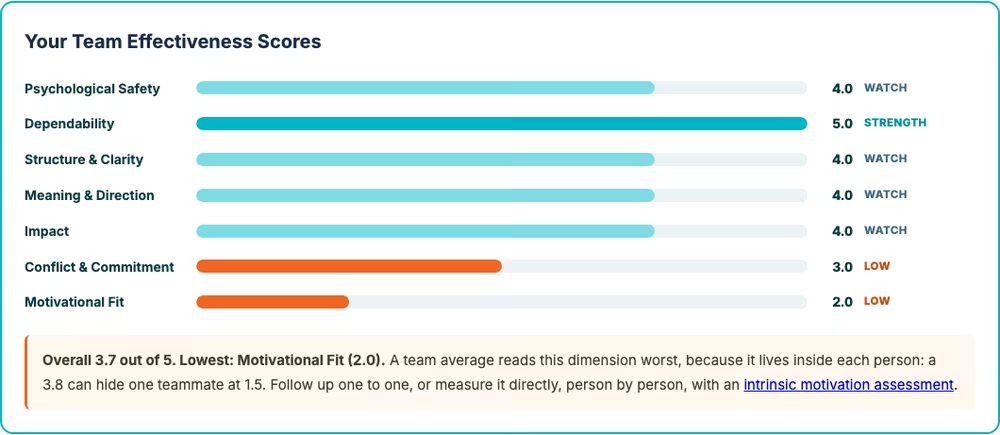
Team effectiveness assessment result panel with seven dimension scores, motivational fit lowest at 2.0

How to Run a Team Effectiveness Assessment in 6 Steps

The statements are the easy part. Most team assessments fail in the handling, usually because nothing visibly changes afterwards.

1. Write Down What You'll Change

Before anyone answers anything, decide what you are willing to change based on the result. If the honest answer is "nothing," skip the assessment. A survey followed by silence does more damage than no survey.

2. Tell the Team Who Sees What

Say exactly who will see individual answers (ideally nobody) and who sees the totals (everyone). People answer for the audience they imagine.

3. Collect Anonymously, With a Floor

Paste the 28 statements into any anonymous form tool. Never report a group smaller than three respondents, since below that anyone can work out who said what. On a team of four, that means reporting the team as a whole and never splitting it.

4. Score by Dimension, Then Look at the Spread

Average each dimension, then check the range. A 3.0 where everyone answered 3 is a different team from a 3.0 where two people answered 5 and two answered 1.

5. Share It Back Within Two Weeks

Show the team the scores, name the lowest dimension, and ask what they think is behind it. Let them explain the number. The manager's version of why a score is low is usually the least accurate one in the room.

6. Pick One Thing, Re-Run in 90 Days

One dimension, one change, one owner. Re-run the same 28 statements a quarter later and compare. Teams that try to fix all seven at once usually fix none, and then the next survey gets fewer honest answers.

Where this does not apply

Skip it, or wait, if the team is under three people (anonymity is impossible), formed less than about six weeks ago (you are measuring a first impression), or in the middle of a reorganization (you are measuring the reorganization). In workplaces with a union or works council, check whether an employee survey needs to be agreed first. Frontline and shift teams without desks can answer the same statements on paper, and response rates are often higher than online.

Team Effectiveness Models Compared

Every team effectiveness assessment is built on a model, whether it says so or not. These are the five you will run into most, what each one is good for, and what it leaves out.

Model What it names Best used for What it leaves out
Project Aristotle (Google re:Work)Five dynamics: psychological safety, dependability, structure and clarity, meaning, impactA research-backed checklist of how a team works day to dayConflict, and anything about the individual people on the team
Hackman and Wageman's team conditionsA real team, compelling direction, the right people, sound structure, supportive context, team coachingDesigning or rebuilding a team, since the conditions are set by leadersDay-to-day behavior; it describes the setup more than the play
Lencioni's Five DysfunctionsAbsence of trust, fear of conflict, lack of commitment, avoidance of accountability, inattention to resultsA leadership team offsite, where the shared language does real workPublished validation; it comes from a management fable, and reads like one
Tuckman's stagesForming, storming, norming, performing, later adjourningExplaining to a new team why the first month feels roughAny way to score a team; it describes a sequence, with no scale attached
Edmondson's psychological safety scaleA short validated scale for one construct, team psychological safetyMeasuring safety precisely when that is the specific concernThe other five or six dimensions, by design

This assessment borrows the structure of the first, the conflict dimension of the third, and the design point of the second: most of what makes a team effective is set by the conditions around it. The one thing none of the five covers is what each person needs from the work, which is why dimension seven exists. For what to measure about the manager specifically, see our guide to manager effectiveness metrics. If you are choosing an instrument to assess the leader, the leadership assessment tools comparison sorts 14 of them by what they measure.

Why a Team Can Score Fine and Still Sound Thin

Sound engineers who record a drum kit with two microphones know a particular way for it to go wrong. Each microphone, soloed, sounds great. Played together they sound hollow, because the two signals arrive a fraction of a millisecond apart and partly cancel each other out. It is called phase cancellation. The usual fix is to move one microphone a few inches, which costs nothing and is deeply unsatisfying to anyone who had been planning to buy a better microphone.

Teams do the same thing. Two capable people, each doing good work, whose needs run in opposite directions: one does their best work with wide latitude and a loose brief, the other needs a clear plan and a known decision owner. Run them both through the same manager and the same process and the team score comes back a flat, slightly disappointing 3.6 that no single answer explains. A team effectiveness assessment adds the two channels together. It can hear that the sound is thin. It has no way to tell you which microphone to move.

01

The Average Hides the Person

A dimension score of 3.8 across seven people can be seven people at 3.8, or six at 4.2 and one at 1.5 who is already interviewing. The second team needs a completely different conversation, and the average reports them identically.

02

Once a Year Is a Post-Mortem

An annual team survey describes a team that existed eleven months ago. By the time a dimension turns red, the person who dragged it down has usually decided. The reading needs to move at the speed people do.

03

People Answer for an Audience

"How are you?" is a ritual question with a ritual answer, and a team survey drifts toward the same thing. Even anonymous, people round toward 4 when they suspect the manager can guess. Step two above exists for this reason.

04

It Hears the Symptom and Misses the Person

In our experience, low psychological safety often traces back to one person's unmet need, like a teammate who ranks Feedback highest and has been getting none, meeting a manager who reads the silence as contentment.

The honest version

None of this is a reason to skip a team effectiveness assessment. Run it. It tells you which dimension to look at, and the six steps above turn that into action. The argument is narrower. A team-level instrument reads the team, and the answer to why a dimension is low usually sits one level down, in what specific people need and are not getting. You need something that measures that level too.

One level down

Your Team Scored 3.8. Find Out What Each Person Needs

A 20-minute call. Bring your team effectiveness results, or just the team, and we will show you what the same people look like measured one person at a time.

No preparation needed. The workbook is free and covers dimension one in depth.

The Individual Layer Under Your Team Survey

Attuned measures dimension seven directly, person by person, and keeps measuring it. It sits underneath whatever team survey you already run and explains the scores that survey cannot.

Step 0 · The Assessment

Everyone on the Team Scores Their 11 Motivators

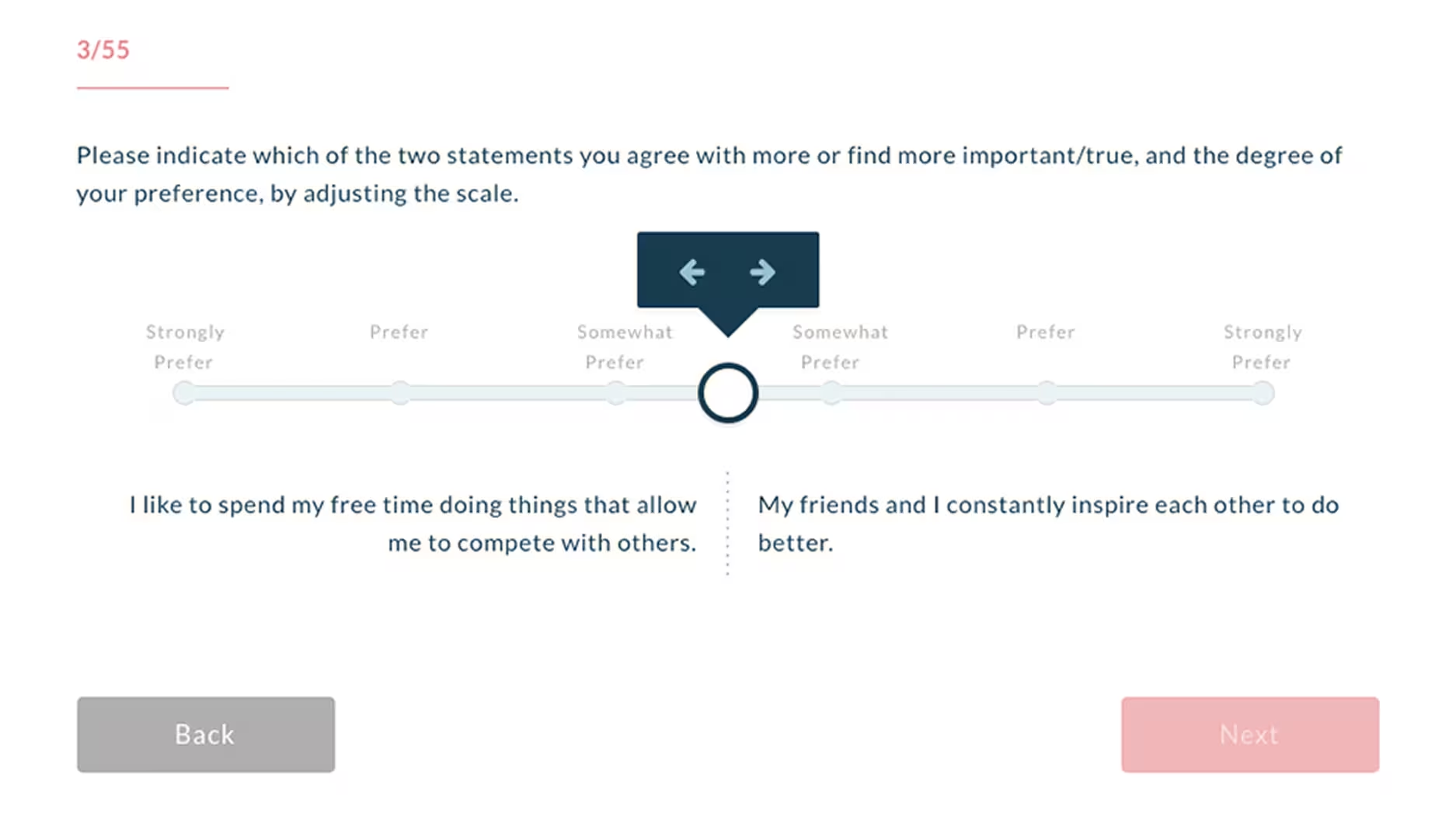
The intrinsic motivation assessment takes about 10 minutes: 55 forced-choice questions, scoring all 11 motivators (Altruism, Autonomy, Competitiveness, Feedback, Financial Needs, Innovation, Progress, Rationality, Security, Social Relationships and Status) from 0 to 100 against one global norm. Each is labeled Need-to-have, Nice-to-have or Neutral. The manager takes it too, so their profile lands next to the team's.

The Attuned assessment showing a forced-choice question between two work situations The assessment: forced-choice, 55 questions
10 minper person
11motivators scored
7.5quadrillion possible profiles
10,000+people assessed, four generations
1

The Team Map Shows Who Pulls Which Way

Seven profiles side by side. This is where you find the two microphones: the person who needs Autonomy sitting next to the person who needs Security, both managed the same way.

2

A Recurring Pulse Replaces the Annual Snapshot

A short satisfaction pulse tracks whether each driver is being met, read at team level with a floor of three respondents. A driver coming loose shows up in weeks, well before a dimension score turns red.

3

The Manager Gets Words to Use Alongside the Chart

AI TalkCoach reads one person's profile and the team's current gaps and drafts what to ask in the next one-on-one. Our list of one-on-one meeting questions is the manual version of the same idea.

4

It Runs Alongside Your Team Survey

Keep the 28 statements for the team view, run quarterly. Attuned runs continuously underneath and explains the lowest dimension when it moves.

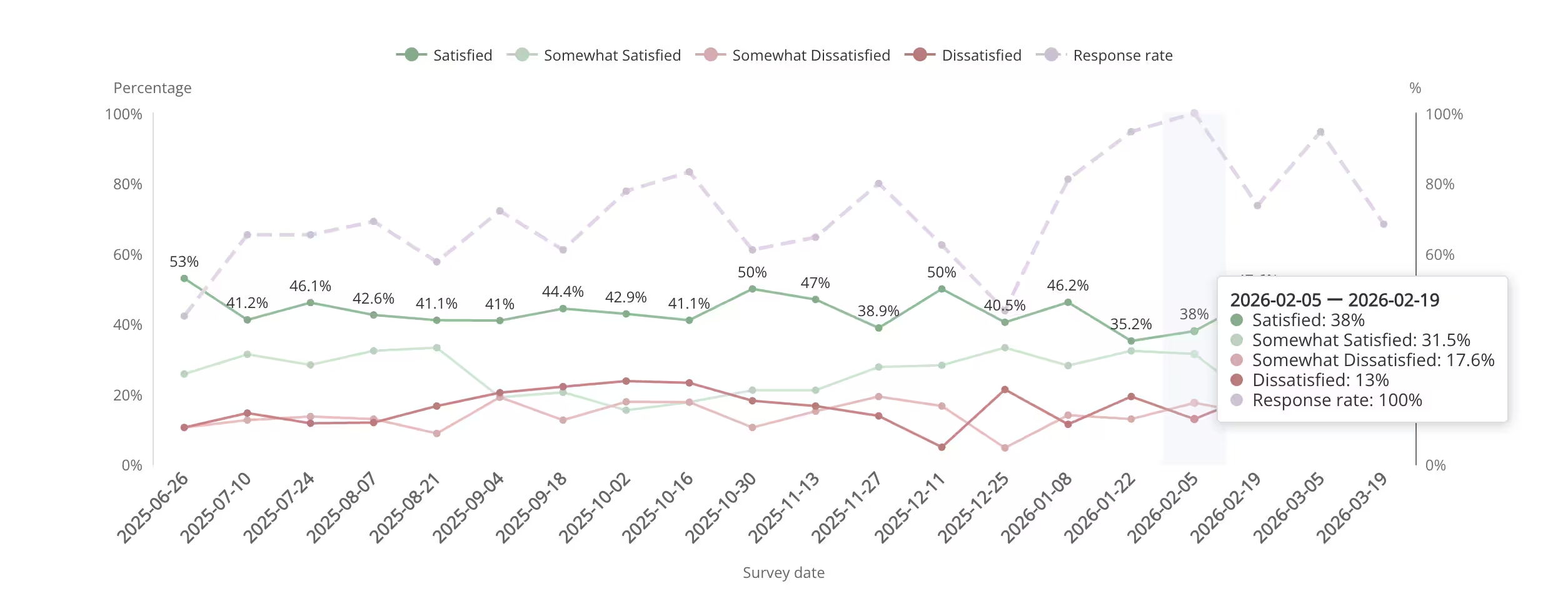
Satisfaction over time

Seeing the Slide Before the Survey Does

Satisfaction is tracked against the drivers each team actually ranks highest. In the teams we see, a downward slope on one of them usually shows up weeks before a resignation decision, and it names the driver and roughly when the slide started. Your next team effectiveness assessment will show the damage. This shows it while there is still time to move the microphone.

Motivator satisfaction tracked over several months, with one driver declining while the others hold steady Motivator satisfaction, tracked over time

How a Growing Firm Stopped Reading People by Instinct

Azon Recruitment Group is an Irish recruitment firm that never ran the 28 statements above, so the parallel is the shape of the problem: a team that looked fine from the outside, a confident read that everyone was happy, and a resignation that proved the read wrong.

The Azon Recruitment Group team

Resources for Acting on Your Lowest Score

The assessment tells you where to look. These cover what to do once you've looked.

The Psychological Safety Workbook

Free exercises for dimension one, the one Aristotle ranked first. Built for managers to run with their own team, no facilitator required.

Get the workbook →

The State of Motivation Report

Motivator profiles from 10,000+ people across four generations, including how much drivers differ between people who sit on the same team.

Get the report →

To Improve Psychological Safety, Measure It First

Why a gut read on safety is unreliable, and what measuring it changes about the conversation afterwards.

Read: measuring psychological safety →

The Age of Ultra (High-Performing Teams)

A panel with a Navy squadron commander and a talent leader on what the best teams they had run had in common. Every one of them started with safety.

Read: high-performing teams →

Psychological Safety in One-on-Ones and Team Meetings

The two settings where dimensions one and six are won or lost, with specific moves for each.

Read: safety in meetings →

Preventing Unwanted Turnover

What a low motivational-fit score turns into if nobody acts on it, and the signals that come before a resignation.

Read: preventing unwanted turnover →

Related pages: how to measure employee engagement for the organization-wide version of this exercise, and the intrinsic motivation assessment for the full method behind dimension seven.

A Team Survey Tells You Where. Attuned Tells You Who and Why

It Measures the Person

Team surveys average by design. Attuned starts from each individual's 11 motivators and builds the team view out of them, so what one person needs is never averaged away into the team's number.

It Moves Before the Survey Does

In the teams we see, motivator satisfaction usually starts to slide weeks before someone decides to leave. A quarterly team assessment finds out afterwards. The pulse shows a team's drivers slipping while there is still time to act.

Built With Psychologists, Honest About Validation

Eleven motivators defined with psychologists and scored against a single global norm, so a 72 in Tokyo and a 72 in Texas sit on the same scale. We have not published a peer-reviewed validation paper and we do not claim one. Research with Goethe University is ongoing.

It Hands the Manager a Sentence

AI TalkCoach turns a person's profile and the team's current gaps into what to say in the next one-on-one. The manager is the 70%, so that is where the result has to land.

Team Effectiveness Assessment: Common Questions

What is a team effectiveness assessment?

A team effectiveness assessment is a structured set of statements that every member of a team rates, usually anonymously, to measure how well the team works together. Good ones cover psychological safety, dependability, structure and clarity, meaning, impact and how the team handles conflict. Scores are read by dimension, and the output should be one or two specific changes the team makes before running the assessment again.

How do you measure team effectiveness?

Ask every team member to rate the same set of statements on a 1 to 5 scale, anonymously, then average the scores by dimension and look at the spread within each one. Pair that with one outcome measure the team already tracks, such as delivery against commitments, so you can see whether changes in how the team works show up in what it produces. Re-run the same statements every quarter; a single reading tells you far less than the change between two.

What are the 5 dynamics of an effective team, according to Google?

Google's Project Aristotle studied 180 teams and found five dynamics that set effective teams apart: psychological safety, dependability, structure and clarity, meaning, and impact. Psychological safety mattered most. The study also found that team size, seniority, tenure, colocation and the individual performance of team members did not predict effectiveness. People on teams with a stronger team culture were rated effective by executives twice as often, and were less likely to leave.

What are Hackman's conditions for team effectiveness?

Richard Hackman, who studied teams at Harvard for decades, argued that effectiveness depends mostly on conditions leaders set up in advance. He set out five conditions in his 2002 book Leading Teams. Later work with Ruth Wageman expanded them to six: a real team with stable membership, a compelling direction, the right people, a sound structure, a supportive organizational context, and competent team coaching. The first three are treated as essentials and the last three as enablers.

How often should you run a team effectiveness assessment?

Quarterly works for most teams: often enough to see whether a change made a difference, and rarely enough that people still answer thoughtfully. Run it again sooner after a big change, such as a new manager or a reorganization, but wait roughly six weeks so the reading reflects the new team once the shock has passed. Annual-only assessment is too slow to act on.

Should a team effectiveness survey be anonymous?

Yes. People answer honestly only when they are confident nobody can trace a score back to them, so collect answers anonymously and never report a group smaller than three respondents. Tell the team in advance exactly who will see what. On very small teams, report the team as a single group and do not split results by role or seniority.

What is the difference between team effectiveness and team performance?

Team performance is the output: what the team delivered, measured against its goals. Team effectiveness is the capability behind it: how well the team works together, and whether it can keep delivering without burning people out. A team can post strong performance for a quarter on the effort of two people while its effectiveness is falling, which is why it is worth measuring both.

What do you do with the results of a team effectiveness assessment?

Share the scores with the whole team within two weeks, name the lowest dimension, and ask the team what they think is behind it before offering your own explanation. Agree on one change, give it one owner, and re-run the same assessment in about 90 days to see whether the score moved. If the lowest dimension is about individual motivation, follow up one-on-one, because a team conversation will not surface what a specific person needs.

Can I benchmark my team effectiveness scores against other teams?

No. No published norm exists for these 28 statements, so any benchmark we showed you would be invented. The useful comparison is your own team against itself a quarter later, and the manager's scores against the team's. If you need external benchmarks, paid instruments such as Leadership Circle's BRITE and the AIIR Team Effectiveness Survey compare results against their own databases, usually with a certified facilitator and a per-team fee.

Is this team effectiveness assessment free?

Yes. The 28 statements, the scoring and the guide on this page are free and ungated, with no email required. Scoring runs in your browser and your individual answers are never sent or stored. If you have allowed analytics, the page logs only which dimension scored lowest and how many statements were answered. You can copy the statements as plain text and run them with your team in any anonymous survey tool.

Team Effectiveness Assessment

You Know Which Dimension Is Low.
Now Find Out What Each Person Needs

Bring your scores, or bring the team. We will show you what the same people look like measured one at a time, and be straight about whether that adds anything your team survey does not already tell you.

20 minutes
10,000+ people assessed
No preparation needed

Talk to Attuned

A working session on the team you are trying to read.

Book a Call → Get the State of Motivation Report Or take the 28-question assessment again ↑

"If an employee was engaged and they looked like they were happy, the assumption would be they were fine." Denise Grant, HR Recruitment, Azon

Prefer email? casey.wahl@attuned.ai

One level down. See what each person needs behind the lowest score.
Book a Call →