People Science · For HR & L&D

Leadership Assessment Tools, and What Each One Actually Measures

Almost every comparison of leadership assessment tools ranks them. Ranking assumes they are interchangeable. They press on five different properties, and a tool can be excellent at the one it measures while being silent on the one you bought it for. Below are 14 leadership assessment tools sorted by category, with what each one measures, what it cannot tell you, six questions to ask a vendor, and the category that four of the fourteen touch at all.

See the 14 Tools ↓ Book a Call Directly →
Customer story below
Azon Recruitment Group
motivator data on 10,000+ people across four generations
14 leadership assessment tools, by the property each one primarily measures
Our classification · see the table below

Swipe to see the fifth category →

PRIMARY PROPERTY MEASURED TOOLS Personality & trait 6 Behavioral style 4 360 perception 2 Cognitive & simulation 1 Intrinsic drivers 1 + 3 Solid: 1 tool measures only this. Hatched: 3 more, already counted in row 1, measure it in part.

A competency gap tells you what a leader cannot yet do. It says nothing about whether they want to, and wanting to is what decides whether the new behavior survives the end of the development program.

Categories that describe capability, style or how the leader is seen The category that describes what the leader needs from the work: 1 tool solely, 3 more in part

What Are Leadership Assessment Tools?

Leadership assessment tools are structured instruments used to measure something about a leader that a conversation alone would not surface reliably. They come in five categories: personality and trait instruments, behavioral style instruments, 360-degree feedback, cognitive ability and simulation exercises, and motivation or driver instruments. Each category presses on a different property. Most organizations buy one, then read its output as though it covered all five.

The short answer

Pick the category before the vendor. If you want to predict whether someone can do the job, use a validated occupational instrument or a simulation. If you want to know how they are experienced by the team, run a 360. If you want to know whether the behavior will survive the training, use a driver instrument. The full list of 14 tools is below, and the six questions to ask a vendor are here.

The Manager Is the Variable Worth Measuring, and the Population Has Moved

The case for assessing leaders at all rests on one well-replicated finding. The case for reassessing them rests on how much the population has changed since most assessment programs were designed.

70%

of the variance in team engagement is attributable to the manager. This is the number that justifies spending anything at all on leadership assessment.

Source: Gallup, Managers Account for 70% of Variance

22%

of managers were engaged at work in 2025, down five points from 27% the year before. An assessment program designed against the 2022 population is measuring different people.

Source: Gallup, State of the Global Workplace 2026 (2025 data)

70-20-10

is the split behind most leadership development: roughly 70% of learning happens on the job, 20% through others, 10% in formal programs. Assessment feeds the 10%. The other 90% runs on the day-to-day conversation.

Source: Center for Creative Leadership, the 70-20-10 Rule

4 of 14

of the leadership assessment tools compared on this page measure motivation at all, whether as their main purpose or as one component of a wider battery. Our own classification, and the table below shows the working.

Source: Our comparison table, classified by primary property measured

Low engagement cost the world economy roughly $10 trillion in lost productivity in 2025, about 9% of global GDP, on Gallup's estimate. Leadership assessment is one of the few interventions that sits upstream of that number, and that is also why choosing the wrong instrument is expensive twice: once for the license, and once for the two years spent developing against the wrong finding.

Sound Familiar?

The L&D Lead Running a Vendor Shortlist

Asked to pick a leadership assessment tool by the end of the quarter

  • Five vendors, five demos, and every one of them claims to measure leadership. None of the decks say which of the five categories they sit in.
  • You asked two of them for validation evidence and received a customer logo wall.
  • The procurement question you cannot answer yet is what this instrument will change about what a manager does on a Tuesday.

"I can tell you what all five tools cost. I can't tell you what any of them would have caught."

The HR Director Who Already Ran One

Assessed 40 leaders 18 months ago and is being asked what came of it

  • Everyone got a profile, a debrief and a development plan. Most of the plans stopped being worked on inside a quarter.
  • The report told you who was low on a competency. Nothing told you which of those people was going to act on it.
  • Two of your strongest results left anyway, and the assessment had nothing to say about why.

"We measured them accurately. I still could not have predicted a single one of the four resignations."

The 5 Categories of Leadership Assessment

Choosing a leadership assessment tool is mostly a category decision wearing a vendor decision's clothes. Pick the category that answers your actual question, and the shortlist inside it is usually two or three names.

1. Personality & Trait

Measures stable dispositions: what this person tends to do, including under pressure, which is what derailer scales exist for. Strongest published research record of the five. Hogan, SHL OPQ32, CliftonStrengths, MBTI, Birkman, Korn Ferry.

2. Behavioral Style

Describes how someone acts and communicates, usually on two to four axes, usually fast to complete. Excellent as a shared team vocabulary. Weak as a predictor, and several publishers say so themselves. DISC, The Predictive Index, Life Styles Inventory, Thomas.

3. 360 Perception

Collects how manager, peers and reports actually experience the leader, and shows the gaps against self-rating. The only category that measures observed behavior from multiple angles. It measures reputation, and reputation lags behavior. Leadership Circle Profile, CCL Benchmarks.

4. Cognitive & Simulation

Observes reasoning or behavior under a constructed load: in-trays, role-plays, business simulations, scored by trained assessors. The best predictive evidence of the five, and the most expensive by a wide margin. DDI assessment centers.

5. Motivation & Drivers

Measures what the person needs from the work. The other four categories measure what they can do in it. One instrument here does only this, and three more carry it as one component of something larger. It is the only category that speaks to whether a developed behavior will still be there in two quarters. Birkman needs scales, Hogan MVPI, Korn Ferry drivers, Attuned.

Where Emotional Intelligence Sits

Some comparisons give EQ its own sixth category. We did not, because EQ names a subject that four of our five categories can be pointed at. The EQ-i 2.0 and the Six Seconds SEI are self-report and behave like category 1. Genos and the EQ 360 are multi-rater, so by our own rule they are category 3. Ability-based measures like the MSCEIT score answers against a consensus key, which puts them nearest category 4. Buy one if EQ is the specific thing you want scored, then classify it by its format, the way you would classify anything else here.

The Common Mistake

Buying from category 1 or 2 because it is cheap and quick, then reading its output as though it answered a category 3 or 5 question. A trait profile cannot tell you how a leader is experienced, and no instrument in categories 1 to 4 can tell you what the leader wants.

14 Leadership Assessment Tools, and What Each One Measures

Grouped by the property each instrument primarily presses on. Every entry carries a "cannot tell you" line, because that is the part a vendor deck leaves out and the part that decides whether the tool answers your question. Where a publisher has taken a public position on how its instrument should be used, we have used theirs.

Personality and Trait Assessments

Six of the fourteen. These measure disposition, meaning what a person tends to do across situations. The category with the longest published research record, and the one most often over-read: a trait profile describes a tendency, and a tendency is a probability, while Thursday is a single event.

1. Hogan Assessments

Personality & trait Measures: three instruments in one battery. The HPI covers everyday personality, the HDS covers derailers that appear under stress, and the MVPI covers core values and motives. The derailer scales are the reason Hogan appears on nearly every executive shortlist. Cannot tell you: what this leader will do inside your specific team this quarter. A disposition read describes the tendency a person brings, and the situation supplies at least as much of the outcome.

2. Korn Ferry Assess (KF4D)

Personality & trait Measures: a four-dimensional battery covering traits, drivers, competencies and experiences, scored against Korn Ferry's own competency architecture. The broadest single purchase on this list. Cannot tell you: anything outside its own model. The output is organized around a competency framework, so if your roles diverge from that framework the report reads generic in exactly the places you needed it specific.

3. SHL OPQ32

Personality & trait Measures: 32 scales of workplace behavioral preference, built for occupational use and supported by a long-standing technical literature. Widely used for volume selection as well as leadership work. Cannot tell you: intensity of need. A preference scale records which way somebody leans. It does not record how much they mind when the work goes the other way, and minding is what produces resignations.

4. CliftonStrengths

Personality & trait Measures: 34 talent themes, ranked, with most programs working from the top five. Its real contribution is a shared developmental language that people enjoy using, and enjoyment is a genuine advantage in adoption. Gallup declines the personality-test label for it; we group it here because it functions as a stable self-report of disposition. Cannot tell you: who to hire. Gallup positions it as a development instrument, and using a ranked strengths profile to screen candidates goes beyond what the publisher claims for it.

5. Myers-Briggs Type Indicator (MBTI)

Personality & trait Measures: preference across four dichotomies, producing one of 16 types. Enormously well known, quick to run, and effective at getting a team talking about difference without anyone feeling judged. Cannot tell you: whether someone should get the job. The Myers-Briggs Company states plainly that the instrument should not be used for hiring or selection decisions, and that position has been consistent for years.

6. The Birkman Method

Personality & trait Measures: usual behavior, interests, underlying needs, and the stress behavior that shows up when those needs go unmet. One of the few established instruments that treats need as a separate construct from behavior. Cannot tell you: much without an interpreter. It is long, the report is dense, and getting value out of it generally means paying a certified consultant for a debrief on top of the license.

Behavioral Style Assessments

Four of the fourteen. Fast, cheap, popular, and genuinely useful as a common vocabulary for a team that has to work together. Treat the output as a conversation starter. Several of these publishers say the same thing about their own instrument.

7. The Predictive Index Behavioral Assessment

Behavioral style Measures: four behavioral drives, through a free-choice adjective checklist that most people finish in under ten minutes. The speed is the product: it is realistic to run this across an entire organization. Cannot tell you: what a person needs from the work. It maps style, so two people with near-identical profiles can want opposite things from the same manager. Our full comparison is at Predictive Index alternative.

8. DISC

Behavioral style Measures: communication and behavioral style across four quadrants. Sold by many vendors under many names, since the underlying model is not owned by a single publisher, so quality varies widely between providers. Cannot tell you: job performance. DISC was built as a description of style, and buying a version whose vendor implies predictive power is the most common way this category goes wrong.

9. Life Styles Inventory (Human Synergistics)

Behavioral style Measures: twelve thinking styles grouped into constructive, passive-defensive and aggressive-defensive clusters, available as a self-report and as a multi-rater. Strong on the defensive patterns that quietly wreck teams. Cannot tell you: why the defensive style is there. It shows the pattern accurately and leaves the cause for someone else to find. That cause is usually a need being persistently unmet.

10. Thomas (Thomas International)

Behavioral style Measures: a suite covering behavior, aptitude and emotional intelligence, assembled so that a mid-sized organization can buy most of its assessment needs from one supplier. Cannot tell you: which component is load-bearing for your decision. Breadth is convenient at purchase and a problem at interpretation, when four scores arrive together with no stated hierarchy between them.

360-Degree Feedback Assessments

Two of the fourteen. The only category that measures what colleagues have actually observed rather than what the leader says about themselves. Also the category with the slowest clock, since a 360 measures reputation and reputation lags behavior by months.

11. Leadership Circle Profile

360 perception Measures: creative competencies against reactive tendencies in a single circular graphic, with the underlying assumptions that drive the reactive half. The visual does a lot of work in a debrief, and executives remember it. Cannot tell you: what the leader wants. It is an aggregate of how other people experience them. What would keep this leader engaged in the role is a separate question.

12. CCL Benchmarks 360

360 perception Measures: observed leadership behavior against a research-based competency set, from the organization that also gave the field the 70-20-10 model of how leaders actually develop. Cannot tell you: anything reliable from a thin rater pool. Every 360 needs enough raters per group to be both statistically meaningful and psychologically safe, commonly a floor of three to five, and small teams routinely fall below it.

Cognitive Ability and Simulation

One of the fourteen, and the most expensive thing on the list by a wide margin. Trained assessors watch a candidate handle constructed leadership situations over hours or days. When the decision is large enough, the cost is defensible.

13. DDI Acceleration Centers

Cognitive & simulation Measures: behavior under a constructed load. In-trays, role-plays and business simulations, scored by trained assessors against defined criteria, in place of self-report about how one would probably behave. Cannot tell you: how someone behaves when the stakes and the relationships are real and ongoing. A simulation runs for a day with strangers. The job runs for years with people whose opinion of you matters.

Motivation and Driver Assessments

One of the fourteen as its whole purpose, and three others touch it as a component (Hogan through the MVPI, Korn Ferry through drivers, Birkman through needs). This is the category that answers whether a leader will keep doing the behavior once the program that taught it is over. It is also the one most often left out of a battery.

14. Attuned Intrinsic Motivation Assessment

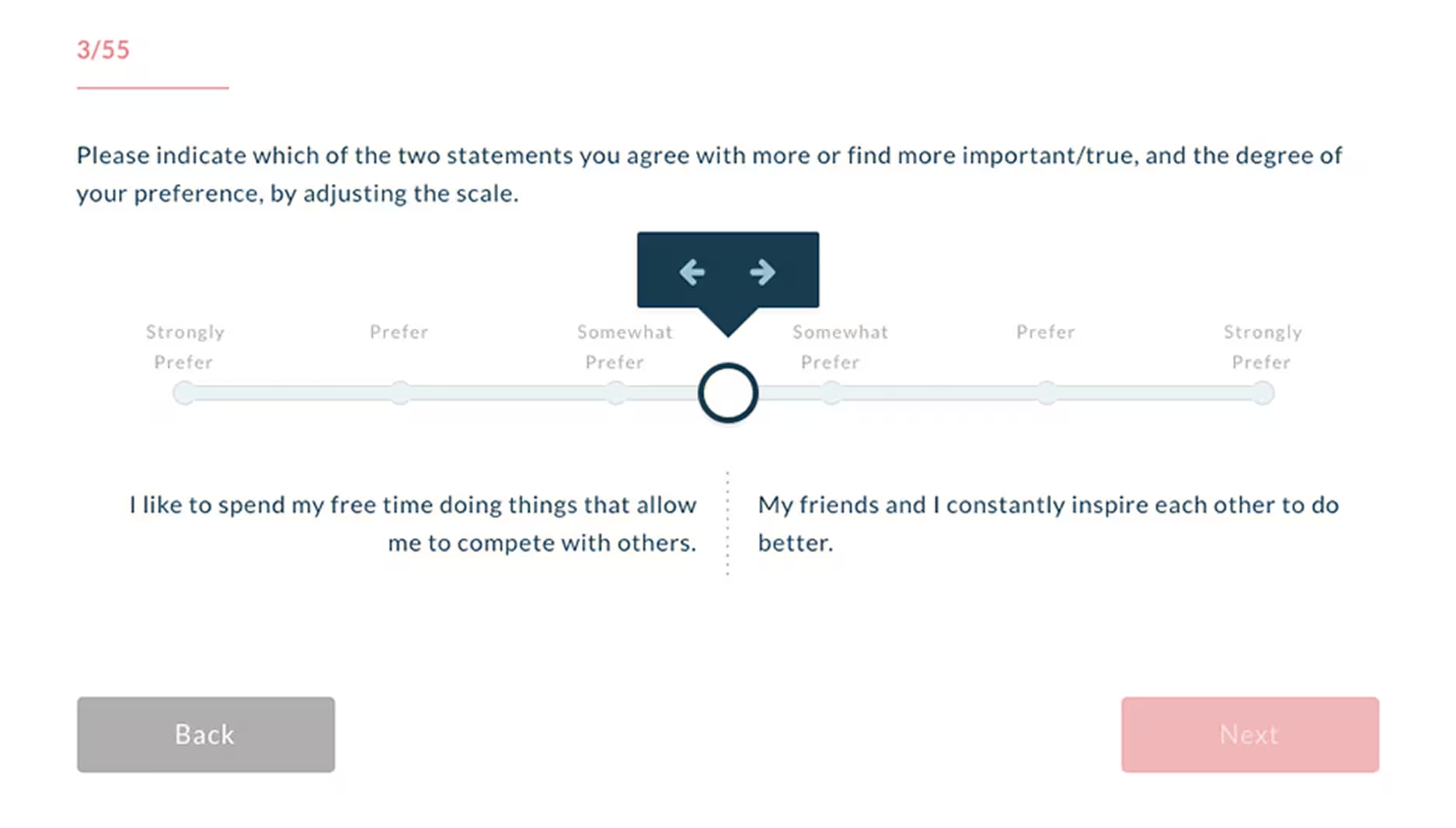
Motivation & drivers Measures: 11 intrinsic motivators per person through 55 forced-choice questions in about 10 minutes, each scored 0 to 100 against a single global norm and labeled Need-to-have, Nice-to-have or Neutral. A recurring pulse then tracks whether those drivers are being met. Full method at intrinsic motivation assessment. Cannot tell you: capability. It says nothing about whether this person can run a P&L, chair a board or handle a restructure. We have also not published a peer-reviewed validation paper, and we do not claim one. Research with a team at Goethe University is ongoing, and we publish what comes out of it.

Leadership Assessment Tools Compared

The same 14 tools in one view, with the category, the typical use it is bought for, and the question it cannot answer. Take it into a vendor meeting and ask them to correct the row about their own instrument.

Tool Category Typically bought for Cannot answer
Hogan (HPI / HDS / MVPI)Personality & traitExecutive selection and derailment riskWhat happens in this particular team this quarter
Korn Ferry Assess (KF4D)Personality & traitSuccession and enterprise talent architectureAnything outside its own competency model
SHL OPQ32Personality & traitVolume selection and leadership screeningHow strongly a preference is held
CliftonStrengthsPersonality & traitDevelopment and a shared team languageHiring decisions, by the publisher's own position
Myers-Briggs (MBTI)Personality & traitTeam workshops and self-awarenessSelection, which its publisher explicitly rules out
The Birkman MethodPersonality & trait (+ needs)Executive coaching and stress-behavior workMuch without a certified interpreter
The Predictive IndexBehavioral styleOrg-wide behavioral common languageWhat a person needs from the work
DISCBehavioral styleCommunication training and team daysJob performance, which it was never built to predict
Life Styles InventoryBehavioral styleCulture and defensive-pattern diagnosisWhy the defensive pattern formed
Thomas (Thomas International)Behavioral styleOne supplier across several assessment needsWhich of its components should carry the decision
Leadership Circle Profile360 perceptionExecutive coaching engagementsWhat the leader themselves wants
CCL Benchmarks 360360 perceptionLeadership programs at scaleAnything reliable below three to five raters per group
DDI Acceleration CentersCognitive & simulationHigh-stakes executive appointmentsBehavior when relationships are real and ongoing
AttunedMotivation & driversRetention risk and one-to-one conversation qualityCapability, at all

Scroll the table sideways to see every column →

Copies as plain text, deliberately: paste it into a procurement doc or a ticket without the column widths arriving mangled.

How to read this table, and where it stops. The "cannot answer" column is our reading, arrived at by taking each publisher's own stated purpose and asking what falls outside it. It is a judgment, and a vendor is entitled to argue with the row about their product. Two rows quote the publisher directly: The Myers-Briggs Company's position against selection use, and Gallup's positioning of CliftonStrengths as a development instrument. The table also carries no pricing and no validity scores, for the same reason: both move, both are negotiated, and a number we could not verify today would be worse than the blank. Ask each vendor for their technical manual and their current fully loaded price, and hold us to the same standard.

Every Instrument on This Page Is a Hardness Test

In metallurgy there is a test where a machine presses a diamond tip into a sample under a known load and measures the dent. It is quick, it is repeatable to a decimal place, and the number it gives you is genuinely hardness. Engineers like it enormously. The test leaves a small permanent mark in the sample. So, occasionally, does the feedback session.

Here is the catch that every materials engineer learns early. Hardness correlates with strength, and most parts in the real world fail in fatigue: a crack that starts somewhere invisible and grows a little every cycle until the thing breaks on an ordinary Tuesday under a load it had handled ten thousand times before. Hardness testing is precise about the property it presses on and silent about the failure mode you actually care about.

Leadership assessments are hardness tests. They press on a property, report it accurately, and go quiet about the way leadership usually fails: a good manager who has been doing a job that gives them none of what they need, for long enough, and who leaves or stops trying on an ordinary Tuesday under a load they had handled many times before.

01

A Competency Gap Assumes the Want Is Already There

Assessment finds a gap. Development closes it. The model only works if the leader wants to do the thing once nobody is watching. Nothing in categories one to four ever asked.

02

Two Identical Profiles, Two Different Resignations

Two leaders can score the same on every trait scale and need opposite things from the role. One is drained by the autonomy the other is leaving for. The trait profile records neither.

03

The Assessment Is a Photograph

Most leadership assessment tools are run once, at the start of a program, and then referenced for two years. Drivers move when the role moves. A reading from before the reorganization is describing a person who no longer holds that job.

04

It Stops at the Individual Leader

The leader gets a profile. Their six reports do not. So the debrief produces advice about the leader's style in general, when the useful version is what this style does to these six specific people, two of whom rank the opposite driver highest.

The honest version

None of this makes the other four categories wrong. A derailer scale catches things a driver assessment never will, and an assessment center predicts performance better than any questionnaire. The argument here is narrower: a leadership assessment battery with nothing from category five has no reading at all on the failure mode that ends most leadership tenures, and the organizations that get surprised by a resignation are usually the ones holding an excellent, accurate, entirely silent profile.

How to Choose a Leadership Assessment Tool: 6 Questions

Ask these six in the order given. The first two eliminate most of the shortlist before you have looked at a single sample report. That is the point.

1. What Decision Will This Change?

Write the decision down before the demo: who to promote, who to coach, what to put in the program, who is at risk of leaving. Each of those points at a different category. An assessment bought without a named decision produces a report everyone reads once.

2. Which of the Five Categories Is It In?

Make the vendor say it out loud. Most will, readily. The ones who answer "all of them" are describing a battery, and a battery has a price and an interpretation burden that belong in the evaluation.

3. Can I See the Technical Manual?

Validated occupational instruments have one and will send it. Development instruments often do not, and that is legitimate as long as nobody then uses them for selection. The answer to this question is more informative than the document.

4. How Often Can We Re-Run It?

A leadership assessment run once at kickoff describes a person as they were at kickoff. Ask the annual cost of re-running the whole population, and whether any part of the instrument is designed to be read continuously rather than episodically.

5. Who Has to Be Certified?

Several of the strongest instruments require a certified practitioner for every debrief. That is a real recurring cost and a real bottleneck on rollout speed. Get the fully loaded number: license, certification, debrief time, and the platform the results live in afterwards.

6. What Does a Manager Do With It on Monday?

Ask to see the output a line manager receives. The consultant's version is a different document. If the manager's artifact is a PDF with a bar chart and no suggested sentence, the instrument has handed the hardest part of the job back to the least trained person in the chain.

A reasonable default

For most organizations under a thousand people: one validated instrument from category 1 for senior appointments, a 360 from category 3 on a two-year cycle for anyone leading leaders, and something from category 5 running continuously underneath both. Skip category 2 unless you specifically want a shared vocabulary, and reserve category 4 for appointments where the cost of getting it wrong runs into the millions.

Past the profile

You Can Assess a Leader Accurately and Still Not See the Resignation Coming

A 20-minute call, the assessment stack you already run on the screen, and an honest read on which of the five categories you have covered and which you do not.

No preparation needed. Bring whichever instruments you already license.

One Instrument in Category Five, Running Underneath the Others

Attuned is a leadership assessment tool in the drivers category, and it replaces nothing on the list above. Two instruments: a 10-minute assessment that scores one person's 11 motivators, and a recurring pulse on whether those drivers are being met, read at team level with a floor of three respondents.

Step 0 · The Assessment

Every Leader and Every Report Scores Their 11 Drivers

The Intrinsic Motivation Assessment runs 55 forced-choice questions in about 10 minutes and scores all 11 motivators from 0 to 100 against a single global norm, labeling each one Need-to-have, Nice-to-have or Neutral. The 55 items are what survived an original battery of more than 400. The assessment sits in the same family of self-report instruments as the Reiss Motivation Profile (Reiss, 2004) and Amabile's Work Preference Inventory (1994). The important difference from the other thirteen tools on this page: the reports take it too, so the leader's profile arrives next to the profiles of the people they lead.
10 minper person
11motivators scored
55forced-choice items, from 400+
10,000+people assessed, four generations
The Attuned Intrinsic Motivation Assessment, a leadership assessment tool in the drivers category, showing a forced-choice question between two work situations The assessment: forced-choice, 55 questions
1

The Leader's Profile Lands Beside Their Team's

A trait report describes the leader in general. Here the same profile is read against the six people who have to work with it. That is where a style stops being an abstraction and turns into two specific reports who need the opposite of what this leader naturally does.

2

The Reading Keeps Running After the Program Ends

The satisfaction pulse runs on a short recurring cycle, so a driver coming loose shows up in weeks. A leadership assessment run once at kickoff describes a person as they were at kickoff, and a reorganization is enough to make that reading stale.

3

The Output Arrives as Language the Manager Can Use

AI TalkCoach reads one person's profile and current gaps and drafts what to ask, how to frame it and what to steer around. This is question six from the buying guide, answered: the manager's artifact is language they can use on Monday.

4

It Sits Under Whatever Else You License

Hogan for the executive appointment, a 360 on a two-year cycle, and this running continuously underneath both. The categories answer different questions, so the sensible arrangement is to hold more than one.

Satisfaction over time

Watching a Driver Come Loose

Satisfaction is tracked against the drivers a team actually scores highest. A downward slope on one of them moves weeks before a resignation decision, which puts it ahead of the annual survey cycle, and it names the driver and roughly when the slide started. This is the fatigue crack, caught while it is still small.
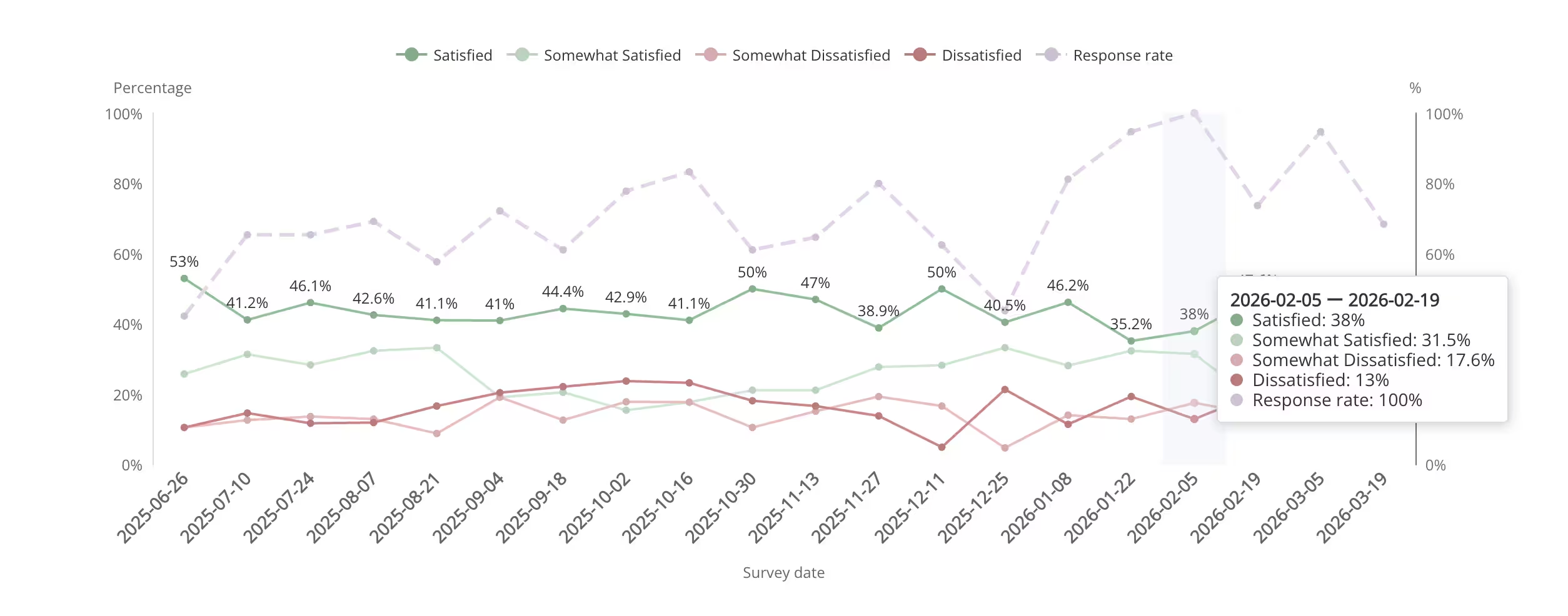
Motivator satisfaction tracked over several months, with one driver declining while the others hold steady Motivator satisfaction, tracked over time

How a Growing Firm Stopped Reading People by Instinct

Azon Recruitment Group is an Irish recruitment firm, so their situation is specific to them. What transfers is the shape of the problem this page is about: a confident, experienced read on how people were doing, held with no instrument pointed at it, and proved wrong by a resignation. We have no leadership-assessment bake-off to show you here, and we would rather say that than dress this up as one.

The Azon Recruitment Group team, a growing Irish firm that replaced instinct about how people were doing with individual motivator measurement

Resources for Choosing an Assessment and Then Using It

An instrument tells you something about a leader. These cover what to do with it afterwards. That is where most assessment programs quietly stop.

The State of Motivation Report

Our own data set: motivator profiles from 10,000+ people across four generations, including how driver profiles differ by role and seniority. The empirical basis for everything in category five above.

Get the report →

Research From Goethe University

The ongoing research collaboration behind the instrument, and what has come out of it so far. Read it before you take our word for anything in the table above.

Read: the Goethe University research →

What Makes a Good Manager

The qualities that sit behind a strong assessment result, and why the same behavior lands differently with two different reports.

Read: what makes a good manager →

Turning Managerial Blindspots Into Strengths

What a leader systematically fails to see about their own team. The gap a 360 exists to close, and the part of it a 360 still misses.

Read: turning blindspots into strengths →

What If I Disagree With My Report?

The question every assessment debrief eventually produces, and an honest answer about what a self-report instrument can and cannot claim about you.

Read: disagreeing with your report →

Preventing Unwanted Turnover

The failure mode the whole hardness-test section is about: why regrettable turnover happens and which signals precede it.

Read: preventing unwanted turnover →

Related pages: intrinsic motivation assessment for the full method behind tool 14, Predictive Index alternative for a direct comparison against tool 7, manager effectiveness metrics for what to measure after the assessment is done, and manager people skills for the development side of a competency gap.

Thirteen Instruments Describe the Leader. One Does Nothing but Describe What the Leader Needs

The Only Thing It Does Is Category Five

Attuned sells one thing: the drivers instrument. Three of the tools above do the drivers job as one component of something larger, which is why theirs run to 90 minutes and this one runs to 10.

It Keeps Reading After the Program Ends

Motivator satisfaction moves weeks before someone decides to leave, which puts it ahead of turnover, exit interviews and the annual survey. Those three report decisions that were already taken.

Built With Psychologists, Normed on Real Data

Attuned worked with psychologists to define 11 workplace motivators, each scored 0 to 100 against a single global norm, so a 72 means the same thing in Tokyo and in Texas. It sits in the same family of self-report instruments as the Reiss Motivation Profile (Reiss, 2004) and Amabile's Work Preference Inventory (1994). We have not published a peer-reviewed validation paper, and we do not claim one. The full instrument comparison is on our intrinsic motivation assessment page.

An Action Attached to the Result

AI TalkCoach converts one person's profile and current gaps into prompts for the next one-to-one. The line manager opens it while preparing, so the assessment arrives with the sentence to say, already drafted.

Leadership Assessment Tools: Common Questions

What are leadership assessment tools?

Leadership assessment tools are structured instruments used to measure something about a leader that a conversation alone would not surface reliably. They fall into five categories: personality and trait assessments, behavioral style assessments, 360-degree feedback, cognitive ability and simulation exercises, and motivation or driver assessments. Each category presses on a different property. Most organizations buy one, and then read its output as though it covered all five.

What are the 5 assessment tools?

The five categories of leadership assessment are: (1) personality and trait instruments, which measure stable dispositions, for example Hogan, SHL OPQ32 and CliftonStrengths; (2) behavioral style instruments, which describe how someone tends to act and communicate, for example DISC, The Predictive Index and the Life Styles Inventory; (3) 360-degree feedback, which collects how colleagues perceive the leader, for example the Leadership Circle Profile and CCL Benchmarks; (4) cognitive ability and simulation, which observe reasoning or behavior under a constructed load, for example DDI's assessment centers; and (5) motivation and driver instruments, which measure what a person needs from work, for example The Birkman Method and Attuned. Categories one to four describe capability and style. Only category five describes want.

How do you assess leadership skills?

Assess leadership skills on three planes and keep them separate. First, disposition: a validated personality instrument tells you what this person tends to do, including under stress, which is what derailer scales exist for. Second, observed behavior: a 360 or a structured simulation tells you what colleagues have actually seen, though a 360 measures reputation, which lags behavior by months. Third, drivers: a motivation instrument tells you what the person needs from the work, which is what determines whether they will keep doing the behavior once the development program ends. A single instrument covering one plane and read as though it covered all three is the most common failure in leadership assessment.

What are the four basic management styles?

The four-style model most often referenced is Rensis Likert's four systems of management: System 1, exploitative authoritative, where decisions are imposed and fear is the motivator; System 2, benevolent authoritative, where decisions are still imposed but rewards are used; System 3, consultative, where the leader seeks input and then decides; and System 4, participative, where decisions are made by the group with the leader inside it. A separate and older three-style model from Kurt Lewin (autocratic, democratic, laissez-faire) is frequently miscounted as four by adding a delegative style, which is Lewin's laissez-faire under another name. Both are frameworks that assessments score against, rather than assessments in their own right.

What are the five leadership skills?

There is no canonical set of five, and any page presenting one as settled is choosing from a large literature. The five that recur most consistently across leadership competency models are: setting direction, developing people, giving and receiving feedback, making decisions under uncertainty, and building trust. Note what the list is made of: five behaviors. Every one of them is something a leader does, so every one can be taught, practiced and observed. None of them tells you whether a given leader wants to keep doing it, which is the question a driver assessment answers and a skills list cannot.

What are the 5 P's of leadership?

The 5 P's of leadership is a mnemonic, and the versions differ enough that naming one as the definitive set would be a choice rather than a fact. The academic version, from Keith Grint and Owain Smolović Jones in Leadership: Limits and Possibilities, is person, product, position, process and purpose. A widely used management version, the 5P's model of Pryor, White and Toombs, is purpose, principles, processes, people and performance. Both work as memory aids for a talk and both fail as assessment frameworks for the same reason: none of the five terms in either version is defined precisely enough to score. No instrument on this page measures against either. If you came here from that phrase, the five categories of leadership assessment above are the closest thing to a structured answer.

Which leadership assessment tool is the most accurate?

Accuracy is only meaningful against a stated purpose. Ask a vendor what the instrument has been validated to predict, and ask to see the technical manual that shows it. For predicting job performance from a personality measure, the instruments with the longest published research records are the established occupational ones, Hogan and SHL among them. For observed behavior, a well-run assessment center outperforms a self-report questionnaire and costs considerably more. For what a person needs from work, a driver instrument is the only category that measures it at all. Ask every vendor, including us, to show the evidence behind the claim.

How much do leadership assessment tools cost?

Pricing runs across roughly three tiers, and the tier is set by how much human interpretation the instrument requires. Self-serve questionnaires with an automated report sit at the low end, per person. Instruments that require a certified practitioner to debrief, including most of the established personality and 360 tools, carry both a per-person fee and the cost of certifying or hiring that practitioner. Assessment centers and executive simulations, where trained assessors observe a candidate for a day, are the most expensive by a wide margin. Ask for the fully loaded number: the per-report price rarely includes certification, debriefs, or the platform the results live in afterwards.

Can you use a leadership assessment for hiring?

Some, and the vendors are usually explicit about which. Occupational personality and cognitive instruments are built and validated for selection and publish evidence to that effect. Others are development instruments whose publishers actively discourage selection use: The Myers-Briggs Company says the MBTI should not be used for hiring decisions, Gallup positions CliftonStrengths as a development instrument, and DISC was built to describe style with no claim on job performance. Using a development instrument to screen candidates is both a validity problem and, depending on jurisdiction, a legal one. Attuned's assessment is used before hiring to inform the conversation. It produces no candidate score and no recommendation to proceed.

What is the difference between a leadership assessment and a 360?

A 360 is one category of leadership assessment among five, and the two terms get used interchangeably far more often than they should. It collects ratings of a leader from their manager, peers and direct reports, and sometimes from the leader themselves, then shows the gaps between those views. Its strength is that it captures observed behavior rather than self-description. Its limits are that it measures reputation, which lags actual behavior by months; that it needs enough raters to be both statistically and psychologically safe, commonly a floor of three to five per rater group; and that it tells you how the leader is seen without telling you what the leader wants, which is why 360 results and driver results are usually read together.

Do leadership assessments measure motivation?

Most do not. Of the 14 tools compared on this page, four measure motivation at all: Hogan through the MVPI values inventory, Korn Ferry through its drivers component, The Birkman Method through its needs scales, and Attuned, which measures only that. The other ten measure disposition, style, perception or capability. That is a reasonable division of labor, and it becomes a problem when an organization buys one instrument, reads a competency gap, books training against it, and then finds the behavior decays within two quarters because nothing in the assessment ever asked whether the person wanted to do it.

Leadership Assessment Tools

You Have an Accurate Profile of Every Leader.
Add the One That Says What They Need

Bring whichever instruments you already license. We will map them onto the five categories, show you which ones you have covered twice, and be straight about where Attuned adds nothing you already have.

20 minutes
10,000+ people assessed
No preparation needed

Talk to Attuned

A working session on the leadership assessment stack you already run.

Book a Call → Get the State of Motivation Report Or read the full method behind tool 14 →

"If an employee was engaged and they looked like they were happy, the assumption would be they were fine." Denise Grant, HR Recruitment, Azon

Prefer email? attuned.ai

Past the profile. See which category your assessment stack is missing.
Book a Call →