Name One Person at Every Huddle
Open the start-of-shift huddle by naming one person and the specific thing they did yesterday.
It takes thirty seconds. “Good job, everyone” teaches nobody anything.
Employee recognition ideas for manufacturing have to reach people with no desk, no inbox and often no day shift. Here are 12. Most cost nothing.
Attuned motivator data runs inside 300+ companies, including manufacturers Hitachi and Autoliv


Recognizing factory workers well means saying what the person did, saying it soon, and saying it where their shift will hear it.
Gallup found that people who don’t feel adequately recognized are twice as likely to say they’ll quit within a year.
Open the start-of-shift huddle by naming one person and the specific thing they did yesterday.
It takes thirty seconds. “Good job, everyone” teaches nobody anything.
Hang it by the time clock or the break room, where nights and weekends walk past too.
Write the name, the act and the date. Wipe it every Monday.
On most lines, praise follows output. Thank the operator who stopped the line or reported a near miss.
Do it in front of the crew, the same day.
Night crews hear about everything last, including praise. Have the plant manager walk nights and thank people at their stations.
Read their shout-outs at the shift-change huddle, where nights will hear them.
Operators see what a supervisor misses: who covered a break, who taught the new hire.
Put thank-you cards and a box by the board. Read two out each week.
When someone’s suggestion makes it into the work instruction, put their name on it: “Fixture change, suggested by J. Ortiz.”
The whole plant sees that ideas from the floor get used.
If someone’s bored on the same station, thank them with the next skill.
Cross-train them on a new machine, get them a forklift ticket, or put them on the next kaizen team. Say plainly that it’s a reward.
Plenty of hourly workers would take a say in the schedule over a mug.
Let the person of the month pick first: the weekend off, the overtime slot or the station.
Heroics get noticed. The operator who shows up, runs clean parts and never needs chasing rarely hears a word.
Mark tenure, a year of reliable attendance and each new certification out loud.
Put the crew’s best week for scrap, uptime or safe days on the board. When they beat it, buy the meal.
Compare the crew with its own past. Ranking it against the other shift starts a feud.
Some people distrust praise without evidence. Give them the data: minutes saved per changeover, or scrap before and after.
A number makes the thanks believable.
Recognition is like torque: set every bolt to one value and some strip while others rattle loose.
One operator wants applause at the huddle. Another would hate it. An intrinsic motivation assessment tells the supervisor which is which.
Thanks that fits one operator falls flat with the next, because people run on different motivators.
Spot it: first to help a new hire or flag a hazard.
Spot it: asks to set their own pace or method.
Spot it: checks the board to see who ran most.
Spot it: asks “how did I do?” after a run.
Spot it: asks about overtime first. Thank with a spot bonus or a path to a higher rate.
Spot it: rigs a better fixture before anyone asks.
Spot it: asks what the next certification is.
Spot it: asks why before changing a setup.
Spot it: wants the schedule posted early and kept.
Spot it: organizes the crew lunch.
Spot it: notices who gets named at the huddle.
The odds of two people sharing a motivator profile are about one in a million. See them all on the motivators page.
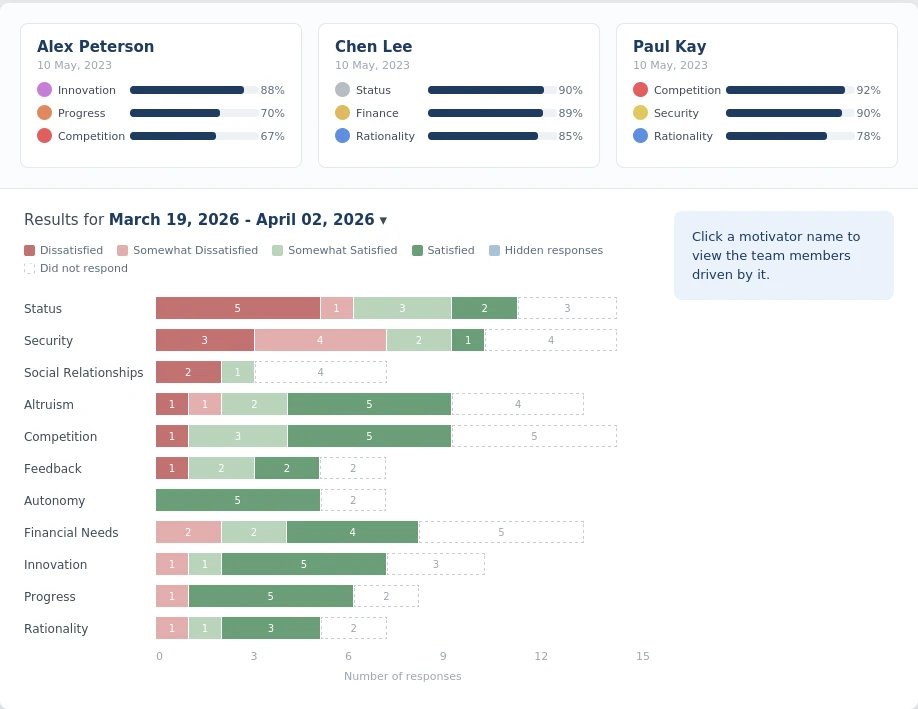
Team-level results only, once three people answer.
Every two weeks, each person rates how satisfied they are on their top motivators.
A red Status bar means the crew wants to be seen. A red Security bar means they want news early.
It flags a dip while a talk can still fix it, and works alongside your employee morale fixes for manufacturing.
Everyone ranks 11 intrinsic motivators in one 10-minute assessment.
Gallup found managers account for at least 70% of the variance in team engagement. On a line, that manager is the supervisor.
Dedicated employee recognition software sends points and badges. Attuned tells the supervisor whether an operator wants points at all.
“New hires have never had a company care about their individuality in this way before.”
Josh MoogDirector of HR, Barnett Plumbing & Water Heaters · Read the storySupervisors giving the thanks can start with these production supervisor skills.
Say what the person did, say it within a day, and say it where their shift will hear it.
Start with the 12 ideas above.
Start with ideas 1, 3 and 12. Name one person at each huddle, thank safety catches, and ask each person how they like to be thanked. All three cost nothing and take a week.
Use the huddle and a board by the time clock, and read shout-outs at shift change.
For nights, go to them, at 2 a.m. if that’s when they work.
Give every shift the same board, the same huddle slot and the same budget. Rotate first pick weekly.
Once a month, check who has been named and look for anyone left out.
It depends on the person. Someone high in Status or Competition usually wants it said in front of the crew.
Someone high in Security or Rationality often prefers a quiet word with the reason spelled out. Ask first.
Often enough that each person hears something specific about their own work every week or two.
Recognition that only comes at the annual awards dinner is too far from the work to change anything.
Track three numbers per crew. How many people were named in the last 30 days? How many near misses were reported? How many people quit in their first 90 days?
If more people get named, near-miss reports rise and early quits fall, it’s working.
It helps. Gallup found that people who don’t feel adequately recognized are twice as likely to say they’ll quit in the next year.
Pay and schedules matter more. Recognition keeps the people who would otherwise drift.
Each person takes a 10-minute assessment that ranks 11 intrinsic motivators.
The supervisor then knows whether an operator wants public thanks, a harder job, a say in the schedule or the numbers.
Every two weeks, a two-minute pulse shows which motivators the crew feels short on.
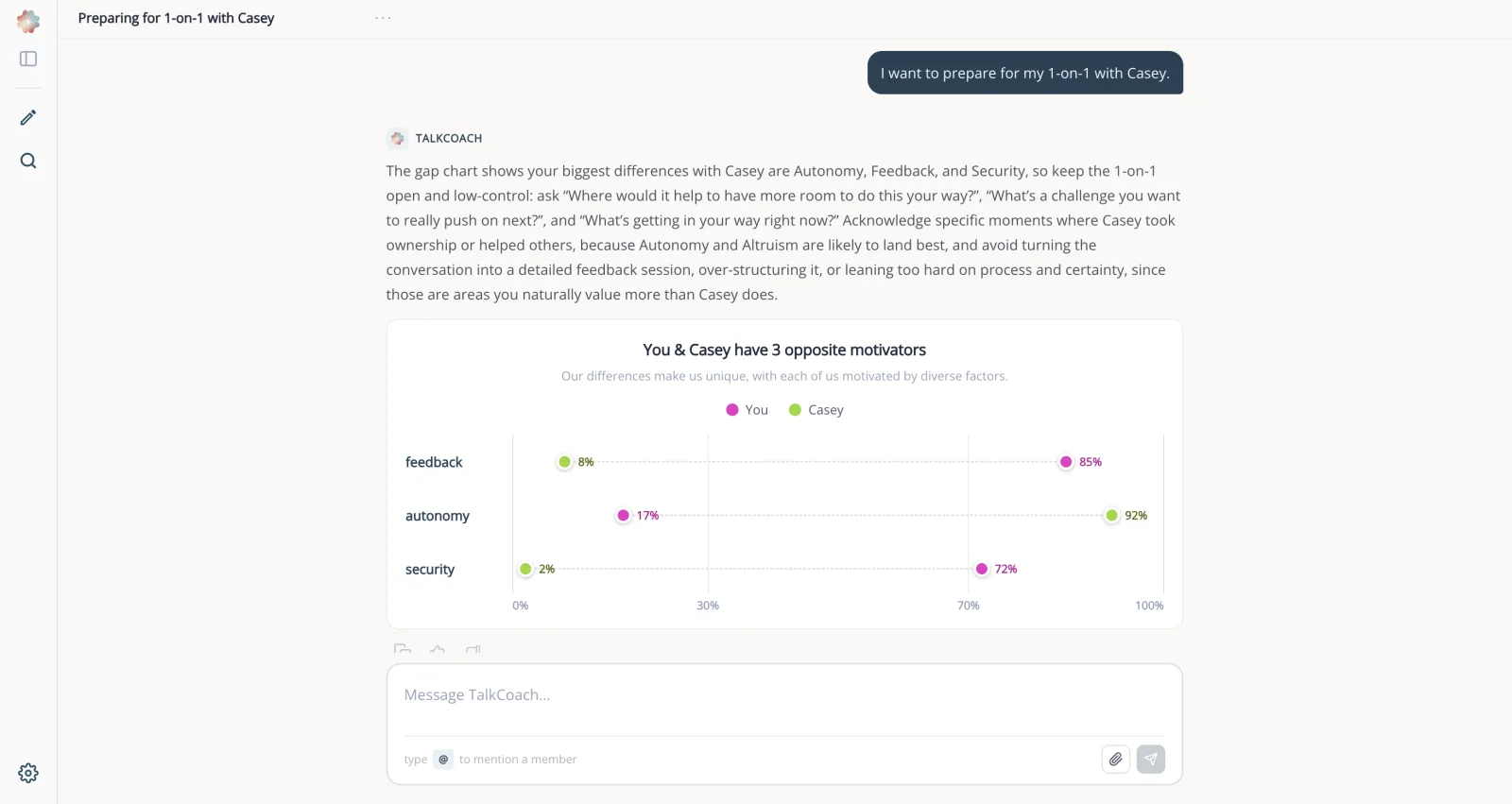
TalkCoach (early access) helps plan the conversation. Team plans start at US$99 per person per year.
No, and we never will. A lot of B2B startups do.
The big AI labs want as much user and customer data as they can get to train their models, and they’re hoovering up whatever startups will hand them.
Too many startups, especially in the US, have made this normal by burying a clause in their terms of service that lets them sell your data on. We think that’s wrong.
We don’t sell your data, we don’t license it, and we don’t play that game at all.
Bring one crew’s roster. We’ll map each person’s motivators and show you who wants which kind of thanks.
Book A Demo