Your plant measures every machine to two decimal places and asks its people how they are doing once a year, by email, on an account most of them never open. Attuned maps what drives each person on the floor and hands it to the supervisor who runs their shift, so engagement becomes something a shift lead can act on this week.
Definition
Employee engagement in manufacturing is the degree to which production workers, maintenance technicians, shift leads, and plant staff are committed to their work and willing to put discretionary effort into it. It differs from engagement in an office because most of the workforce is deskless, works in shifts, and often has no company email address, so the usual engagement tooling never reaches the people it is meant to measure.
Engagement in a plant shows up in concrete places long before it shows up in a survey: scrap and rework rates, whether near-misses get reported or swept up, unplanned absence on a Monday, who volunteers for overtime, and how many new hires are still there after ninety days. Because every one of those outcomes is produced by an individual making a small decision, engagement work in manufacturing succeeds or fails on whether frontline supervisors understand what each person on their shift actually cares about.
Every industry loses money to disengagement. Manufacturing loses something scarcer, because the person who walks out may not have a replacement waiting in the labor market at all. That changes the arithmetic on retention, and it changes how much a supervisor's read on their own team is worth.
Engagement programs in manufacturing usually fail in the gap between the people who buy them and the people who would have to use them. Here is how that looks from the two chairs that feel it most.
You run three shifts and you know your equipment intimately. Your people data is a headcount number and an exit interview nobody reads. New hires leave inside three months, always for reasons that sound plausible and never quite explain the pattern, and the agency fees to replace them are now a line item you have to defend.
You run the annual engagement survey and the results describe the front office in detail and the plant floor barely at all. The people who make the product are the people you know least about. You have budget for an engagement initiative and no way to aim it, so it becomes a barbecue, a noticeboard, and a set of numbers that will not move.
Most engagement advice for manufacturing is a list of programs: recognition schemes, town halls, development pathways. Those help, and they also assume you already know what any given person on your floor wants. These seven start from the opposite end, with the individual, because that is where engagement on a shop floor is won or lost.
Two operators can run the same cell on the same shift and want completely different things from it. One is driven by mastery of the machine and wants harder setups. One is driven by security and wants a predictable schedule they can plan childcare around. One wants the social side and would take a pay freeze over losing their crew. Handed the same "engagement initiative," at most one of them is served.
Measuring intrinsic motivation individually is what makes everything downstream aimable. Attuned maps each person across 11 motivators, which produces roughly 1.7 million possible combinations, and that number is the point: the odds that a single blanket program fits your floor aren't good.
The single most common reason plant engagement data is bad is that it was collected through a channel the workforce does not use. If your instrument needs a laptop, a corporate SSO login, and twenty uninterrupted minutes, you have built a survey of your office staff and labeled it a survey of your plant.
Anything aimed at the frontline has to survive contact with the actual job: a phone, a shared terminal, or a kiosk near the clock-in point, in a window short enough to fit in a handover. Attuned's assessment is slider-based and takes about ten minutes, which is short enough to run during induction.
Gallup's finding on manager influence lands hard in manufacturing, where that manager was usually the best technician on the line and got promoted for it. They know the equipment inside out. Nobody ever taught them how to run a difficult conversation with someone they've worked beside for six years.
Training helps, and training that arrives with data about the specific humans on their shift helps considerably more. That is the difference between a workshop on active listening and knowing that the quiet one on nights is driven by autonomy and reads close supervision as distrust.
Task-fit is the most direct lever a plant has, and it is nearly free. The person energized by variety should be the one you cross-train across cells. The person driven by security should get the steady schedule instead of being volunteered for every cover shift because they never say no. The person driven by status should be the one you send to the customer audit.
None of that costs money. It costs knowing who is who, which is precisely the thing most plants can't see.
Recognition is the most-recommended engagement lever in manufacturing and the most frequently wasted, because it is usually delivered as a blanket. Naming someone in front of the whole shift is a genuine reward for a person driven by status and a small punishment for someone driven by security who would rather be told quietly.
The same gesture, aimed correctly, is worth several times more than the same gesture broadcast evenly. Knowing which of your people wants which is the entire trick.
On a production floor, psychological safety has a direct operational readout. In a plant where people feel safe speaking up, a near-miss becomes a report. In a plant where they do not, it becomes a rumor, and eventually an incident with a cost attached to it.
The same silence that hides a safety issue hides a person who is about to resign. Our work on psychological safety and turnover covers why people hold back and what changes when they stop.
An annual survey tells you what your plant felt like on one Tuesday, several months ago, filtered through whoever happened to respond. Disengagement does not work on that schedule. It builds over weeks, in one person at a time, and the useful window for a supervisor to do something about it opens and closes long before the next survey cycle.
Track motivation and satisfaction continuously and engagement stops being an annual scorecard. It becomes an operating signal, and plants already know what to do with a signal.
The standard engagement survey was designed for a salaried, desk-based workforce that shares a working day and an inbox. Point it at a plant running three shifts across four generations and it fails in four specific ways, each of which is structural rather than a matter of trying harder next year.
| The difference | Annual engagement survey | Attuned |
|---|---|---|
| How it reaches people | Email link, corporate login | Phone, shared terminal, or kiosk |
| Time required | 20 to 40 questions, off the line | About 10 minutes, once |
| What it reports | One aggregate score per site | A motivator profile per person |
| Who can act on it | HR, at site level, months later | The shift supervisor, this week |
| What you learn | The site scored 6.8 out of 10 | Who is drifting, why, and what to change |
Production staff often have no company inbox and no reason to open one. A survey delivered by email systematically over-samples the office and calls the result a site score.
Day, back, and night shifts can have genuinely different cultures under one roof. A single site number blends a healthy day shift with a struggling night shift and reports something true of neither.
A thirty-year machinist and a first-job apprentice are both on your floor. Our research on generational difference found the real variation sits between individuals rather than between age brackets, which is exactly why the average fails.
Someone decides to leave over about six weeks. A survey that runs once a year confirms it long after the moment when a supervisor could have changed the outcome for the cost of one conversation.
There is a slightly awkward asymmetry in most plants. Overall Equipment Effectiveness gets broken into availability, performance, and quality, tracked per asset, per shift, and reviewed in the morning meeting. The humans operating those assets get one number a year for the entire site, and it arrives in a slide deck. A plant that can hear a bearing starting to fail six weeks out has no equivalent instrument for the setter who has stopped caring. Nobody sells an accelerometer for that, and the second failure costs more.
Every plant knows the economics of running an asset to failure and has organized itself to avoid it: scheduled maintenance, condition monitoring, a stores cupboard full of spares for parts that have not broken yet. Then the same organization runs its people to failure as standard practice, discovers the problem at the exit interview, and books the replacement cost as an unavoidable feature of the labor market.
Attuned People Science TeamDisengagement is a persistent gap between what a person values and what their job currently gives them. A mastery-driven technician kept on repetitive work, a security-driven operator whose schedule changes every two weeks, an altruism-driven line lead whose team keeps getting broken up: each is under a strain no productivity report will show, and each is on a path that ends in a resignation nobody saw coming.
Attuned makes that gap visible per person and turns it into guidance the supervisor can use in a five-minute conversation at handover. Most of that conversation is ordinary 1-on-1 coaching, right up until the point where it isn't, which is why the same profile also drives our guidance on giving difficult feedback.
Over a year, the compounding effect of those conversations is what shows up as employee retention: fewer people reaching the point of deciding to leave, in the roles you can least afford to backfill.
Condition monitoring caught on in manufacturing because catching most failures early beat diagnosing all of them perfectly afterwards. The same trade holds for people, and the reading is considerably cheaper.
High Mastery and Autonomy mean Dave is fed by getting better at something difficult and owning how it is done. A long run of repetition reads to him as going stale, which is how a nine-year setter starts taking recruiter calls without ever raising a complaint.
Here is how a plant goes from one engagement number a year to every supervisor knowing what drives each person on their shift, without adding an IT project or taking anyone off the line for long.
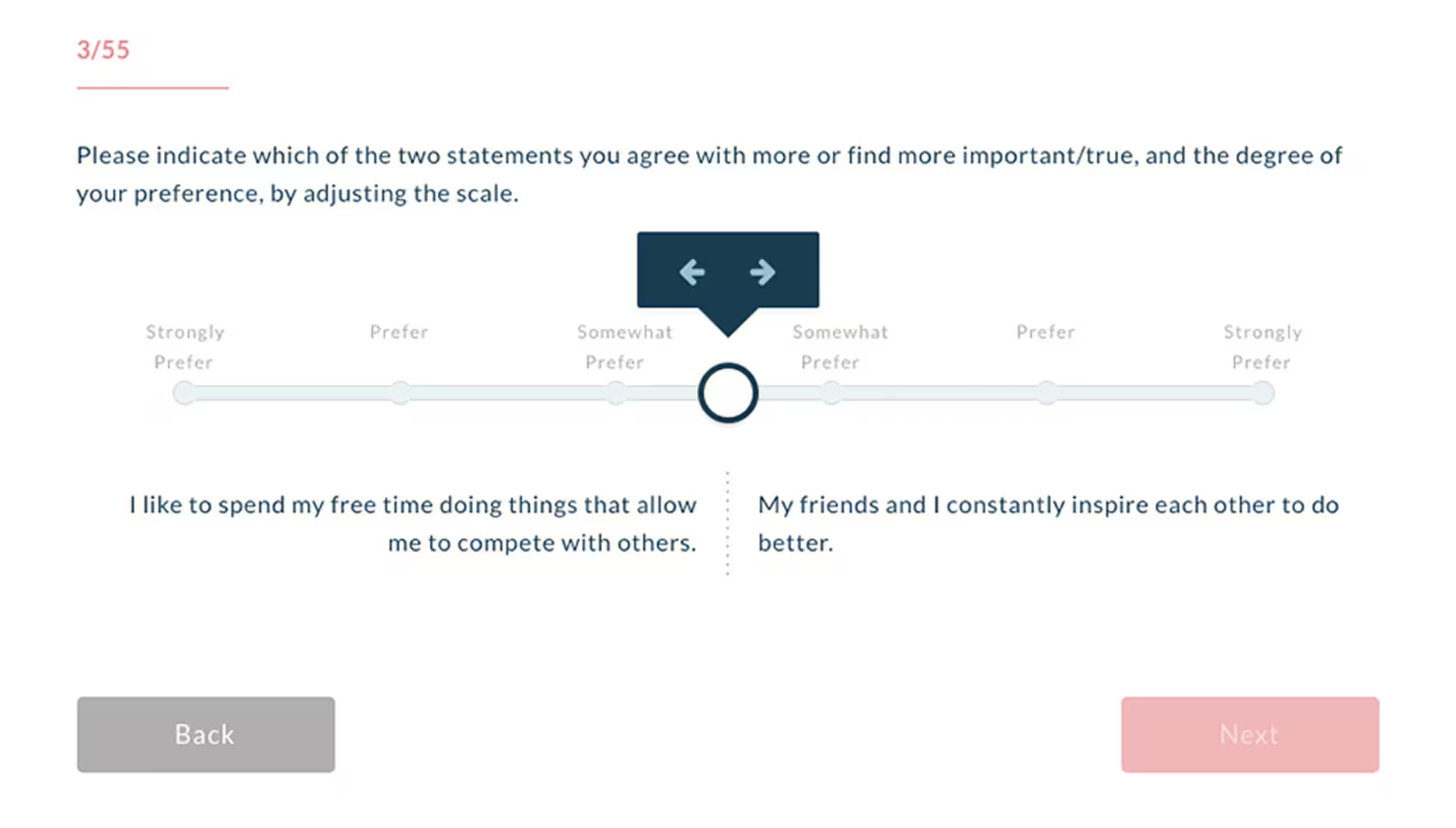
No rollout program and no integration work. Each person answers a set of slider-based questions on a phone, a shared terminal, or a kiosk, and Attuned calculates their profile across 11 intrinsic motivators. It fits inside an induction or a shift handover, and most sites are running within a week.
Slider-based questions, ~10 min
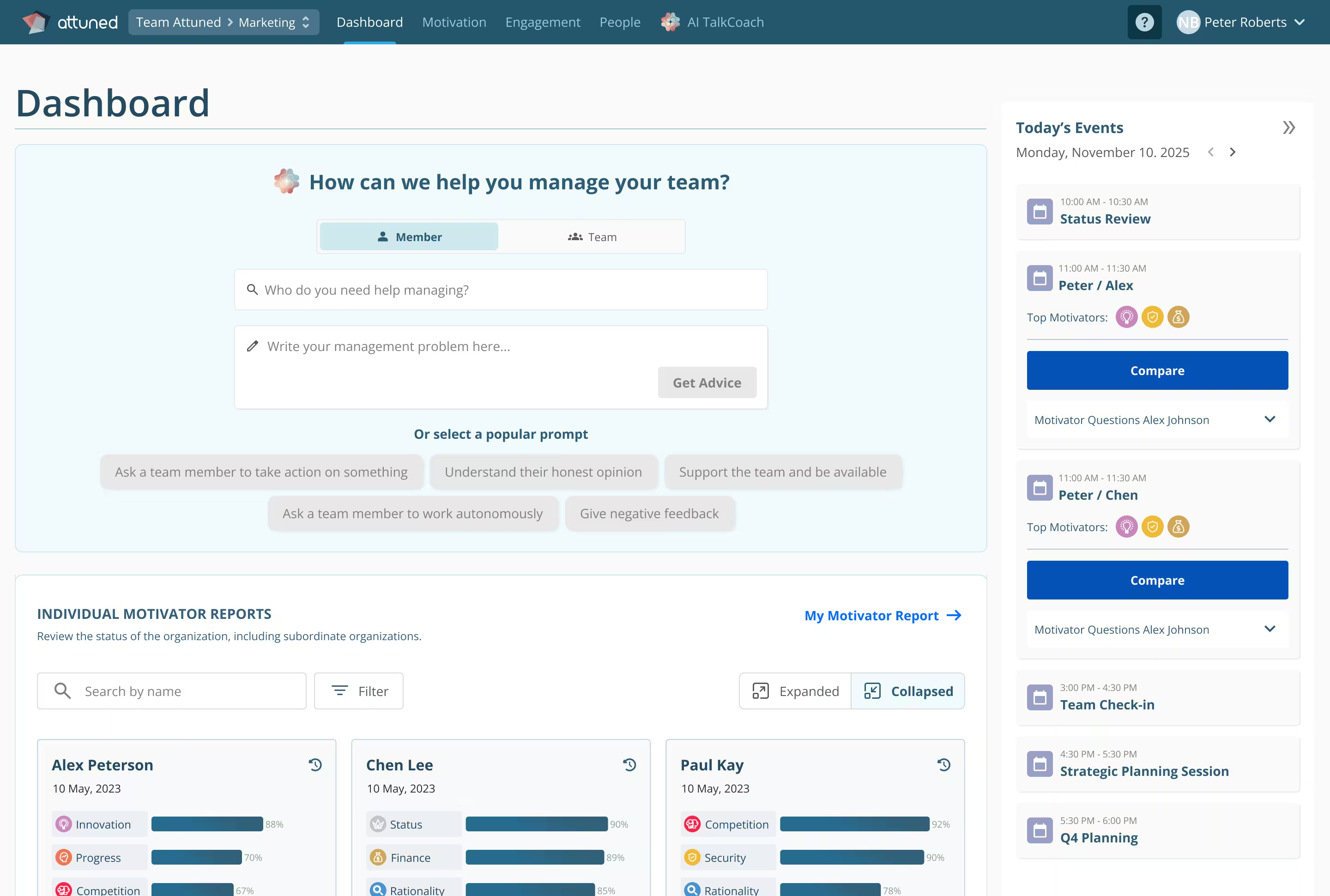
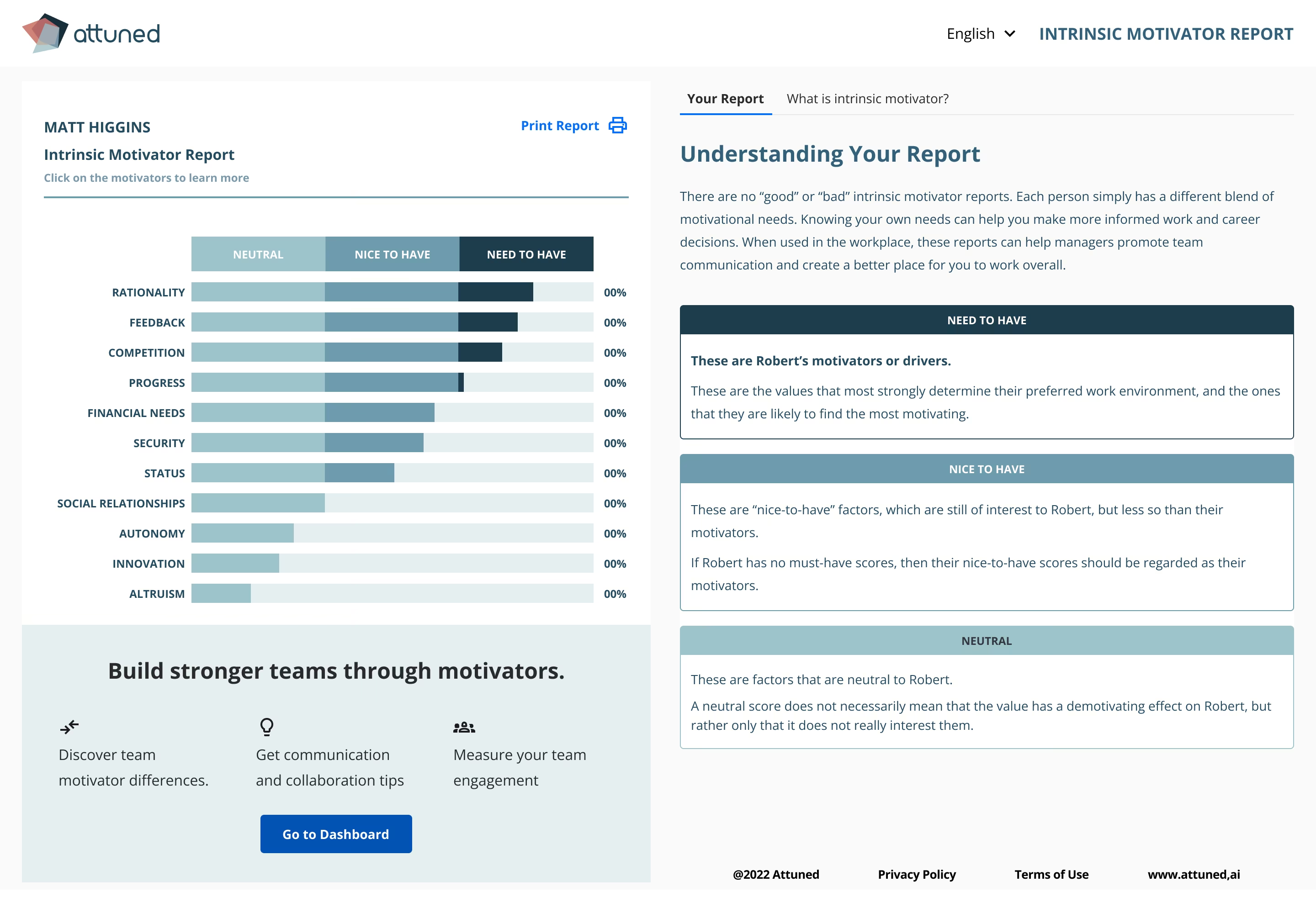
Every person gets a profile across 11 motivators, visible to them and to their supervisor. You can finally see whether someone leads with mastery, autonomy, security or altruism, which is what determines whether a given shift pattern and workload energize them or wear them down.
Attuned highlights the motivational gaps between a supervisor and their team, and between teammates, so you can hand the complex setup to the person fed by it, cross-train the one who wants variety, and stop quietly loading every cover shift onto the person driven by security.
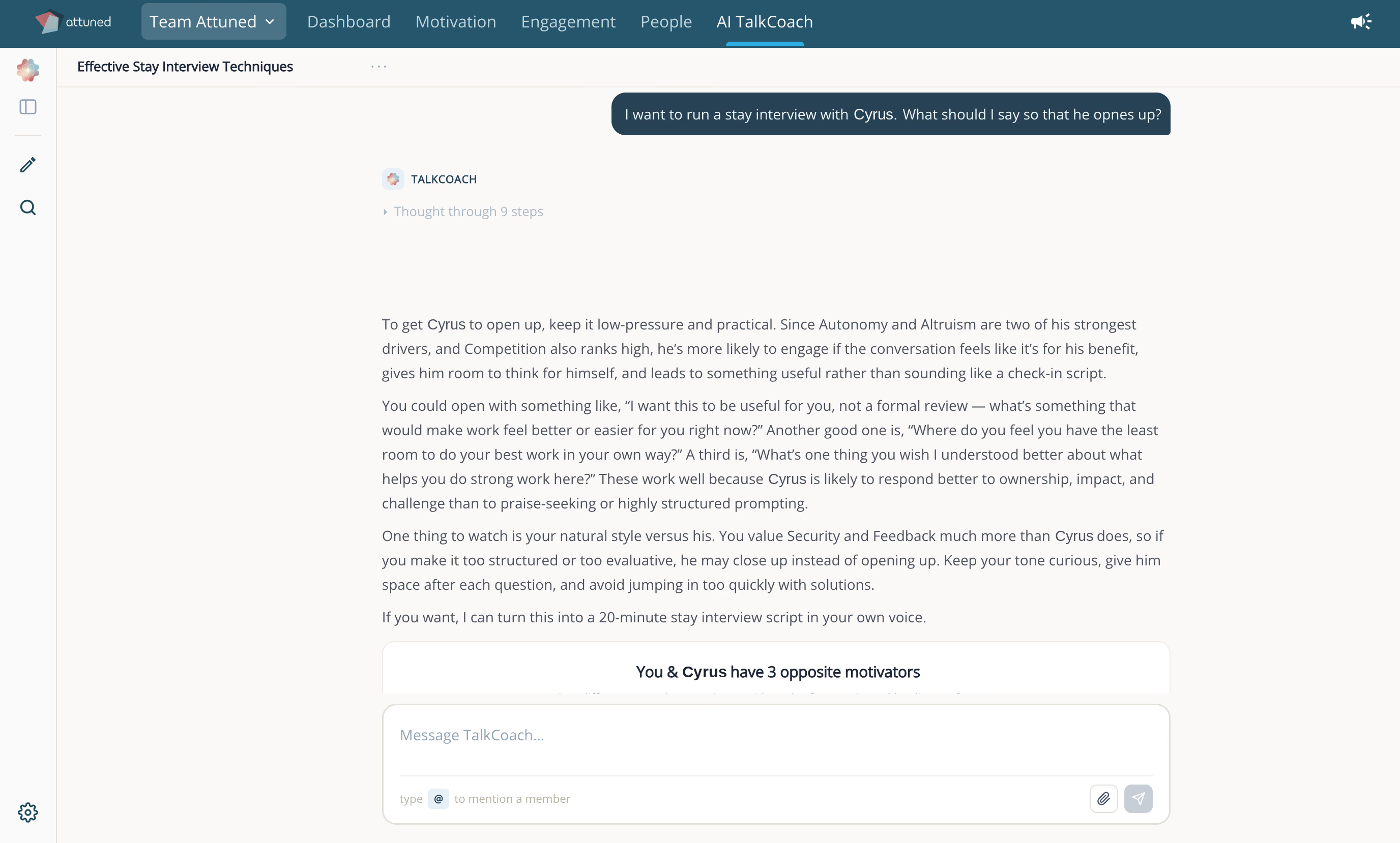
The AI TalkCoach turns each profile into what to ask and how to frame it, so a supervisor promoted off the line can run a five-minute check-in that lands. It also supports the difficult conversations, which is where technically excellent supervisors most often come unstuck.
When a supervisor understands what drives someone, the conversation moves from performance policing toward genuine support. On a plant floor that pays back twice: people tell you they are struggling, and they tell you about the near-miss.
Attuned tracks motivation and satisfaction over time and flags the widening gap between what someone values and what their role delivers. In a labor market where the replacement may not exist, seeing that two months early is worth considerably more than an accurate exit interview.
In most industries, keeping someone saves you a recruitment cost. In manufacturing it often saves you a vacancy you cannot fill at all, plus the overtime, the agency cover, and the line you cannot run at full rate while a replacement gets trained. That is why a modest improvement in engagement pays back faster here than the generic business case suggests.
Attuned is grounded in more than 10,000 assessments across four generations of the workforce. We don't have a published plant case study yet, so rather than dress one up, here is a real customer from professional services. The mechanism is the one described on this page: read motivation at the individual level, hand it to the person who manages them, act before the resignation.
Azon Recruitment Group, a firm that scaled from a handful of people to multiple specialist teams.
Azon hit the problem any plant manager will recognize: once there are too many people to read the mood of the room, you stop knowing who is genuinely doing well. Their read on how people were doing relied on instinct, until a resignation proved the instinct wrong. Attuned gave managers a shared, individual view of what each person valued, so the drift that leads to departures could be caught while there was still time.
"Being able to get to the nub of people's underlying motivations at the start of a process and see what really drives and motivates people in the workplace has been very helpful, and we've seen a dramatic increase in the numbers of people we hire that we feel we've gotten right." Kevin Halligan, Associate Director, Azon
"Since beginning to use the software, we have really seen that benefit translating to earnings for our business." Kevin Halligan, Azon
"I would recommend Attuned to any company that is fast-growing, wants to make the right decisions from the outset, wants to make sure that they have a harmonious work environment, and are bringing in the best talent into the organization. As well as the most important piece: retaining and developing their existing employee base." Ronan Colleran, CEO, Azon Recruitment Group
Practical writing from the Attuned team, starting with the State of Motivation Report, plus pieces on generational difference, workload, turnover, and the supervisor conversations that decide whether someone stays.
What actually drives people at work right now, drawn from more than 10,000 assessments across four generations. The data behind everything on this page.
Read the report Blog · GenerationsUseful if your floor spans a thirty-year machinist and a first-job apprentice. The real variation sits between individuals.
Read the post Blog · RetentionThe signals that precede a resignation and what a manager can do in the weeks when it is still reversible.
Read the post Blog · WorkloadPractical workload balancing, which in a plant is the difference between a schedule that fits people and one that quietly grinds them down.
Read the post Blog · Psychological SafetyWhy people hold back when something is wrong, and what changes on a floor when speaking up stops feeling risky.
Read the post Solution · RetentionHow making motivation visible turns into fewer regretted departures in the roles that are hardest to backfill.
See the solutionPlenty of tools will give you a site score. What is genuinely difficult is getting a usable read on the deskless majority and putting it in the hands of the supervisor who runs their shift. That is the part Attuned is built for.
A ~10-minute assessment on a phone, terminal, or kiosk. No IT project, no integration, no company email needed.
11 motivators mapped per person and tracked over time, so you see the individual and the shift rather than a site average.
The AI TalkCoach preps the conversation, so a shift lead promoted off the line can run a check-in like a seasoned people manager.
Lawful basis, data minimization, individual access rights, and the right to be forgotten. Your people own their motivator data.
We have spent years studying what drives people at work, and helping the managers who lead them see the drift while there is still time to act. It fits into a handover rather than adding another program to the plan.
Our expertise is people science: what motivates each person, why the same shift pattern suits one operator and grinds down another, and what a supervisor needs to see to keep someone who would otherwise quietly leave. We would like to bring it to your plant.