 September 9, 2020
 By Anju Kajihara
 Share The Article



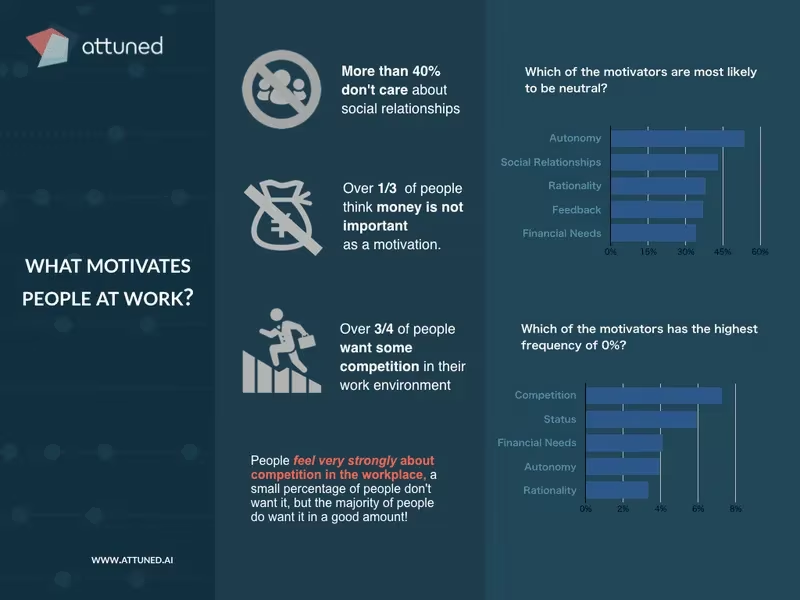
Infographic: What motivates people at work?


This historical infographic summarizes motivational profiles from thousands of Attuned respondents analyzed in 2020. The results describe that sample, rather than all employees. The interpretation below has been updated to clarify what a low or neutral motivator score can tell a manager.
Infographic: What motivates people at work?
Attuned describes workplace motivation through 11 intrinsic motivators. People can place different importance on each, so a useful management conversation starts with the individual’s needs rather than a single incentive assumed to suit everyone.
You can read more about the differences between intrinsic and extrinsic motivation here.
We wanted to find out what motivates people at work and so we analyzed the motivational data of thousands of Attuned survey respondents to answer two questions:
“Which of the motivators are most likely to be neutral?”
“What of the 11 intrinsic motivators has the highest frequency of 0%?”
The data returned was not what I expected, and not what most people might expect to motivate their organizations. Let’s break down some of the results.
In this historical sample, the motivators most likely to be neutral were “Autonomy”, “Social Relationships”, “Rationality”, “Feedback” and “Financial Needs”. A neutral Autonomy score does not mean someone cannot work autonomously, nor that control over their work is irrelevant. It suggests Autonomy is a lower motivational priority in this assessment. Ask which decisions the person wants to own and what support they need.
Over 40% of respondents in this sample had neutral Social Relationships scores. This does not show that isolation has no negative effects, or identify who is best suited to remote work. Motivation, loneliness, collaboration and working conditions are different questions. Discuss contact preferences and access to help with each person; our remote team motivation guide offers a practical starting point.
More than one third of respondents in the sample had neutral Financial Needs scores. That does not mean pay is unimportant or that fair compensation can be ignored. It is a reason to ask what else matters to the person, rather than assuming a monetary incentive will address every unmet need.
For this question I wanted to see the extreme. How many people have a score of 0% for a certain motivator? Our motivational data showed that “Competition“, “Status“, “Financial Needs“, “Autonomy“ and “Rationality“ are the motivators most often to be 0%.
Competition had the highest frequency of 0% scores in this sample, at 7%. More than 75% of respondents placed it in the Nice-to-Have or Need-to-Have categories. These figures describe the historical sample, not a universal requirement for competitive work environments. Explore whether a person prefers a personal challenge, a shared team goal, or comparison with others before choosing an approach.
Read the infographic as a snapshot of the 2020 analysis. For newer research context, see The State of Motivation Report 2026; it is a separate report, not the source of the figures shown here. Use either resource to prompt questions about individual needs, rather than treating motivation, happiness and productivity as interchangeable outcomes.
Help us to make work more meaningful.

Practical checks for designing workplace incentives, with research examples and safeguards for quality, creativity and collaboration.
6 minutes read
Managing different generations can seem hard, but each one doesn’t need a wildly different management style to stay motivated. Here’s why.
7 minutes read
Are men and women motivated by different things? We compare their motivational needs at work using tens of thousands of Attuned Motivation Assessments.
6 minutes read
 Prev Article
