

Theory X and Theory Y in 3 Minutes: What Managers Assume About People

An employee waits for approval before replying to a routine customer request. Their manager thinks, “Why won't they take ownership?” But last month, the same manager rewrote every reply before it went out.
Is the employee avoiding responsibility, or following the rules they have learned? McGregor's Theory X and Theory Y give managers a way to examine that question.
The three-minute summary
Douglas McGregor developed Theory X and Theory Y in The Human Side of Enterprise, published in 1960. They describe contrasting assumptions behind management decisions. They are not two personality types to assign to employees. The publisher's introduction to the annotated edition places those assumptions at the center of the book.
| Question | Theory X assumes… | Theory Y assumes… |
|---|---|---|
| How do people approach work? | People tend to avoid work, so management must push them. | Work can be a normal, satisfying activity under suitable conditions. |
| Where does direction come from? | External control is necessary to get the required effort. | People can direct their own effort toward goals they are committed to. |
| What about responsibility? | People prefer being directed and avoiding responsibility. | People can learn to accept and seek responsibility when conditions support it. |
These are the framework's opposing assumptions, not findings about every worker. A useful question is: What am I assuming, and what in this situation supports that assumption?
Theory Y does not mean leaving people alone without standards or help. In his original essay, available through MIT, McGregor gives management responsibility for creating conditions, removing obstacles and providing guidance. He explicitly rejects abandoning leadership or lowering standards.
So the practical takeaway is to review how work is organized before deciding that someone “doesn't care.” Clear expectations, access to information and usable authority can be part of that review. Removing every check is not the test of whether you trust someone.
That is the short version. The sections below show how to try it on one task.
A customer-reply example
Consider a fictional support team. An experienced colleague drafts routine delivery updates, but every message needs the manager's approval. The manager is busy, customers wait, and the colleague stops proposing wording because it will be replaced anyway.
“They lack initiative” is one explanation. Another is that the approval process leaves little room to use it. Neither explanation should be treated as established without talking to the person and examining the work.
Instead of announcing “I trust you now,” the manager could ask: “Which delivery updates could you handle without waiting for me, and where would you still want a second opinion?”
Suppose they agree to try one change for a week. The colleague can send routine status updates using confirmed delivery information. They cannot promise a new delivery date, offer compensation or disclose information outside the existing policy. Uncertain cases still go to the manager. Existing company requirements remain in force; the manager first confirms that this change is within their authority.
The following agreement makes the trial specific. It is an original application of the framework, not an example from McGregor's book or a tested intervention.
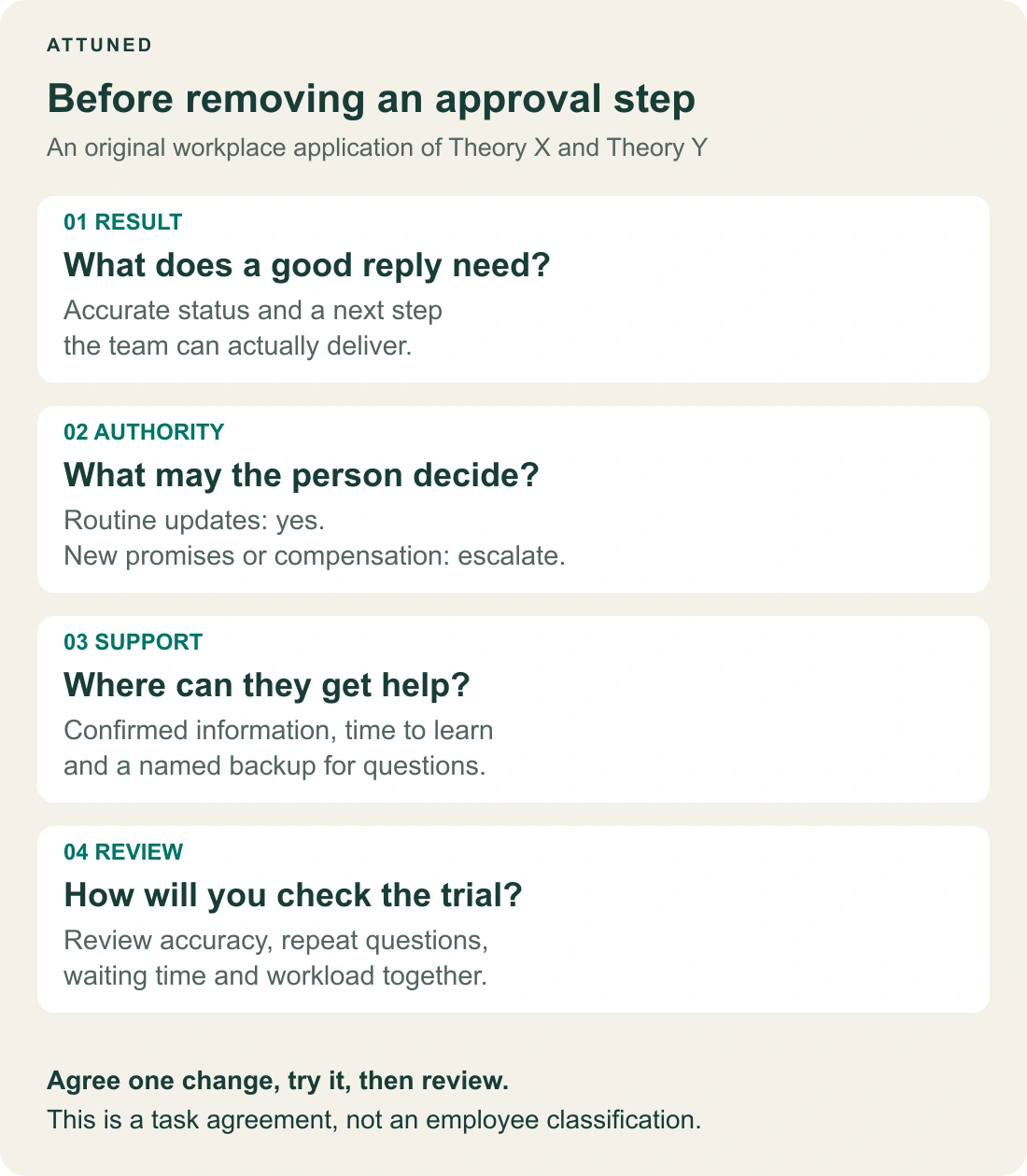
Original workplace application: agree what changes before removing an approval step.
Start with the result. A useful reply gives an accurate status and explains the next step the team can actually deliver. “Keep the customer happy” is too vague to guide a difficult decision. Ask the colleague what else a good reply needs.
Name the decisions. Write down which messages they may send and which promises need approval. A person cannot take responsibility for a decision they are still forbidden to make. If every routine update remains subject to sign-off, the task has not really been delegated.
Keep help reachable. Make the approved information easy to find. Agree who will answer an escalation if the manager is unavailable. If the colleague wants to review the first few messages together, include that support. Asking for help does not invalidate the trial.
Review the work together. At the end of the week, look at a small agreed sample of replies. Were they accurate? Did customers have to ask again because the next step was unclear? Did the colleague spend less time waiting, or more time searching for answers? Ask whether the arrangement felt manageable. A shorter approval queue alone would not establish better service or higher motivation.
Keep what helped and change what did not. If there was an error, find out whether the boundary, information, training or execution needs attention. “Trust failed” is too broad a conclusion to tell you what to fix.
Questions for your next 1on1
Use a recent task rather than asking whether someone is an “X person” or a “Y person.” For example:
- “Tell me about the last reply you had to wait to send. What were you unsure about?”
- “Which part could you decide yourself if the information and limits were clear?”
- “Where would you still want me to check your work?”
- “If we change this approval step, what time or support would you need?”
- “What should we look at next week to decide whether the change helped?”
The answer may be that more training is needed, or that the person already has more work than they can finish. Giving them another responsibility would not address either problem. The manager may also discover that they have been asking for initiative while correcting every harmless difference in approach.
What the framework cannot tell you
Theory X and Theory Y are a lens for examining managerial assumptions, not a diagnostic test or a guarantee that delegation improves results. They cannot tell you how skilled someone is at a particular task, whether a procedure is mandatory, or how much work is reasonable.
Nor does a preference for detailed instructions establish laziness. Someone may be learning a task, dealing with unclear expectations, or working where mistakes are costly. Keep necessary controls and explain their purpose. There is no need to infer a fixed view of human nature from every checklist or approval.
MIT's account of McGregor's work also records Edgar Schein's warning that McGregor was discouraged when Theory Y became another rigid doctrine. Replacing “nobody will work without pressure” with “everyone will flourish if I step away” misses the invitation to question assumptions.
A useful next step
Choose one task where work waits for your approval. Ask the person doing it what makes that wait necessary. You may find a check that protects quality, a missing skill to develop, or a decision that could be made closer to the work.
For more on individual preferences and delegation, read Embracing Autonomy Doesn't Mean Losing Control. Its discussion of autonomy is a separate perspective, not a measurement of Theory X or Theory Y.
If those conversations reveal that different people want different things from work, Attuned's Motivation Assessment offers a profile of 11 motivators to discuss. It does not classify employees as X or Y, determine their competence, or decide which approvals a manager should remove.