
The Fearless Organization Summary in 3 Minutes

The launch meeting is almost over when someone says, “There’s a customer task we haven’t tested.” You have a deadline, a room full of colleagues, and a choice about what to say next.
Amy C. Edmondson’s The Fearless Organization helps explain why that moment matters. This is a short guide to the book’s central argument, followed by an example you can adapt for your next meeting.
Start with the three-minute summary, or jump to the launch meeting example and a small exercise for this week.
The three-minute summary
The book examines how fear of other people’s reactions can stop useful information reaching a team. Its central subject is psychological safety: people’s belief that they can raise questions, concerns, mistakes, and different views without being humiliated or punished for speaking up. Edmondson explains psychological safety
| Idea to remember | What it means for a team |
|---|---|
| Silence leaves information missing | A quiet meeting does not tell you whether everyone agrees. |
| Candor and standards belong together | People should be able to question a plan while remaining responsible for good work. |
| Leaders have work to do before and after inviting input | Explain the uncertainty, ask for contributions, and respond constructively when they arrive. |
Edmondson describes three leadership practices: set the stage, invite participation, and respond productively. The meeting example below applies that framework; its scripts are our own illustrations. Read Edmondson’s interview with Attuned
Psychological safety does not remove accountability. Edmondson treats them as separate dimensions that need to work together. A team can welcome a difficult question and still require evidence, decisions, and follow-through. Edmondson on safety and accountability
Before the meeting, name what you do not know
Return to that launch. The release date is agreed, but the team has not tested how a new customer will complete one important task. If the agenda simply says “final approval,” a colleague may wonder whether it is too late to raise a problem.
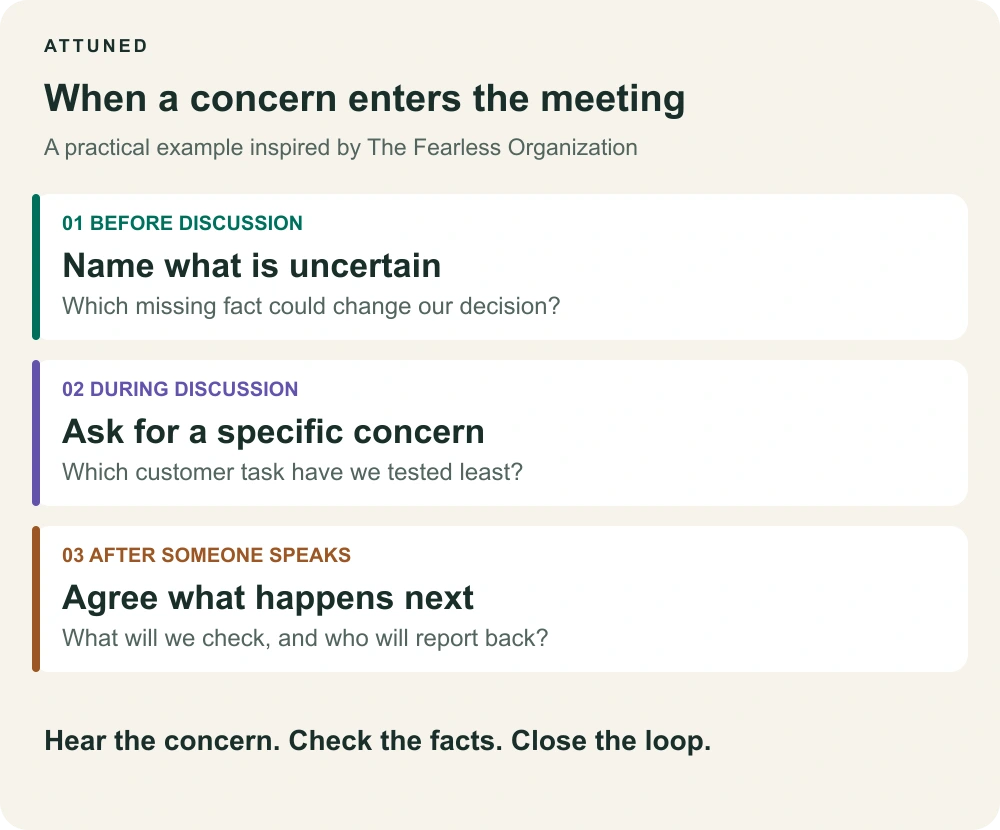
You can make the purpose clearer at the start: “We need to decide whether we are ready to release. We still have gaps in what we know about first-time customers. I want to hear about anything that could change today’s decision.”
That does not promise that the date will move. It tells the team which information belongs in the conversation. Name the constraints too: who makes the final decision, which requirements cannot be waived, and how much time is available to investigate.
Ask a question someone can actually answer
“Any thoughts?” gives the room very little to work with. Try a question tied to the decision: “Which customer task have we tested least?” or “What would make you uncomfortable approving this release?”
Give people a moment to think before answering your own question. For a meeting where some colleagues need time to prepare, ask for written concerns beforehand as well. Make clear who will read them and when they will receive a response.
In your next one-on-one, you might ask: “Was there anything you wanted to raise in the meeting but decided to leave out?” Listen before explaining why the plan was reasonable. The answer may concern the plan, your meeting format, or something you had not considered.
What to say when someone raises a concern
Now the colleague says, “There’s a customer task we haven’t tested.”
An impatient “Why didn’t you mention this earlier?” shifts attention to their timing before you understand the issue. You can examine the timing later. Start by finding out what the team needs to know:
“Thanks for raising it. Which customer task is affected, and what have we observed so far?”
Then separate the concern from the release decision. “Let’s spend twenty minutes checking that path. Maya will bring back the result, and we’ll decide whether to fix it, limit the release, or proceed with a documented risk.”
You have acknowledged the contribution without agreeing that every concern requires a delay. If the evidence does not support the concern, explain what you checked and why the decision stands. If it changes the decision, tell the team what changed. Either way, close the loop with the person who raised it.
These scripts illustrate a way to handle a meeting. They are not book quotations or a guarantee that one good response will change a team’s culture.
Keep the work standards clear
Suppose the concern reveals that a required check was skipped. Thanking someone for telling you does not settle what happened. Establish the facts, address the missed requirement, and agree what needs to change. You can do that without ridicule or public blame.
People also need a way to raise issues outside a group meeting. A one-on-one can help you understand an individual’s experience, but it cannot establish how safe the whole team feels. Do not promise confidentiality you cannot provide, especially when a concern needs a formal response.
Try this at your next team meeting
Choose one real decision. Before discussion, write down what is still uncertain. Ask everyone for one concern or missing piece of information, with a chance to contribute in writing.
Afterward, record what was raised, what you decided, and who will follow up. At the next meeting, report back. Ask the team whether the process made it easier to contribute and what they would change. Review whether each concern received a response and whether the person heard the outcome, rather than just counting who spoke.
Keep learning about your team
For a more structured conversation, explore Attuned’s Psychological Safety Workbook. The accompanying interview with Edmondson also discusses how psychological safety and intrinsic motivation relate.
Psychological safety and motivation are related, but they are different things. To explore what someone values in their work, see how Attuned’s motivation assessment works. A motivation profile cannot tell you how safe a team feels about speaking up.