

Maslow’s Hierarchy of Needs Explained in 3 Minutes
Imagine offering a capable colleague a stretch assignment. They turn it down. You were hoping the chance to grow would appeal to them, but you have not yet asked what taking it on would change about their week.
Maslow’s hierarchy gives you several places to look. Here is the short explanation, followed by workplace examples and questions you can use in a one-on-one.
Read the three-minute summary, see why the order has limits, or jump to the stretch-assignment example.
The three-minute summary
Abraham Maslow’s 1943 theory groups needs into five categories. He proposed that more pressing unmet needs generally take priority, allowing other needs to become more prominent as those pressures ease. Read the original paper.
| Need | Plain meaning |
|---|---|
| Physiological | Food, rest, bodily necessities |
| Safety | Security and stability |
| Love and belonging | Connection and acceptance |
| Esteem | Self-respect and recognition |
| Self-actualization | Developing one’s potential |
The five categories can help you ask a broader set of questions about work. They do not tell you why a particular colleague accepted a promotion, declined a project, or stopped contributing to meetings. You still need to ask.
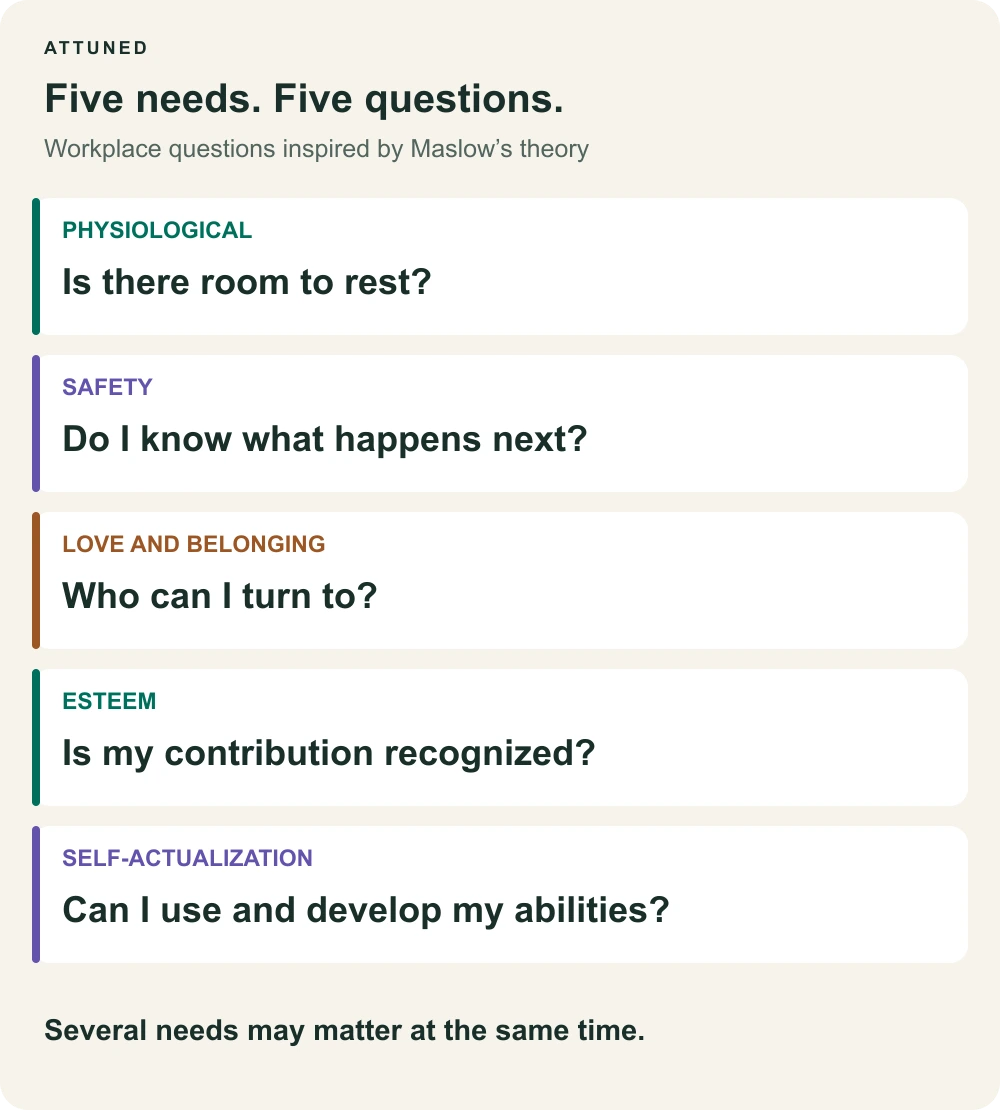
The diagram below turns each category into an original workplace question. Several questions may matter to the same person at once.
Why the order has limits
Maslow explicitly described exceptions to the order and rejected the idea that one need must be completely satisfied before another appears. See his discussion of flexibility and relative satisfaction.
Later research also gives reason to be careful with a strict ladder. Tay and Diener’s cross-national study found that the association between fulfilling particular needs and well-being was largely independent of whether other needs were fulfilled. This was observational research on well-being, not a trial proving that a particular management action improves performance. Read the study.
For a manager, that leaves room to address more than one issue. You can clarify a person’s workload while discussing what they want to learn. You do not have to decide that they have “completed” one category before they deserve attention in another.
Ask what the assignment would change
Return to the colleague who declined the project. Rather than deciding they lack ambition, try: “What would taking this on mean for your existing work? Is there anything about the assignment that makes it hard to say yes?”
Suppose they say, “I’d like to do it, but nobody has said which of my current deadlines would move.” That answer gives you a practical problem to work on. Agree which work will stop or move, who will make that decision, and when the arrangement will be reviewed.
Someone else might say the workload is manageable but they would be the only person who understands the subject. In that case, ask whether a named colleague could help them think through difficult decisions. A third person might want to know whether they will get to make decisions or simply coordinate other people’s work.
Those are different conversations. The point of using the model is to notice questions you have missed, rather than fit every answer into a category.
Turn the five needs into useful questions
Here are illustrative ways to explore each category. These are applications for a conversation, not items from a validated employee assessment.
| Area to explore | Question for a one-on-one | Possible follow-up |
|---|---|---|
| Rest and basic working conditions | “Does the way we schedule this work leave enough time for breaks and recovery?” | Review meeting load or shift coverage together. |
| Security and predictability | “What about the next few weeks is still unclear?” | Name what is known, what is undecided, and when an update is due. |
| Belonging and support | “Who can you turn to when you get stuck?” | Agree on someone who can help and time to work with them. |
| Recognition and respect | “Which contribution would you like more useful feedback on?” | Discuss a specific piece of work and how its impact is recognized. |
| Using and developing abilities | “What would you like to do more of that this role does not currently allow?” | Try a bounded assignment and decide what work it replaces. |
Ask the person which question fits their situation. A lack of rest, unclear expectations, and an interesting challenge can all be part of the same conversation.
Keep the categories in perspective
Avoid writing “safety stage” or “esteem stage” beside an employee’s name. Instead, record what they actually said: “Needs clarity on which deadline moves before accepting the project.” That is something both of you can check later.
Maslow’s safety category is also broader than psychological safety at work. Psychological safety concerns whether people feel able to take interpersonal risks such as asking questions or raising concerns; it should not be treated as another name for the whole safety category. Edmondson explains psychological safety at work.
Make one agreement and follow up
At the end of your next one-on-one, choose one issue the person wants to address. Write down what will change, who will do it, and when you will discuss whether it helped. If you cannot change something, explain the constraint and agree what you can do next.
For more ideas, read five ways to cultivate intrinsic motivation on your team.
If you want to explore what each person values at work, Attuned’s motivation assessment offers its own framework of 11 workplace motivators. It is separate from Maslow’s five categories and does not assign employees a level in his hierarchy.