

Expectancy Theory in 3 Minutes: Why a Reward May Not Be Enough

A manager offers someone the chance to present a new dashboard to senior leaders. The colleague says, “Thanks, but I don't think I can take this on.” The manager wonders whether the opportunity needs a bigger reward.
Perhaps. But the colleague may not know how to build the dashboard, may doubt that the presentation will happen, or may have no interest in presenting. Those are different problems. Expectancy theory gives you a way to ask which one you are facing.
The three-minute summary
Expectancy theory looks at how people connect their effort with what they can achieve and what might follow. Victor Vroom developed his account of work motivation in Work and Motivation, first published in 1964. Its three concepts describe different judgments:
| Concept | Plain-language question | What you might hear |
|---|---|---|
| Expectancy | Can my effort produce the required performance? | “I don't know where the numbers come from.” |
| Instrumentality | Would that performance lead to the outcome being discussed? | “Last time, the promised presentation was cancelled.” |
| Valence | How attractive or unwelcome is that outcome to me? | “I'd rather learn the analysis than present it.” |
These are the person's perceptions, not just what the manager believes is possible. The definitions are discussed in Van Eerde and Thierry's research review.
You will often see the shorthand motivation = expectancy × instrumentality × valence. It appears, for example, in this research paper's explanation of the model. It is a simplified teaching expression, not a way to calculate an employee's motivation from three guesses. Vroom's fuller models allow multiple outcomes; an outcome can also be unwelcome rather than simply valuable or worthless.
For a manager, the immediate use is to ask about the task, the credibility of the proposed outcome and the person's preferences separately. A more attractive opportunity does not teach someone missing skills. More training does not make a promise credible. Neither makes public speaking desirable to someone who does not want it.
That is the short explanation. The rest applies it to a fictional workplace conversation.
- What the dashboard conversation could reveal
- Questions for your next 1on1
- What the model cannot settle
What the dashboard conversation could reveal
Imagine an operations colleague who has been asked to prepare a monthly staffing dashboard. Their manager calls it a chance to gain visibility at the planning meeting. The colleague has already said their normal workload is full.
Before treating this as a motivation problem, the manager needs to decide what existing work can move. If nothing can move, an enthusiastic explanation of career benefits does not create time. The following is an original illustrative application, not a case from Vroom's book or an intervention shown to produce a particular result.
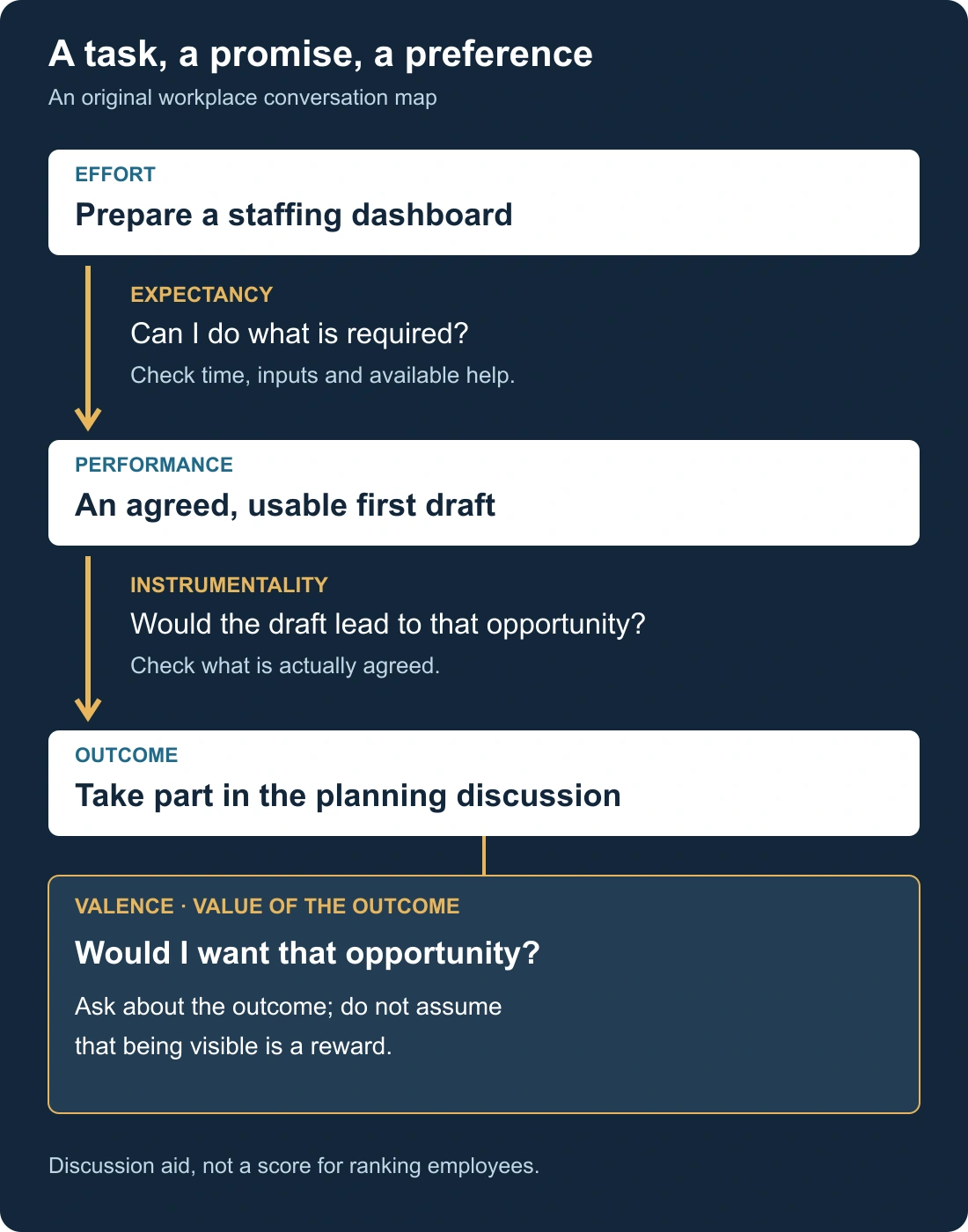
An original map of the dashboard conversation.
The manager could start with: “What would make this difficult to deliver alongside your current work?” Suppose the colleague explains that they can make charts but do not know which staffing figures are approved for the forecast. That is a concrete obstacle to completing the task, rather than evidence of a poor attitude.
They agree that the person responsible for the data will explain the inputs. The colleague will make a sample using last month's figures, and the manager will check whether the assumptions are clear before the dashboard is used. The manager confirms which existing task can be deferred with its owner. Provide the time, information and training needed for the task; that support should not depend on first proving they can already do it.
The promised presentation deserves a different conversation. Who decides the agenda? Has the meeting owner actually agreed to a slot? Is the invitation conditional on a result that has been defined? If the manager can only put forward a suggestion, they should say so. A calendar invitation is something the colleague can verify; “this will be good for your career” is not a commitment to a particular outcome.
Then ask whether that outcome is wanted. In this fictional example, the colleague wants to understand staffing decisions but is not looking for a public presentation. They might prefer attending the discussion with an experienced analyst, if that can be arranged. Or they might decline the extra assignment. The point of asking is to hear an answer, including one that changes the manager's plan.
For a small trial, agree what the first draft needs, where its preparation time will come from, who will answer questions and what opportunity is actually available. Any trial still needs to respect existing pay arrangements and agreed responsibilities.
After the first draft, review the work and the agreement together. Were the input figures available? Were the assumptions understandable? Did preparation fit within the agreed time? Did the promised discussion happen, and did the colleague find it useful? A finished dashboard alone would not establish that motivation increased or that the arrangement was fair.
Questions for your next 1on1
Choose a real assignment and explain why you are asking. You do not need to introduce the theory's terminology.
- “Which part of this task feels achievable, and where would you need help?”
- “What do you expect would happen if you delivered it well?”
- “What makes that outcome feel likely or unlikely?”
- “Would that outcome actually be useful to you? What would you prefer?”
- “What would have to move so this fits within your working time?”
Ask about previous experience if it is relevant, but do not argue someone out of an account of a broken promise. Find out what happened and what you can now commit to. If the outcome depends on someone else's decision, make that dependency clear.
Avoid turning the answers into a league table. Someone who declines a presentation is not necessarily less ambitious than someone who accepts it. You have learned something about one assignment and one possible outcome, at this point in time.
What the model cannot settle
Expectancy theory does not establish whether the workload is reasonable, a decision is equitable or an employee has the necessary competence. Those questions require their own evidence and conversation. Nor does it mean every action follows a deliberate calculation of rewards.
The 1996 meta-analysis found a more varied picture than a simple universal formula suggests, including differences in how the concepts were measured. That is a reason to be cautious about using a few conversation answers as a prediction of performance. This article's map is a discussion aid, not a validated assessment.
The framework is also different from a list of needs or an account of intrinsic motivation. It concerns expectations and the value attached to possible outcomes. An outcome might involve learning or doing useful work, not only money. None of that excuses unreliable promises or makes a manager the sole judge of what another person should value.
A useful next step
Return to one opportunity you have offered recently. Write down what the work requires, what outcome you can genuinely arrange and what the person has said they want. Leave blanks where you do not know. Those blanks are the next conversation, rather than a reason to increase the incentive immediately.
For more on connecting goals with something personally meaningful, read How to Build Trust and Credibility as a New Leader, Part 2.
If you want a broader discussion of individual work preferences, Attuned's Motivation Assessment provides a profile of 11 motivators. It is a separate framework; it does not measure expectancy, instrumentality or valence, verify someone's ability, or tell you which reward to offer.