
Daniel Pink’s Drive Summary in 3 Minutes
Why does someone spend an evening learning a difficult skill, yet struggle to get started on work they are paid to do?
Daniel Pink’s Drive: The Surprising Truth About What Motivates Us offers a useful starting point: look at what makes the activity worth doing. Here is a quick summary, followed by practical ways to use the idea in your next one-on-one.
Start with the three-minute summary. For ideas to try at work, continue to autonomy, mastery, and purpose, then choose one small change.
The three-minute summary
Pink argues that rewards and punishments can be a poor fit for complex, creative work. His framework emphasizes three elements: autonomy, having a say in your work; mastery, improving at something that matters; and purpose, contributing to something beyond yourself. Together, they help explain why the experience of work matters alongside its rewards. Daniel Pink’s overview of Drive
The book describes motivation through three “operating systems”: survival, external rewards and punishments, and motivation arising from within. These are Pink’s explanatory categories, rather than a test that sorts employees into fixed types. The author’s overview
For a manager, the useful question is: What could we change about this person’s work so they have more reason to engage with it?
Here is a quick way to remember the three elements, with examples of how a manager might apply them:
| Element | What it means | Example at work |
|---|---|---|
| Autonomy | Having a say in how you work | Choose how to present a proposal within an agreed brief. |
| Mastery | Getting better at something important to you | Practice explaining a technical idea to a customer. |
| Purpose | Making a contribution | See how a report helps Support find recurring faults. |
Pay still matters, and the kind of task matters too. The rest of this article shows how to use the framework without treating it as a reason to remove rewards or leave people unsupported.
Give people room to decide
Imagine a capable colleague waiting for approval on every customer presentation. Before treating that as a lack of initiative, ask whether they know which decisions they can make without checking with you.
Try agreeing on the outcome, deadline, and constraints, then let them choose the approach. For example: “We need the proposal ready by Thursday and the pricing approved by Finance. Which parts would you like to own, and where would a check-in help?”
Write down which decisions they can make, which require consultation, and which you retain. That gives both of you a practical agreement to return to when something changes.
Ask in your next one-on-one: “Which decision are you waiting on me for that you could make yourself?”
Make progress visible
Suppose a colleague wants to become better at explaining technical ideas. A target such as “deliver five presentations” tracks activity, but it does not tell you what they are learning.
Choose one skill to practice: opening with the customer’s problem, explaining an unfamiliar term, or answering a difficult question. Ask them to compare two attempts and identify what changed. Offer specific feedback, then agree on the next opportunity to practice.
For example: “Your opening made the problem clear this time. In the next presentation, let’s work on explaining the trade-off without using technical shorthand.”
Ask in your next one-on-one: “What can you do now that felt difficult a month ago?”
Show who the work helps
Purpose need not mean changing the world. In his interview with Attuned, Pink distinguishes a wider contribution from everyday acts such as helping a teammate or solving a customer’s problem. Read the interview
Consider a weekly report that feels like administration. Ask who uses it and which decision it supports. If the team cannot name either, investigate whether the report is still necessary. If it helps a customer service team spot repeated problems, explain that connection and bring back examples of how the information was used.
A useful explanation of purpose is concrete enough to question. “This helps the business” gives a colleague less to work with than “These entries help Support find the faults customers keep encountering.”
Ask in your next one-on-one: “Who benefits from this work, and do you get to see that benefit?”
Three misunderstandings to avoid
Money still matters. Pink explicitly rejects the idea that compensation is unimportant. His argument is about how pay and incentives work, not permission to replace fair pay with an inspiring mission. Pink’s clarification on compensation
Autonomy needs an agreement. In the presentation example, the deadline, pricing checks, and responsibility remain clear. Giving someone more choice should come with the information and support needed to use it.
Meaningful work is not always enjoyable. Someone might find a report dull but still care about helping a teammate use it. Academic self-determination theory distinguishes enjoyment of an activity from personally valuing its outcome. Both can be self-directed reasons for working.
That theory identifies three basic psychological needs: autonomy, competence, and relatedness. This is a different set from Pink’s autonomy, mastery, and purpose. Deci, Olafsen, and Ryan’s workplace review
Try one small change this week
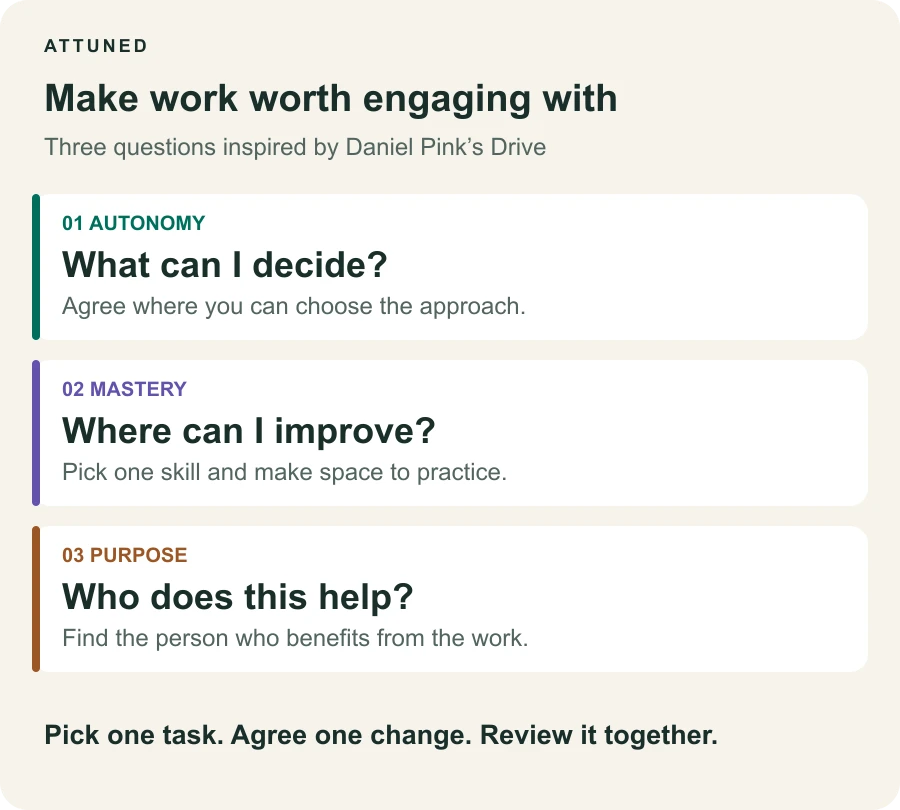
Choose one recurring task and discuss these questions with the person doing it:
| Question | Change to consider |
|---|---|
| What can you decide? | Hand over one decision within agreed boundaries. |
| Where would you like to improve? | Choose a skill to practice and a time to discuss how it went. |
| Who does this help? | Show how someone uses the work, or reconsider whether it is needed. |
Choose one change together. At the next check-in, ask what helped, what made the work harder, and what you should adjust. Treat the conversation as a way to learn about this person, rather than assuming the same change will suit everyone.
Understand what matters to each person
For more ideas to try with your team, read five ways to cultivate intrinsic motivation.
Knowing the three elements still leaves a question: what matters most to this colleague, in this job? Attuned’s assessment offers a profile across its own 11 workplace motivators. Use it to open a conversation about their work. That framework is separate from Pink’s model and self-determination theory. See how the motivation assessment works