
Atomic Habits Summary in 3 Minutes: Four Laws You Can Try at Work

Imagine leaving a project meeting with a clear decision. Someone will put it in the shared log, but another call begins and the agreement stays in a notebook. At the next meeting, the team has to reconstruct it.
“Remember to write it down” is an understandable request. James Clear’s Atomic Habits suggests looking more closely at the moment when that small action is supposed to happen.
Read the three-minute summary, see the meeting example, or use the questions for your next one-on-one.
The three-minute summary
Clear argues that small repeated actions can accumulate, and that the routines supporting an outcome deserve as much attention as the outcome itself. A goal describes what you want; a system organizes what you repeatedly do. His explanation of goals and systems.
He also emphasizes identity: practicing actions consistent with the kind of person you want to become. In a team, that could mean becoming someone who makes an agreement easy for others to find. It should be a useful aspiration, not a label a manager imposes. Clear on identity.
The book describes a habit through cue, craving, response and reward. Its four laws translate that account into a practical design framework:
| Clear’s four laws | What to examine |
|---|---|
| Make it obvious | Whether you notice the opportunity to act |
| Make it attractive | Whether starting has an appealing aspect |
| Make it easy | The effort required to begin |
| Make it satisfying | The immediate experience after acting |
To interrupt an unwanted habit, Clear reverses the approach: reduce its visibility and appeal, add friction, or change its immediate consequences. The author’s overview of the framework.
That is the short version. The rest of this article applies the ideas to one recurring workplace action, rather than promising a complete team transformation.
Make the decision note part of the meeting
For the project team, start by asking where recording the decision currently breaks down. Is the log hard to find? Is it unclear who writes the entry? Does everyone leave for the next call before anyone has time?
Suppose the log is several clicks away and writing it is left until after the meeting. Here are four possible changes to discuss with the person who will make the entry. These are original applications, not examples or findings reported in the book.
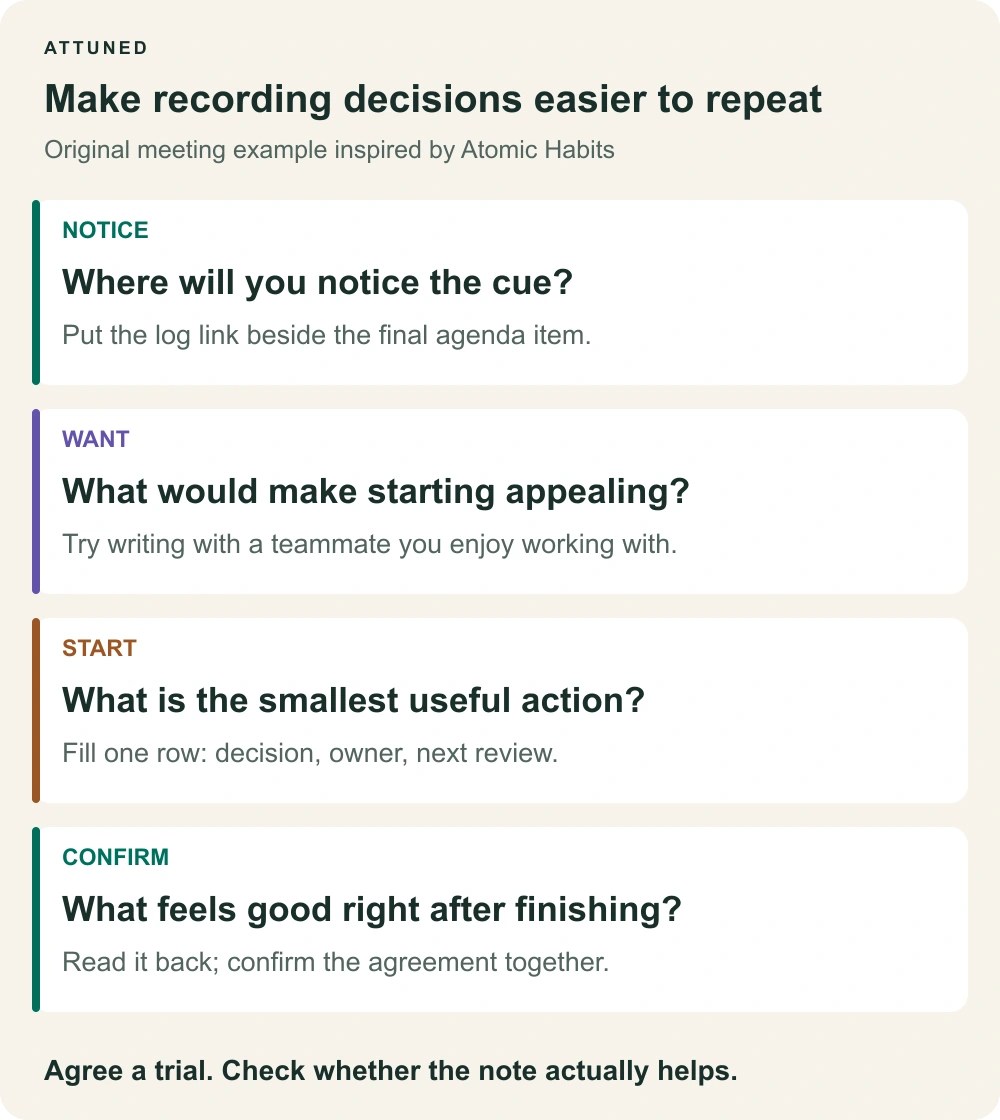
Put the cue where the action belongs. Add the log link beside the final agenda item. Open the row while the decision is still being discussed. A reminder that arrives later may be easy to dismiss because the person has already moved to other work.
Make starting more appealing. If the colleague enjoys working with a particular teammate, ask whether they would like to fill in the row together as the meeting closes. Doing it with someone they like working with may be more inviting than being left with admin after everyone leaves. Ask what they prefer; some people would rather have a quiet minute to write.
Reduce the work needed to start. Prepare three fields: decision, owner and next review. Reserve time within the meeting for one row. If the decision needs more explanation, agree who will add it; a small starting action does not remove the need for a usable record.
Confirm the agreement straight away. Once the row is written, read it back and ask the participants whether it captures what they agreed. That gives the writer an immediate moment of completion: the decision is recorded and checked before people leave. Ask whether that feels satisfying to them, rather than assuming it will. Using the entry at the next meeting is a separate, later check that the record helps; a checked box alone does not establish that.
Attach a small action to something that already happens
Clear calls linking a new behavior to an existing routine “habit stacking.” He also recommends reducing the starting version of a new habit to something that takes less than two minutes. These are starting techniques, not a requirement to finish every worthwhile task that quickly. Habit stacking · The two-minute approach.
For this meeting, the agreed trigger could be the chair closing the final agenda item. The small action is to open the decision row and write the agreement while everyone is still present. State who does it; an action assigned to “the team” may still belong to nobody.
Try the arrangement for the next few meetings, then look at what happened. Was the entry made? Could someone who missed the meeting understand it? Did recording it create a useful check or just another task? Change the arrangement if it adds work without helping.
What the book cannot promise
Clear’s framework is a practical synthesis, not a guarantee that a workplace behavior will become automatic by a particular date. In Lally and colleagues’ study, people repeated self-chosen eating, drinking or activity behaviors in a consistent context; the time associated with developing automaticity varied considerably. That was not a trial of these meeting changes or a test of Clear’s book. Read the original study.
A decision log also contains two different things: the routine of opening it and the judgment needed to write an accurate decision. Making the first easier does not make the second automatic or unnecessary.
Finally, a habit exercise cannot resolve a conflict about priorities, authority or workload. If the person has no time between meetings, creating time is part of the manager’s job. Repeated reminders will not supply it. Agree on the purpose and practical conditions before treating a missed entry as a lack of effort.
Questions for your next one-on-one
Ask about one behavior the colleague wants to make more consistent:
| Question | What it helps you discuss |
|---|---|
| “When did you intend to do it, and what happened instead?” | The actual point of interruption |
| “What already happens at a useful moment to begin?” | A specific, repeatable cue |
| “What would make starting less of a chore?” | The person’s preference and avoidable effort |
| “How will we know the action helped?” | A useful result beyond completing a tracker |
Choose a small trial together. At the review, ask what got in the way and whether the behavior is worth keeping. A missed attempt is information about the arrangement, not a verdict on someone’s character.
For a broader exercise in reviewing your working routines, read Choosing to Manage Your Time.
If you want to discuss differences in what people value at work, Attuned’s motivation assessment uses its own 11-motivator framework. It does not measure habit automaticity or test whether someone follows Clear’s four laws.