People Science · For Leaders Two Levels Up

Skip-Level Meeting Questions That Get You an Honest Answer

You have half an hour with someone who reports to one of your managers, sees the work up close, and is quietly calculating how candid it is safe to be. Below are 55 skip-level meeting questions, 45 for the leader and 10 for the employee, plus the 30-minute agenda you can paste straight into the invite. Then the part most question lists skip: how to read the answers, and how to tell a real manager problem from a mismatch between what someone needs and what their role gives them.

Jump to the Questions ↓ Book a Call Directly →
Customer story below
Azon Recruitment Group
motivator data on 10,000+ people across four generations
What the team knows, and what reaches you
The same quarter · three vantage points
ON THE TEAM 14 specific things people could tell you • the build takes 20 minutes now • roadmap changed twice in six weeks • two of us are covering a vacancy • Priya's promotion case stalled • nobody knows who owns the migration • standup runs 35 minutes • the client escalation was avoidable • onboarding docs are a year stale • Sam has quietly stopped volunteering • three more, smaller plus one nobody says out loud summarize THE MANAGER keeps the 3 that fit the meeting • tooling needs investment • we're a head short • delivery is on track the summary is the job. roll up WHAT YOU HEAR “Team's doing fine. A couple of grumbles about tooling.” the skip-level meeting
The normal reporting line, working as designed The skip-level, going straight to the source

What is a skip-level meeting?

A skip-level meeting is a conversation between a leader and an employee two levels below them, skipping over that employee's direct manager. A director sits down with an individual contributor who reports to one of their managers. The purpose is to hear the unfiltered version of how the work is going, to sense-check what the leader is being told through the management chain, and to give people further down the organization genuine access to whoever is setting direction.

What it is for

Listening, mostly. You are checking whether the strategy makes sense from where this person sits, whether their manager has what they need to lead well, and what has quietly failed to travel up the chain. The best outcome is that you learn one thing you would never have heard otherwise.

What to keep it clear of

Keep it well away from performance reviews, from the working agenda their regular one-on-one already covers, and from collecting complaints about their manager. Used as a back channel once, it stops working permanently, because word travels faster than your good intentions do.

How often it runs

Quarterly if your organization is small enough, twice a year if it is not. Predictability matters more than frequency: a skip-level on a known cycle reads as routine, while one that appears out of nowhere reads as an investigation into somebody.

Who knows about it

The direct manager, before it happens. A skip-level program that managers find out about second-hand creates precisely the defensiveness that ruins it, and it leaves the employee looking like they went around their boss.

Case Study · Azon Recruitment Group · Ireland

"Being able to get to the nub of people's underlying motivations has been very helpful."

Kevin Halligan, Associate Director, Azon Recruitment Group

A firm that outgrew reading the room

Azon grew from a handful of people into an award-winning talent business, one of those recruiting agencies whose specialists are the product it sells. Once there were several teams and several managers, the leadership could no longer take the temperature of the place by walking through it.

Everyone looked fine from two levels up

"If an employee was engaged and looked happy, the assumption was they were fine, until you got the resignation," their HR team noted. The reports coming up the chain were accurate and reassuring, and they were also a summary of a summary.

A read on each person, one profile at a time

Attuned mapped every member across 11 intrinsic motivators, so leaders could see what mattered to each individual, one profile at a time, where before they had an averaged team score, and knew which specific driver was going unmet for which specific person.

Honest conversations. Retention followed.

"A dramatic increase in the numbers of people we hire that we feel we've gotten right," reports Kevin Halligan, Associate Director. "We have really seen that benefit translating to earnings for our business."

Note on the fit: Azon is a recruitment firm rather than a skip-level case study, and we are not going to dress it up as one. What transfers is the underlying problem: leaders who could no longer see individuals through the reporting layers. Read the full story →

The Case for Asking, From Two Levels Up

Gallup surveyed 717 US employees who had voluntarily left an employer in the previous year. The findings are a fairly direct argument for a conversation that does not depend on one manager remembering to have it.

45%
Of voluntary leavers said that in the three months before they left, neither a manager nor another leader proactively discussed their satisfaction, performance, or future with them. The skip-level is where "another leader" comes in.
42%
Of those who left said their manager or organization could have done something to prevent it. By the leavers' own account, close to half of that turnover was avoidable.
70%
Gallup put at least this much of the between-team variance in engagement down to the manager, and has re-found the same effect in every survey since. It is why "how is your manager doing?" is the question a skip-level is uniquely placed to answer.
1.7M
Possible combinations of the 11 intrinsic motivators. It is why the same answer to the same skip-level question means different things coming from different people.
Attuned motivator model
The detail worth sitting with

In the same Gallup study, even among leavers whose managers did engage them, fewer than three in ten had a conversation about the future of their career with the organization (29%) or about their job satisfaction (28%). Two gaps, then. Nobody asked, and the conversations that did happen routed around the two subjects most likely to change someone's mind.

Gallup, "42% of Employee Turnover Is Preventable but Often Ignored"

Sound familiar?

Skip-level questions are easy to find. Getting something true out of the meeting is the hard part, and it goes wrong in two reliably different ways depending on which chair you are in.

“all good”

The Director Who Keeps Hearing "All Good"

"I run skip-levels every quarter and learn almost nothing."

You block the time, you ask good questions, and you get half an hour of pleasant, careful nothing. Everyone says the strategy is clear and their manager is great. Then a resignation lands, or an engagement survey comes back with a score that nobody in any of those meetings mentioned, and you find out the information existed the whole time.

  • Answers so diplomatic they carry no information
  • No baseline to judge "fine" against, because you barely work with this person
  • The same three confident voices volunteering every time
  • Themes you cannot act on without exposing who said them
  • Managers who go quiet and defensive when the meetings appear
A pattern more than one director has described to us: a full round of twelve skip-levels where nobody had anything getting in their way, and two of the twelve gone within months, both citing something that had been fixable all along.

The Employee Doing Fast Political Math

"How honest can I be here, exactly?"

You have been invited to speak candidly to your boss's boss for half an hour, and you have no idea what happens to what you say. Your manager will still be your manager on Monday. So you offer a mild, safe version, keep the real problem to yourself, and leave slightly annoyed that you were asked at all when nothing changes.

  • No stated rule about what gets shared and what does not
  • A real concern that is impossible to raise without sounding disloyal
  • Meetings that happen once and are never followed up
  • The suspicion that this is a box-ticking exercise on someone's goals
  • Previous candor that came back around, badly
"I told a skip-level once that our roadmap kept changing. It got repeated in a leadership meeting, almost verbatim, and my manager knew exactly who had said it. I have been careful ever since."

45 Skip-Level Meeting Questions for Leaders, Grouped by Category

Do not work through all 45. Pick six or eight across the categories that fit the person and the moment, and leave real silence after each one. Ask about specifics: "what slowed you down most last month?" gets you further than "are you happy?". Each category flags the intrinsic motivator it tends to surface, so when the same theme repeats across a round of skip-levels you can see which driver your organization keeps failing to meet.

1. Opening, and lowering the stakes

Sets the tone · buys you the rest of the meeting

  • What are you working on that you are genuinely enjoying?
  • What did you expect this job to be like, versus how it actually is?
  • What is something the leadership team probably has wrong about your work?
  • If we only get through one topic today, what should it be?
  • What would make this half hour worth your time?

2. The work, and what gets in its way

Reveals Progress, Rationality, Autonomy

  • What slowed you down most in the last month?
  • Which part of your process would you delete if you could?
  • Where do you spend time that you think creates no value?
  • What decision are you waiting on that is holding up your work?
  • Do you have what you need to do the job properly? What is missing?

3. Their manager, asked fairly

Reveals Feedback, Autonomy, Security

  • What does your manager do that helps you most?
  • What could I give your manager more of, so they can support you better?
  • Do you get feedback often enough to know where you stand?
  • When you raise a concern with your manager, what usually happens next?
  • How much room do you have to make your own calls?

4. The team, and how it really works

Reveals Social Relationships, Altruism, Status

  • Who on the team makes your job easier, and does anyone know that?
  • What does the team disagree about that never gets resolved?
  • Is there something the team has stopped bothering to raise?
  • How do decisions actually get made here, as opposed to on paper?
  • Would you recommend this team to a friend? What would you warn them about?

5. Growth, and what comes next

Reveals Progress, Status, Competition

  • What do you want to be doing in two years, and are you closer than last year?
  • What skill do you want to build that this role is not giving you?
  • Is there a piece of work you want that keeps going to someone else?
  • Has anything about your progression here felt unfair or unclear?
  • What would make you say this was the best year of your career so far?

6. Strategy, from where you sit

Reveals Rationality, Autonomy, Altruism

  • Can you explain our current priorities in your own words?
  • Which of those priorities looks wrong or impossible from your desk?
  • What are we investing in that you think we should stop?
  • What is the most confusing message you have had from leadership lately?
  • Does your day-to-day work connect to something you believe in?

7. Being seen, and being valued

Reveals Status, Feedback, Financial Needs

  • What is something you did well recently that went unnoticed?
  • Does recognition here feel genuine, or ceremonial?
  • Who noticed the last hard thing you pulled off?
  • Do you feel the way you are rewarded matches the work you do?
  • What is one thing we could do that would make you feel valued this quarter?

8. During a reorg, or after layoffs

Reveals Security, Rationality, Social Relationships

  • What are people saying about this that is not being said in meetings?
  • What has been the least convincing part of how we explained it?
  • What has landed on your plate that nobody has acknowledged?
  • Who on the team are you worried about right now?
  • What would you need to hear from us to feel steady about next quarter?

9. Closing questions, every time

The five that earn the meeting its keep

  • What should I have asked you today and did not?
  • What is one thing you would change about how this place runs?
  • Is there anything you have been sitting on that you want to say now?
  • What do you want me to do with what you have told me?
  • Who else should I be talking to, and why them?

Skip-Level Meeting Agenda Template (30 Minutes)

A 30-minute skip-level runs in five blocks: five minutes of opening, ten on the work and what blocks it, seven on support and growth, six on the strategy check, and two to close. Here is the whole thing as a skip-level meeting template you can paste straight into the calendar invite.

Free skip-level meeting agenda · copy and paste into the calendar invite

Send the agenda with the invite. People give better answers when they have had a day to think, and a published agenda is the cheapest way to make this look like the standing cadence it is.

SKIP-LEVEL : [Their name] <> [Your name]
30 minutes · quarterly · [their manager] knows this is happening

Why we do these: I want to hear how the work actually goes from
where you sit, and find out what is not reaching me. This is not a
performance review, and it does not replace your one-on-ones.

What I will do with it: I share themes, never attributed quotes.
If something needs escalating I will tell you before I do it.

0-5 min   You talk first
          - What are you working on that you are enjoying?
          - If we cover one thing today, what should it be?

5-15 min  The work and what blocks it
          - What slowed you down most last month?
          - What decision are you waiting on?
          - Do you have what you need to do the job properly?

15-22 min Support and growth
          - What could I give your manager more of, to back you better?
          - What do you want to be doing in two years?
          - What went well recently that nobody noticed?

22-28 min Strategy check
          - Can you explain our current priorities in your own words?
          - Which of them looks wrong from your desk?

28-30 min Close (always ask)
          - What should I have asked and did not?
          - What do you want me to do with this?

My notes  Theme: ______________________________________
          Action I own: ________________________________
          To tell them by: _____________________________
How to read the answers

Skip-levels are most useful in aggregate, and most dangerous one at a time. One person saying "I don't get enough feedback" is a data point that could mean their manager is absent, or could mean this is simply a person with a high Feedback motivator in a role that runs quiet. Ten people saying it across a round of skip-levels is a management problem you can name. Keep your notes at the level of themes, tag each theme to the driver underneath it, and be honest with yourself about which of the two you are looking at before you go and have a word with anybody's manager. The same principle applies to the one on one meeting questions a manager asks weekly: the question is the cheap part, and the interpretation is where it gets earned.

Why the Same Answer Means Different Things

Two people can give you the identical answer in a skip-level and need completely opposite things from you. What separates them is what intrinsically drives each one. This 5-minute video explains the difference between intrinsic and extrinsic motivation, which is the difference between collecting answers and understanding them.

Attuned explainer: intrinsic vs extrinsic motivation, with the 11 motivator icons around the Attuned mascot
Attuned · YouTube
Intrinsic vs. Extrinsic Motivation, and Why It Changes the Answers You Get
Click to play, loads YouTube only after you click

Every layer of management is, technically,
a compression step.

A good manager takes fourteen conversations and gives you three lines. That is the job, and it is what makes running anything larger than a small team possible. It also means that by the time information has traveled two levels, it has been through two rounds of somebody deciding what matters enough to keep. Everyone in that chain did exactly what the chain asks. The detail still dies in the summary.

45%
of voluntary leavers said no manager and no other leader had discussed their satisfaction or future with them in their final three months. Gallup, Q4 2023
Research Insight

Psychologist Adam Mastroianni has written that "How are you?" is a ritual question that expects a ritual answer. Both parties understand: what is being exchanged is a performance of connection, not connection itself. A skip-level meeting is unusually vulnerable to this, because you and the person across the table have almost no shared history to fall back on, so the ritual is most of what you have got. "How's it going?" from someone two levels up gets a ritual answer with a compliance report attached.

Adam Mastroianni, Experimental History

Walk in already knowing what this person values

The reason skip-levels produce so little is that you are trying to read a person you barely work with, from a single conversation, with no baseline. "Things are fine" carries no information unless you know what "fine" would have to include for this particular individual. A high-Progress person who has shipped nothing new in six months is in trouble and may not say so. A high-Security person will read your enthusiastic talk of restructuring as a threat, and go quiet for reasons you will never trace back.

Attuned maps every person across 11 intrinsic motivators, so you can see before the meeting which drivers this individual leads with and which are currently going unmet. It pairs naturally with our manager feedback tool, so the themes you pick up two levels down turn into something the manager in between can actually act on.

  • See which motivators each person leads with, before you sit down
  • Aim your questions at what this person cares about, not a generic list
  • Tell a genuine manager problem from a motivator-and-role mismatch
  • Track whether the theme you heard last quarter actually moved

There is a term for this in information theory. A summary that throws away detail to fit the available space is lossy compression, and the thing about lossy compression is that you cannot recover the original from the copy. The skip-level meeting is you asking to see the original file. It is worth remembering that the person opening it for you knows you will close it again in half an hour, and that they still report to whoever produced the summary you are checking.

The same skip-level question, aimed at what this person actually values
The person's motivator profile
DK
Dana K.
Engineer · reports to one of your managers
Progress 89
Rationality 81
Autonomy 74
Status 22
Competition 17
What to ask Dana, and what to avoid
“Which decision this quarter looked wrong from where you were sitting, and did anyone ask you before it was made?”

High Rationality and Progress mean Dana wants decisions to make sense and wants to be moving. Ask about the logic of the work and you will get a genuinely useful answer. Ask “are you happy?” and you will get a polite yes.

With Status and Competition both low, do not open by praising Dana's visibility or floating a promotion race. It lands as noise at best, and makes the rest of the conversation feel misaimed.

4 Reasons Skip-Level Meetings Produce Nothing

A skip-level is a good idea that fails in fairly predictable ways. Each of these is fixable, and none of them is fixed by a longer list of questions.

01

The honest answer is not safe yet

The person is doing rapid political arithmetic about what happens to whatever they say, and their manager will still be their manager on Monday. With no stated rule about attribution, the rational move is the mild version. You get what psychological safety you have built, and no more.

02

You have no baseline to read against

You meet this person for half an hour a quarter. When they say things are fine, you cannot distinguish contentment from quiet resignation, because you have never had a calibration point. The information arrives without a scale attached.

03

The manager in the middle feels audited

Skip-levels sprung on managers read as a performance investigation with extra steps. The predictable result is a manager who coaches their team on what to say, which converts your listening exercise into a very expensive piece of theatre.

04

Nothing visibly happens afterwards

Someone tells you something real, and then observes the following quarter that nothing changed and nobody mentioned it again. That is worse than never asking, because it teaches the whole team that candor costs something and buys nothing.

How to Run a Skip-Level That Earns Its Time

The questions are the easy part. Whether a skip-level gets you anything depends on how you set it up, what you promise about attribution, and what visibly happens next. First, how it differs from the one-on-one it is often confused with, then six habits that make the difference.

Skip-level meeting vs. one-on-one
The difference One-on-one Skip-level
Who is in the room A person and their direct manager A person and their manager's manager
How often Weekly or every other week Quarterly, or twice a year
What it is about Priorities, progress, blockers, coaching Whether the strategy and the support hold up from the ground
Who does most of the talking Both, working through the week The employee, by a wide margin
What it must never become A status report read aloud A back channel for grading the manager in between

1. Tell the managers first

Explain the purpose to the managers in between before you book anything, and make the cadence public. The goal you are selling them is better support for their team, and their own priorities getting heard higher up. Managers who learn about skip-levels from their reports will never relax about them again.

2. State the attribution rule out loud

Say in the first two minutes what you will do with what you hear: themes get shared, named quotes do not, and anything serious gets escalated only after you tell them. Then hold to it exactly. One repeated quote will cost you every future skip-level you ever run.

3. Talk less than a quarter of the time

Send the agenda in advance so they can prepare, then let the silences sit. Most leaders fill a three-second pause and lose the sentence that was coming. If you are explaining the company's strategy for eight minutes, you are having a different meeting than the one you booked.

4. Look for the driver underneath

"No room to grow" and "no feedback" are symptoms, and the cause is usually a specific unmet motivator. Tag each theme to the driver beneath it before you act, or you will fix a management problem that was actually a role-fit problem. This is what Attuned's intrinsic motivation assessment is built to reveal.

5. Close the loop visibly

Come back within two weeks, to the individual and to the team, with what you heard as themes and what you are doing about one of them. Even "we looked at this and decided not to change it, here is why" counts. Silence is the only answer that reads as contempt.

6. Handle what you hear about a manager carefully

If a real concern about the manager in between surfaces, resist acting on a sample of one, and never open with "someone told me". Look for the pattern across the round, then coach directly. Our guide to giving difficult feedback covers doing that without torching the relationship.

How to Prepare for a Skip-Level Meeting as an Employee

If your boss's boss has just put half an hour in your calendar, the honest first reaction is usually mild alarm. It is almost always routine. Here is how to get something out of it, and what you are under no obligation to say.

Pick two or three things in advance

Decide what you want this person to know before you walk in, and bring one concrete example for each: a date, a number, a specific decision. A precise example travels up the organization intact. A general feeling gets compressed into nothing by the time it reaches the next meeting.

Bring a question of your own

Ask about strategy, a decision that confused you, or what they are worried about this quarter. Leaders remember what people were curious about, and it moves you out of the reporting posture and into a conversation between two adults.

Raising a manager problem, if you have one

It is legitimate to raise, and it lands best as a pattern with dates attached. "The last three sprint priorities changed after work started, here are the dates" is actionable. "My manager is disorganized" invites a defense of your manager instead.

You can decline to answer

"I would rather work that through with my manager first" is a completely reasonable sentence to say to a director, and a good one will respect it. A skip-level is not a loyalty test, and you are not obliged to hand over everything you know to prove you are a team player.

10 Questions to Ask Your Boss's Boss

The meeting goes better when you bring questions of your own. Pick two or three of these, and ask the ones you genuinely want to know the answer to.

  • What are you most worried about this quarter?
  • What does success for our team look like from where you sit?
  • Which of our current priorities would you drop if you had to drop one?
  • What do you wish people at my level understood about the decisions you make?
  • How will you judge whether this year went well for us?
  • What is changing in the next six months that I should be getting ready for?
  • Where do you think I could have the most impact that I am not having now?
  • What skills are becoming more valuable here?
  • How do you prefer to hear bad news?
  • What should I bring you next time we do this?
A Simple Structure to Steal

If you want a container for the half hour, run it in four parts. Open with what you are working on and enjoying, because it is true and it settles both of you. Spend the middle stretch on the two or three things you decided in advance, with your examples ready. Then ask your question, and listen to the answer properly, which means not spending it composing your next point. Close by agreeing what happens next, even if that is only that they will think about it. The people who get the most out of skip-levels tend to be the ones who arrived having already decided what the meeting was for.

Our own rule of thumb, from watching a lot of these go badly.

From half an hour of polite answers to knowing what to ask, in under a week

Here is how a leader goes from running skip-levels that produce very little to walking in with a read on what each person values, and leaving able to tell which themes are a management problem and which are a fit problem.

Step 0 · Start Here

Everyone completes a ~10-minute assessment. That's the whole setup.

No rollout plan. No IT project. Each member answers a simple set of questions, and Attuned automatically calculates their profile across 11 intrinsic motivators. Most teams are up and running within a week of signing up.

Slider-based questions, ~10 min

Attuned motivator assessment screen with slider-based questions
~10 minper member
11motivators mapped
1.7Mpossible profiles
Week 1ready to go
01
See What Drives Each Person

Get a baseline before you sit down

Every person gets a profile across 11 motivators, so before a skip-level you can see whether this individual leads with Progress, Rationality, Security or Status. That is the calibration point a quarterly half-hour can never give you on its own.

11 motivator dimensions One profile per person
Motivator profile generated immediately
Attuned motivator breakdown showing a team member's intrinsic motivator profile and which drivers are going unmet
02
Prepare the Conversation

Turn the profile into questions worth asking

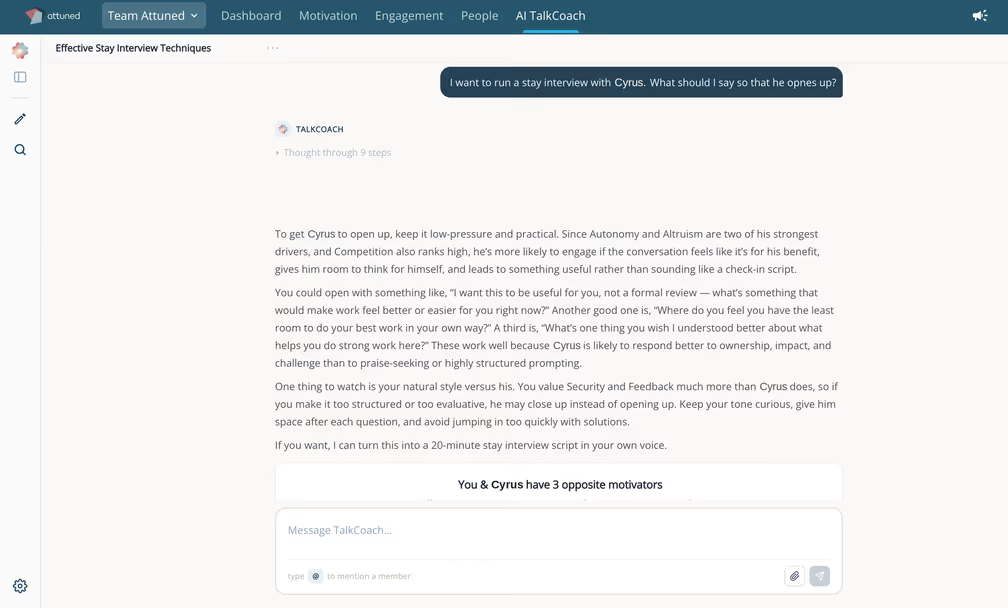
The AI TalkCoach turns each profile into what to ask, how to frame it, and what to steer around. For a skip-level that means arriving with two questions aimed at what this person genuinely cares about, instead of working down a generic list.

AI coaching per person Ready-to-use conversation prompts
AI TalkCoach · suggested conversation prompts
Attuned AI TalkCoach turning a team member's motivator profile into a suggested prompt a senior leader can open a skip-level meeting with
03
Separate the Two Problems

Tell a manager problem from a fit problem

Attuned shows the gap between what each person values and what their role currently delivers, per motivator, across the whole group. That is how you find out whether "I get no feedback" means the manager is absent or means this is a high-Feedback person in a role that runs quiet, before you go and coach anybody.

Value-vs-role gap map Guidance on what to change
Detailed breakdown · member responses by top motivators
Attuned Detailed Breakdown dashboard: a stacked satisfaction bar for each of the 11 intrinsic motivators, from dissatisfied to satisfied, so a leader can see which drivers are going unmet across the group
04
Better Conversations

Ask the question that gets a real answer

A skip-level lives or dies on two or three questions. Attuned turns a vague "everything okay?" into something aimed at what the person in front of you actually cares about, which is the difference between a ritual answer and information you can use.

Prepped conversations Harder conversations, handled
The same skip-level, with and without Attuned
DK
Skip-level · Dana K.
Top motivators: Progress · Rationality
The usual opener
“So, how's everything going?”
Gets the ritual answer: “Yeah, all good.”
Aimed at what drives Dana with Attuned
“Which decision this quarter looked wrong from where you were sitting?”
Opens the Rationality conversation immediately
05
Between the Meetings

See whether the theme actually moved

Attuned tracks motivator satisfaction over time, so the theme you heard last quarter is something you can look up next time. It also flags the person whose drivers are going unmet in the months between your skip-levels, which is where most of the damage quietly happens.

Early-warning drift alerts Continuous tracking
Motivator satisfaction tracked over time
Attuned dashboard tracking motivator satisfaction over time and flagging the member whose motivators are going unmet between skip-level meetings
Tired of half an hour of "all good"?
Walk into your next skip-level knowing what each person values.
No IT project. Your group is profiled and your questions are aimed at the individual, not the org chart, before Friday.
Book a Call Directly →
Book a time that works for you · No callback queue

How a Growing Firm Got a Read on Individuals Again

Azon Recruitment Group grew from a small team into an award-winning business, and hit the point every scaling company hits: the leadership could no longer see individual people through the reporting layers. They fixed it with individual motivator data. A team dashboard was never going to show them a person.

Azon Recruitment Group team, a fast-growing firm whose leaders regained a read on what drove each individual, with Attuned

Resources for the Conversations Around a Skip-Level

A skip-level sits on top of everything else your managers do or fail to do each week. These are the pieces worth reading next, from our team and from the research we build on.

The State of Motivation Report

Our annual research on what actually drives people at work, drawn from over 10,000 users across four generations. Useful background for whose answers you are trying to interpret.

Read the 2026 report →

Psychological Safety Workbook

Whether anyone tells you the truth in a skip-level is a psychological safety question first. This workbook covers how to build it and how to measure whether you have.

Get the workbook →

Why 1-on-1s Fail

The top five reasons regular one-on-ones stop working, which is usually why a skip-level had to be invented in the first place.

Read the post →

Safety in One-on-Ones and Team Meetings

Practical ways to create the conditions where people say the real thing, in the meetings where it matters most.

Read the post →

Building Trust as a New Leader

If you have just inherited an organization and are booking your first round of skip-levels, start here.

Read part one →

Quiet Quitting, and What to Do

The disengagement that skip-levels are often quietly hunting for, and what the research says about catching it. Pairs with our guide to the signs of quiet quitting.

Read the post →

Anyone can hand you a list of questions. Knowing which two to ask this person is the hard part.

Question lists are free and interchangeable, and they all assume you know how to interpret the answer. What you cannot download is a read on what the individual across the table values, or whether the thing they just told you is a manager problem or a fit problem. That is the part Attuned does, and it is what turns a quarterly listening exercise into something that changes a number.

Up and running in a week

A ~10-minute assessment. No IT project, no manager training required. Your whole group can be profiled within days of signing up.

Personalized to each person

11 intrinsic motivators mapped per person, so a leader two levels up has a baseline for someone they see for half an hour a quarter.

AI coaching for every manager

The AI TalkCoach preps the conversation with what to ask and what to avoid, so the manager in between gets better at this too.

GDPR-compliant by design

Lawful basis, data minimization, individual access rights, and the right to be forgotten. Your people own their motivator data.

Skip-Level Meetings: Common Questions

What is a skip-level meeting?
A skip-level meeting is a conversation between a leader and an employee two levels below them, skipping over the employee's direct manager. A director meets an individual contributor who reports to one of their managers. The purpose is to hear the unfiltered version of how the work is going, to sense-check what the leader is being told through the management chain, and to give people further down the organization real access to the person setting direction. You are there to listen. The performance conversation belongs in a review, the week's work belongs in their one-on-one, and the direct manager should know this meeting is happening.
What questions should you ask in a skip-level meeting?
Cover nine areas: opening and rapport, the work itself, their manager and the support they get, team dynamics, growth and career, organizational clarity, recognition, what to ask during a reorg, and a short set of closing questions you ask every time. Pick six or eight. Working down the whole list is how you end up with 45 polite answers. Ask about specifics: "what slowed you down most last month?" gets further than "are you happy?". Always finish with what you should have asked but did not. The 45 questions on this page are grouped by category so you can build a version that fits your organization.
What is the difference between a skip-level meeting and a one-on-one?
A one-on-one is a recurring working meeting between a person and their direct manager, focused on priorities, progress and blockers. A skip-level happens between an employee and their manager's manager, usually every quarter or twice a year, and focuses on the wider picture: whether the strategy makes sense from where they sit, whether their manager has what they need, and what the leader is not hearing. The one-on-one runs the work; the skip-level checks the signal the leader is getting through the management chain. That is also why it should never be used to performance-manage or to give the direct manager feedback by proxy. If you are building out the weekly version, our one on one meeting questions and one on one meeting template cover that meeting properly.
How often should you hold skip-level meetings?
Quarterly is a common rhythm for a leader with a large organization, and twice a year works if the group is bigger than you can reasonably cover. The rule that matters more than frequency is predictability: a skip-level that appears on the calendar out of nowhere reads as an investigation, while one that happens on a known cycle reads as normal. Rotate through the group, and make a point of the quieter half. Then hold the cadence you commit to. Booking a round of skip-levels and then quietly abandoning them costs more trust than never starting.
How long should a skip-level meeting be?
Thirty minutes, and 45 the first time you meet someone. Half an hour is long enough to get past the pleasantries and short enough that you will actually keep the commitment across a large organization, which matters more than the extra quarter of an hour. Send the agenda in advance so the clock is not spent on orientation, and protect the last two minutes for the closing questions, because that is where the thing people were deciding whether to tell you usually arrives.
Is a skip-level meeting a bad sign?
Almost never. In most organizations skip-levels are a standing cadence that a leader runs with everyone in rotation, so an invitation means your name came up on a list. It is worth a second look if there is no established cadence, if you are the only person on your team being asked, or if it lands during a reorg or straight after a performance conversation. Even then the usual explanation is a leader gathering context on a decision. If you want the reassurance, ask your manager whether they knew it was booked. A well-run skip-level program is announced to managers first precisely so the answer is yes.
How do you document skip-level meetings without breaking confidentiality?
Write down themes and actions, never attributed quotes. A practical format is one line for the theme, one for the action you now own, and one for what you promised to come back to the person about, with no name attached to the theme itself. Keep those notes out of any shared performance record. When you report upward or across, aggregate across the whole round so no single person is identifiable, and if something needs escalating with detail attached, tell the individual before you do it. Get this wrong once and nobody tells you anything real for the next two years. That costs more than any policy breach would.
What should you do if an employee raises a serious concern about their manager?
Separate the genuinely serious from the merely frustrating. Anything touching harassment, discrimination, or safety leaves the skip-level process immediately and goes down your formal escalation path, and you tell the employee that is what you are doing. For everything else, resist acting on a sample of one: look for whether the same pattern shows up elsewhere in the round, then coach the manager directly on the behavior without revealing who raised it. Never open with "someone told me", which converts a coaching conversation into a hunt for the source and teaches the whole team what happens to candor. Our guide to giving difficult feedback covers the coaching conversation itself.
How do you prepare for a skip-level meeting as an employee?
Decide in advance on two or three things you actually want the leader to know, and bring one concrete example for each, because a general complaint will not travel. Think about what you want from the meeting: visibility for your team's work, clarity on strategy, or a decision that is stuck. It is reasonable to raise a problem with your manager if you have one, and it lands better as a specific pattern with dates than as a character assessment. Prepare a question to ask them as well, because the leader learns as much from what you are curious about as from what you report. You are not obliged to volunteer everything, and a skip-level is not a loyalty test in either direction. There is a fuller section on this above.
Should you tell the employee's direct manager about a skip-level meeting?
Yes. Tell the manager before you start, explain the purpose, and make the cadence public so it is visibly routine and clearly not aimed at anyone. A skip-level program that managers discover second-hand generates exactly the defensiveness that stops it working, and it puts the employee in the position of appearing to go around their boss. Agree in advance what you will do with what you hear: themes get shared, specific attributed complaints do not, and anything genuinely serious follows your normal escalation path. Managers who understand that the goal is better support for them, rather than an audit of them, usually stop worrying quickly.
How does Attuned help you run better skip-level meetings?
The hard part of a skip-level is interpretation. You get one conversation a quarter with someone you barely work with, so you have no baseline to judge the answer against, and "things are fine" reads the same whether it means contentment or resignation. Attuned maps each person across 11 intrinsic motivators, so a leader can see before the meeting what this individual values and which of those drivers is currently going unmet. That turns a generic question list into questions aimed at what this person cares about, and it lets you tell a genuine manager problem from a mismatch between someone's motivators and their role. It works alongside our employee retention software for the months in between.
Is Attuned GDPR-compliant?
Yes. Attuned operates under GDPR principles for any EU or UK data subject: lawful basis, data minimization, individual access rights, and the right to be forgotten. Users own their motivator data and choose what is shared with their organization. This landing page itself uses consent-gated cookies, so analytics and marketing scripts only load after you accept them. See our Privacy Policy for full details.
People Science for Managers

Fifty-five questions will fill the half hour.
Knowing what to listen for is the edge.

We hold motivator data on more than 10,000 people across four generations, and we spend our days helping the leaders above them read it. It costs you the half hour you were already going to book.

Our expertise is people science: what motivates each individual, why the honest answer gets held back from whoever holds the org chart, and what a leader needs to see to make a skip-level worth both people's time. We have brought it to fast-growing firms like Azon, and we would like to bring it to yours.

No pitch deck
No callback queue
Real conversation
Proven with Azon Recruitment Group
A fast-growing firm whose leaders got a read on individuals again, lifted retention, and saw it translate to earnings.
Book a Call Directly
Pick a time that works for you. No waiting for a callback. No sales queue.
Book a Time → Read the State of Motivation Report Or get the Psychological Safety Workbook
Book a time that works for you. No callback queue.
Past "all good". Know what each person values before you sit down.
Book a Call →