

The Importance of Great Managers, and How to Be One
Guest post by Evan LaPointe, founder of CORE. Reproduced with permission from CORE Concepts, where this article was originally published on October 12, 2026. Evan’s article is reproduced below as written.
Very few companies have great managers. It's the biggest mistake they make.
THE SITUATION
Managers control motivation
Very few people fully process the real job of manager…or the impact that managers have.
They’re the #1 reason people leave a job.
They’re the #1 reason people become disengaged or counterproductive.
They’re the #1 reason for cross-team dysfunction and project problems.
Most people know these sound bites and realities. But almost nobody acts like they know these things. Almost nobody is doing anything to actually fix it.
According to Gallup, 82% of the managers out there aren’t the right person for the job. 4 out of every 5 managers start managing people without any form of training at all. And research from Korn Ferry and HRPA shows that over half of bad managers stay in their role…or get promoted, instead of getting replaced.
Managers aren’t just a manager problem. They are a leadership problem.
Leadership isn’t just about what leaders do, themselves. It’s also about who they put into, and keep in, management roles. Every promotion reflects the leader. Keeping a clown manager reflects the leader. The Machiavellian logic that a manager who gets results should stay reflects the leader (which is especially bad when the team drives great results completely without, or in spite of, the manager, which is usually the case).
And economically speaking, managers are the largest business problem in existence…
Let’s do some quick “Manager Math”…
If a manager manages 8 people, that’s easily a million or multiple millions of dollars of salary that you are putting in that manager’s hands.
Gallup’s research shows that only 1 in 10 managers are good. So let’s say that a bad manager is getting less than half of the engagement that they could be getting out of their team. Here’s a little poll I did last week:
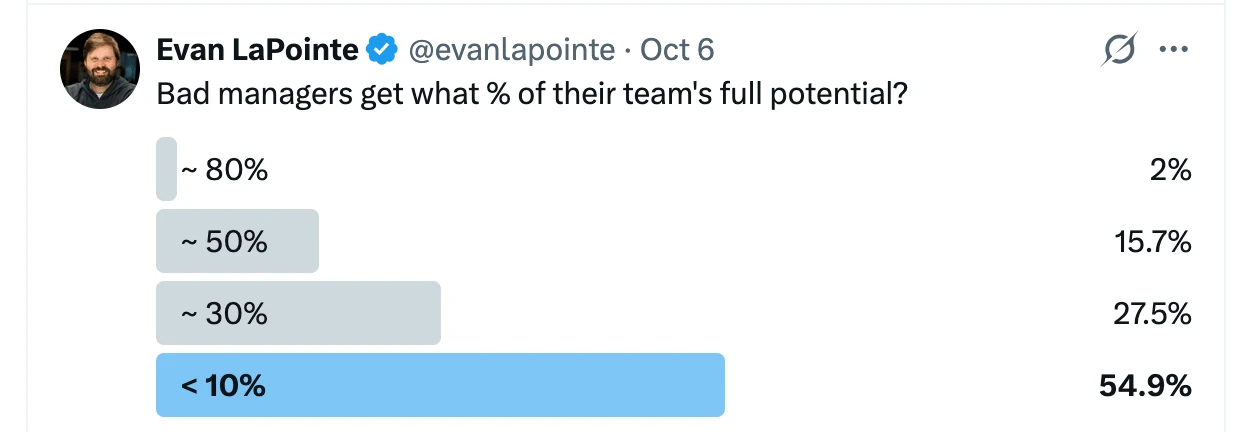
Statistically speaking, that means that 90% of your managers are each setting half a million dollars (or a lot more) on fire every year, and that’s before we even count the results that team would have gotten if they were working better or more.
So, for every 10 managers, it costs the business $4.5 million of direct salary waste per year, or more, plus all of the resource allocation waste, bad decisions, and opportunity left on the table from better outcomes that didn’t happen.
There isn’t a bigger financial fail point in almost any business on earth.
All facts in plain view…that almost nobody is taking seriously at all, or thinking through with any real depth.
So, let’s do that today.
WHAT NORMAL LOOKS LIKE
It probably goes without saying that most people are promoted to manager because of how they did as contributors.
The manager pipeline is chock full of people who “earned it” by doing well in their previous role, meeting their goals, and showing various forms of ownership, loyalty, accountability, grit, and resourcefulness.
On some level, it makes sense that a person who did a job well would make a good manager.
Or perhaps said more precisely: they might make a good teacher.
It is normal to think that a good contributor can sculpt other people into good contributors, too. But, unfortunately, this logic is exactly why 82% of managers aren’t the right person for the job. And that’s why it’s so normal for people to work for someone so bad that they want to disengage, they stop doing anything close to their best work, and they eventually want to quit.
WHAT GREAT LOOKS LIKE
Great begins with actually giving the role of manager some thought. Great is about understanding what managers do, focusing on the nature and demands of the job instead of focusing on who “deserves” career progression.
What is managing actually about?
When you really think hard about it, it is actually fairly illogical that a person would be a good manager because they were a good individual contributor.
At best, that manager can attempt to teach their technique. Their knowledge…
…to 8 people who are totally different from them.
Ready, willing, and able…
You’ve probably heard this phrase. It apparently originated in English contract law, meaning that one party was ready, willing, and able to complete a contract. In the early 1900s, it became popular in common vernacular, in the military, and more.
And it’s this exact phrase that teaches us what managing is actually about. It’s about 8 people at a time being ready, willing, and able to meet or exceed the demands of their job because of how they are being managed.
Spot the problem?
The manager who was promoted because of their IC work might be capable of making 8 people able. But are they capable of making those 8 people ready? Or willing?
Usually not.
Most managers make their 8 people unready and unwilling. Because no normal human is willing or ready to do their best work for a clown who has zero curiosity, zero empathy, zero listening skills, and zero latitude…all because they are trying to teach 8 people how to be them.
Deeper down, what managers actually manage is human motivation. They manage a phenomenon…a force…a substance.
Not the jobs to be done. Not the milestones or goals. The underlying force of motivation, willingness, and readiness.
The struggling manager doesn’t make people less able…they make people less willing and less ready. And this is the exact failure most people miss.
The Three Types of Motivation
Human motivation is pretty simple, but it’s easy to forget how it works when so many dumbasses are out there shilling bad leadership and management advice that sounds right.
Bad, thoughtless, illogical advice and sound bites are what prevent so many leaders and managers from being great…all they do is distract leaders from understanding how motivation, willingness, and readiness actually work inside of human minds.
Humans don’t become motivated because someone else expects them to. They don’t become motivated because “it’s their job” or “they’re being paid to do it.” They get motivated only when specific things happen in their brain, putting them into one of three motivated states:
Safety seeking
Reward seeking
Purpose seeking
All three of these “work,” but each produces very different results.
You can motivate a human by making them feel unsafe (threaten to fire them, give them a bad review, make them feel behind or like they’re doing a bad job). But ask yourself: what kind of work is a safety-seeking person going to do, exactly? Is it actually going to be good work? Might there be some optics management, self-censorship, and other weird behavior? And how long, exactly, will a person tolerate being motivated in this way?
And you can motivate a human being by getting them to chase rewards, by giving them incentives, and by making them want. But again, ask yourself: what kind of work are we going to get? Any chance we’re going to “play the game,” sell things that’ll probably churn next year, or neglect things that don’t have direct rewards tied to them? And will someone who had an incentive this year step up next year if the incentive is the same, or lower…or will we have to keep ratcheting incentives up over time?
Safety and reward seeking are both extrinsic motivators. They do work. But they don’t work anything like the motivation the best managers use. That 1 out of 10 manager who is actually great…they understand something the other 9 don’t: intrinsic motivation.
They create a team that intrinsically wants to do great work, both for and with other people. They take specific, consistent action that builds trust, meaning, intelligence, bond, and more. We’ll talk about that in the live session if you want to learn how it works. It’s surprisingly easy.
The six personas and philosophies
Almost every human out there has a built-in management approach that they will use the day they are promoted to manager. And the built-in approach fails 82% of the time. Having great managers requires the skill of identifying which built-in approach someone will use, and exactly what they will need to turn into a great manager.
Let’s wrap with a few recognizable categories of managers that you can start using to understand the managers around you. This is how you can start selecting and training managers better, starting this week.
The Craftsperson - cares about others’ competence, thinking, and output quality
The Visionary - cares about impact and mattering in the world
The Humanist - cares about the team and customer, as humans
The Operator - cares about internal goals and efficiency
The Hustler - cares about perceived effort and grit
The Deputy - cares about looking loyal and good
The first three manager types are the only ones who use, and who understand, intrinsic motivation. They will usually need to be trained in business fundamentals and pushed to implement more operational rigor to reach their full professional potential.
The last three manager types do not use or understand intrinsic motivation in others (despite being intensely self-driven themselves). They need to be taught that other people are different than them, and will stay different than them. They need to learn how to employ cognitive empathy and flexibility. Where they are strong is in operational rigor. They will plan, structure, monitor, and measure everything.
In the live session, we’ll dive deeper into these personas, exactly how to turn most types into exceptional managers, and how to know which ones should not manage. For now, start categorizing the managers you have and start thinking through your strategy for them.
Great looks like being intentional with your managers, focusing much more on their impact to readiness and willingness, understanding that 8 real humans are deciding whether to be ready or willing every day based on whether their manager is great or is a clown.