A retention plan has six sections. A template can lay out five of them, and it does that usefully: the baseline, the scope, the actions, the owners, the review date. The sixth section asks why these particular people might leave, and no template can answer that, because the answer lives in your own employees. Below is the full six-section employee retention plan template, written out so you can copy it, plus an honest account of what has to go in the box the template leaves empty.
Swipe to see what a template can pre-fill →
Five of the six sections are structure, and structure is genuinely worth having. The sixth is evidence, and a document downloaded from the internet has no way of knowing anything about the people you are trying to keep.
An employee retention plan is a written document that states who you are trying to keep, why those specific people might leave, what you are going to do about it, who owns each action, and how you will know whether it worked. The word carrying the weight in that sentence is specific. A document that lists good practice in general, with no named roles, no named causes and no owner against any line, is a statement of intent. Plans get reviewed. Statements of intent get filed.
Use the six-section template below and write it in order. The order is the method: baseline, then scope, then diagnosis, then actions. Most retention plans are written in the reverse direction, starting from an action someone already wanted to fund, which is why so many of them read as a budget request with a preamble. The section that decides whether the plan works is section three.
Copy this into a document and fill it in top to bottom. Every prompt below is written as a question, because a section of a retention plan that cannot be phrased as a question is usually a section with nothing in it. There is a copy button underneath.
Total turnover for the last twelve months, then regrettable turnover as a separate number. Break both down by team and by tenure band, because a first-year exit and a sixth-year exit are two different problems wearing the same label. Add your average time to fill for the roles in scope. If you want an external reference point for your sector, the US Bureau of Labor Statistics publishes monthly quits and separations data by industry in the JOLTS release, which is more useful than any benchmark quoted in a vendor deck, including ours.
Name the roles, teams or individuals the plan covers, and write one line on why losing each would hurt. A retention plan that covers everyone commits you to nothing in particular, and it is the most common way a plan quietly becomes unfalsifiable. Most useful plans cover somewhere between one team and three roles. If yours covers the whole company, you have written a policy.
For each person or group in scope, what would make them go, and what is your evidence? Evidence means something that came from them: a stay interview, a motivator profile, a pattern in one-to-one notes, a change in their situation you have actually observed. A reason you inferred from a general article about retention is a hypothesis. Write those down too, and mark them as hypotheses. This section gets its own part of the page below, because it is the one that decides whether the other five were worth writing.
One action per diagnosed cause, written so that someone reading it in six months could tell whether it happened. "Sam and their manager agree a written next-step plan, two candidate moves, by 30 November" is checkable in December. "Improve career development" gives a reader in December nothing to check. Keep pay actions in a separate block and treat them as the last resort they are: money is the one lever every competitor can also pull, and matching an offer resets the clock without answering the question.
A named human and a date against every action, and most of those names should be line managers rather than HR. HR owns the document; the manager owns the outcome, because nearly every action that actually moves retention is something only a direct manager can do. If every owner in your plan works in HR, you have written a list of policies rather than a list of changes.
A date for the next review and the measure you will judge the plan against, agreed before anyone starts. Quarterly works for the plan as a whole, since most retention actions need one to two quarters to show up. State explicitly that you are tracking regrettable turnover rather than headline retention, and name one leading measure that moves before a resignation rather than after it. Our post on why retention rate is not the metric you are looking for covers why the headline number is the wrong thing to watch.
No email required, and no form. It copies to your clipboard as a plain-text outline with blank fields, ready to paste into a doc.
The six sections of an employee retention plan template, and who has to supply each one.
Each row below is shown as a block on a small screen.
| Section | What goes in it | Who owns it | Can a template pre-fill it? |
|---|---|---|---|
| 1. Baseline | Turnover and regrettable turnover, by team and tenure band | HR / People Ops | The fields only. The numbers are yours. |
| 2. Scope | The roles, teams or individuals this plan covers, and why each matters | HR with the function lead | Mostly |
| 3. Diagnosis | Why these specific people might leave, with the evidence for each | Line manager, evidence from the person | Almost none |
| 4. Actions | One change per diagnosed cause, written so it can be checked later | Line manager | A menu of options, never the choice |
| 5. Owners and dates | A named human and a date against every action | HR holds the list | Almost entirely |
| 6. Review | Cadence, plus the measure you will judge the plan against | HR | Almost entirely |
Sections one, two, four, five and six are easy to imagine filled in. Section three is the one people ask what it should look like, so here it is for one person. Names and numbers are illustrative.
Section three for one named person, in a retention plan for the platform team.
| Field | Entry |
|---|---|
| Person and role | Sam R., Senior Engineer, platform team, 3 years 4 months tenure |
| Why losing them would hurt | Sole maintainer of the billing service. Estimated 5 months to full cover. |
| Likely cause | Autonomy. Scored 92nd percentile as a Need-to-have, currently reported as not met. |
| Evidence | Sam's motivator profile, shared with their manager by agreement. Said directly in a stay interview on 4 September: "I find out what I am building in sprint planning now." Two consecutive platform-team pulses also put autonomy at the team's lowest score, which is what prompted the conversation, though the pulse reads at team level and says nothing about Sam on its own. |
| Confidence | High. Two independent sources, the profile and the stay interview, both from Sam rather than inferred. The team pulse is context, not evidence about Sam. |
| Competing hypothesis | Pay. Band is at market midpoint. No evidence from Sam. Logged and held, not acted on. |
| Action it implies | Sam owns technical direction on billing, including sequencing, from the October cycle. Owner: Priya (manager). Check: 15 December. |
Note what the entry does not say. It does not say "Sam seems disengaged", because that is an observation about Sam rather than evidence from Sam. The competing hypothesis is written down and explicitly not acted on, which is what stops a plan from quietly becoming a retention-bonus request.
Three situations where the six sections above need reworking rather than filling in. Frontline and shift work: the levers that move retention are rota predictability, commute and pay, so section four is mostly outside a line manager's gift and the plan has to escalate rather than assign. Unionized workplaces: several of the obvious section four actions are collectively bargained, and writing them into a local plan can cut across an agreement. Teams under about five people: any survey-based diagnosis becomes individually identifiable, so section three has to come from conversations you have openly rather than from an anonymous instrument.
Two numbers decide who should own this plan. 70% of the variance in team engagement traces to the manager. And 7.5 quadrillion possible motivator combinations mean the generic plan describes almost nobody who actually works for you.
of the variance in team engagement is accounted for by the manager. Whatever the company does centrally, the experience an employee is actually having is largely set one level above them, which is why the owner column of a retention plan matters more than the actions column.
quadrillion possible combinations of the 11 intrinsic motivators we measure, once each is banded and ranked. That number is the reason a single retention plan written for "our engineers" tends to work for some of them and land as noise for the rest.
people across four generations in our motivator dataset, which is what we norm individual scores against. The full breakdown, including how profiles differ by role and seniority, is in the State of Motivation Report.
annual salary, Gallup's range for the cost of replacing one employee, which they describe as a conservative estimate. Multiply it by the names in section two of your plan and you have the number that justifies writing the plan at all.
Fill in a generic template honestly and you end up describing a composite employee: someone who wants career progression, recognition, flexibility and fair pay, roughly in that order, at roughly average intensity. That person is a statistical artifact. Nobody on your team is them. The plan you write for them will be partly right for everyone and exactly right for no one, and the people it misses are disproportionately the ones you most wanted to keep, because high performers tend to have sharper and more unusual profiles than the average.
There is a form every HR team already knows that has this same property. The emergency contact details in the personnel file: collected on day one, filed immediately, never revisited, and consulted exactly once, on the day it turns out the number rings a landline in a house the employee moved out of four years ago. The form was never wrong. It was just answered once, about a situation that has since changed. A retention plan written at onboarding and reviewed annually ages the same way, and for the same reason.
The most common failure. Section three gets filled in from the actions someone already wanted to run, which makes the whole document circular. If you can delete section three without changing section four, the plan was written backwards.
HR can run the analysis and hold the cadence. HR cannot change what an engineer works on next quarter. If every action sits with the people team, you have written a list of announcements. HR can publish a policy. Only Sam's manager can change what Sam builds in October.
Turnover rate and exit interviews both report decisions that were already taken, sometimes months earlier. A plan whose only feedback loop is the thing it exists to prevent cannot be corrected in time to matter. Pair it with something that moves earlier, like stay interview questions asked while the person is still deciding.
The emergency contact problem. A person's situation changes on its own schedule, not on your review calendar, and the changes that precede a resignation are usually small and gradual. Annual review is a record of what was true last year.
Section three
Thirty minutes on what you would actually need to know to fill in the diagnosis box for your own team.
No deck. We will ask what your last three regrettable exits had in common.
Three sources can put evidence in the diagnosis box, and they arrive at different times. Exit interviews arrive after the decision. Stay interviews arrive when you remember to ask. Motivator data arrives continuously, which is the only one of the three that can move an action while there is still something to act on. Attuned is the third of those. It replaces neither of the first two.
The intrinsic motivation assessment runs 55 forced-choice questions in about 10 minutes and scores all 11 motivators from 0 to 100 against a single global norm, labeling each one Need-to-have, Nice-to-have or Neutral. The 55 items are what survived an original battery of more than 400. What this gives section three of your retention plan is a sentence with a name in it: this person needs autonomy and feedback at the 90th percentile, and neither is currently being met, which is a cause you can write an action against.
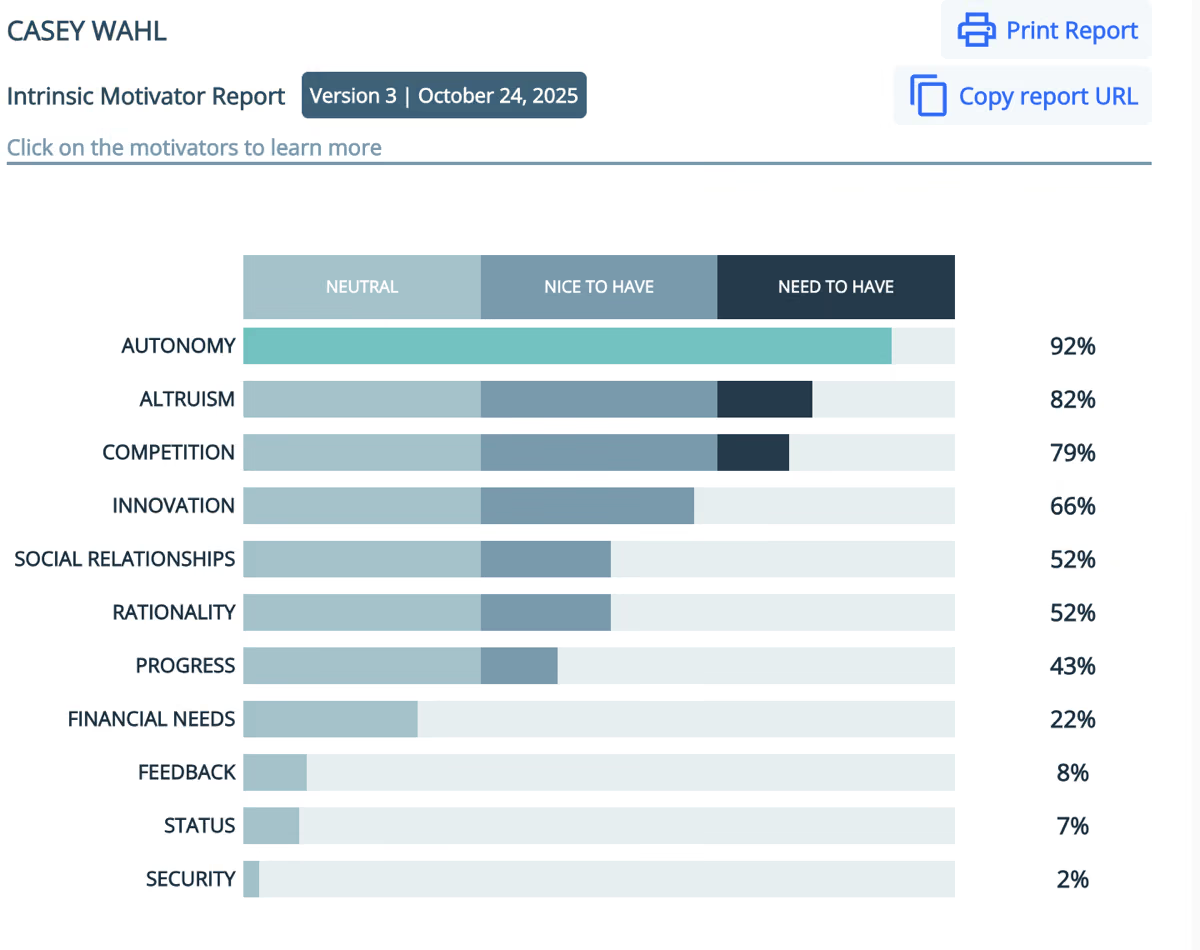
One person's 11 motivators, scored against a global norm
Two engineers on the same team, the same tenure, the same pay band, can be at risk for opposite reasons. One needs autonomy that the current project structure removed. The other needs the social contact that remote work took away. A plan written for "our engineers" addresses at most one of them, and there is no way to tell which from the outside.
The satisfaction pulse runs on a short recurring cycle, so a motivator dropping out of "met" registers on the next cycle rather than at the exit interview. In our own customer data that has tended to be a cycle or two before anything reached HR. We have not published that as a study, so treat it as our observation rather than a finding. Section six of your plan needs at least one measure of this kind.
AI TalkCoach turns one person's profile and current gaps into prompts for the next one-to-one, which the line manager opens while preparing. That matters for section five: the owner is the manager, and handing a manager a diagnosis without handing them the sentence to say is how owners quietly become non-owners.
The satisfaction pulse reads at team level with a floor of three respondents, so nobody's individual answer is traceable back to them. The individual motivator profile belongs to the person and is shared with their manager by agreement. A retention plan built on data people did not consent to giving has a shorter shelf life than the problem it is solving.
If what you are looking for is the tooling rather than the document, that is employee retention software. If you want the questions to ask before you have any instrument at all, start with stay interview questions, and keep exit interview questions for the cases you did not catch in time.

Azon Recruitment Group is an Irish recruitment firm, so their situation is specific to them. What transfers is the shape of the problem: a confident, experienced read on how people were doing, held with no instrument pointed at it, and corrected only by a resignation. We have no controlled study of retention plans with and without motivator data, and we would rather say so than dress this up as one.
An award-winning Irish recruitment agency, and one of the country's fastest-growing talent providers.
Azon's read on how people were doing rested on body language and on what surfaced through their managers. "Typically, if an employee was engaged and they looked like they were happy, the assumption would be they were fine," says Denise Grant, Manager for HR Recruitment at Azon, "until you get their resignation and you realize at an exit interview that they weren't as happy as you had assumed." Written into a retention plan, that assumption becomes section three: cause unknown, evidence none, everybody appears fine. Attuned gave them a measured, individual view of what each person valued, so the impression could be checked against something specific before the resignation rather than after it.
"Being able to get to the nub of people's underlying motivations at the start of a process and see what really drives and motivates people in the workplace has been very helpful when trying to hire, and we've seen a dramatic increase in the numbers of people we hire that we feel we've gotten right, and that are a right fit for the business." Kevin Halligan, Associate Director, Banking & Financial Services, Azon
"Since beginning to use the software, we have really seen that benefit translating to earnings for our business." Kevin Halligan, Associate Director, Banking & Financial Services, Azon
The template above is the structure. These cover the arguments underneath the sections that are hardest to write honestly.
The long-form version of section three: which signals actually precede a regrettable exit, and why the ones most organizations watch arrive too late to use.
Read: preventing unwanted turnover →Section six, argued properly. Why the headline retention number is the wrong thing to judge a plan against, and what to put in its place.
Read: retention rate is not the metric →Scope, section two. Why the people worth writing a plan about are also the people a generic plan is least likely to describe correctly.
Read: how to retain your top talent →One specific cause worth checking for in section three, and the reason it rarely shows up in an exit interview even when it was the reason.
Read: psychological safety and turnover →Our own dataset: motivator profiles from 10,000+ people across four generations, including how profiles differ by role and seniority. The empirical basis for the diagnosis section above.
Get the report →The case that most of what a retention plan is trying to fix was decided before the person's first day, and what that implies for where the plan should start.
Read: retention starts at the interview →Related pages: employee retention software for the tooling side of the same problem, how to measure employee engagement for section six, stay interview questions for gathering section three by hand, and turnover metrics every CEO should track for section one.
Attuned measures what each person needs from work and whether they are currently getting it. That is section three of your plan and nothing else. It will not write your actions, hold your review cadence or calculate your turnover rate, and any vendor telling you their product does all six sections is selling you a document.
Turnover rates, exit interviews and the annual engagement survey all report decisions that have already been taken, which makes them a record rather than an input. A recurring satisfaction pulse is the one measure here that can still change the outcome, because it reads the conditions while the person is still weighing them.
Attuned worked with psychologists to define 11 workplace motivators, each scored 0 to 100 against a single global norm, so a 72 means the same thing in Tokyo and in Texas. It sits in the same family of self-report instruments as the Reiss Motivation Profile (Reiss, 2004) and Amabile's Work Preference Inventory (1994). We have not published a peer-reviewed validation paper, and we do not claim one. The full method is on our intrinsic motivation assessment page.
Section five of a retention plan names a line manager. AI TalkCoach converts that person's profile and current gaps into prompts for the next one-to-one, so the action arrives with the opening sentence already drafted rather than as a task with a due date.
An employee retention plan is a written document that states who you are trying to keep, why those specific people might leave, what you are going to do about it, who owns each action, and how you will know whether it worked. The word that does the most work in that sentence is specific. A document listing good practice in general, with no named roles, no named causes and no owner, is a statement of intent rather than a plan. A retention plan is usually written at team or segment level and reviewed quarterly.
Six sections. (1) Baseline: your current turnover and regrettable turnover rates, by team and tenure band. (2) Scope: which roles or people the plan actually covers, because a plan covering everyone covers no one. (3) Diagnosis: why these specific people might leave, evidenced rather than assumed. (4) Actions: what changes, for whom, starting when. (5) Owners and dates: a named person and a date against every action. (6) Review: the cadence and the measure you will judge it against. Sections one, two, four, five and six are structure, and a template can lay them out for you. Section three is the only one that requires evidence from your own people, and it is the section most templates leave as an empty box.
There is no standardized set, and two different versions circulate widely enough that naming one as definitive would be a choice rather than a fact. The most common version is compensation, culture, career, communication and celebrate. A competing version, framed as verbs, is care, connect, coach, contribute and congratulate. Both are memory aids for a talk. Neither is a diagnostic: they tell you the categories a retention problem can live in, and they cannot tell you which category yours is in, which is the only thing a retention plan actually needs to know. Use them to structure the conversation, then get evidence before you commit budget to any of the five.
Ranking retention strategies in the abstract is the mistake the ranking is meant to solve, because the right strategy is the one that addresses the cause you actually have. The five that appear most consistently across the research are: a structured onboarding period rather than a first-day orientation; pay reviewed against market rather than against last year; a visible next step in the person's career, even where the next step is sideways; a manager who runs regular one-to-ones that are not status updates; and work that is matched to what the individual needs from a job. The fifth is the one most organizations skip, because it requires knowing something specific about each person rather than something general about all of them.
Work through the six sections in order and refuse to skip section three. Start with your actual numbers, including how many leavers you would have kept if you could. Narrow the scope to the roles where a departure would genuinely hurt. Then gather evidence on why those particular people might go: stay interviews, motivator data, one-to-one notes, anything that came from the person rather than from a general article about retention. Only then choose actions, because an action chosen before the diagnosis is a guess with a budget line attached. Assign a name and a date to each one. Set a review date and a measure before you circulate it.
HR owns the document and the line manager owns the outcome. That split matters, because most of the actions in a working retention plan are things only a direct manager can do: change what someone works on, adjust how much autonomy they have, have the career conversation, alter the shape of the one-to-one. HR can run the analysis, hold the cadence and escalate. HR cannot personally do the thing that keeps a given engineer from taking the other offer. A retention plan whose actions all sit with HR is usually a plan of policies rather than a plan of changes.
Quarterly for the plan as a whole, and continuously for the diagnosis underneath it. The two cadences are different on purpose. A quarter is a reasonable interval to judge whether actions have moved anything, since most retention actions take one to two quarters to show up in the numbers. The diagnosis needs to run faster than that, because the thing you are trying to catch is a person's situation changing, and people do not change their minds on a quarterly boundary. A plan reviewed annually is a record of what was true last year.
Not by the headline retention rate, which moves too slowly and hides the thing you care about. Track regrettable turnover separately from total turnover, because keeping a poor performer and keeping your best engineer both register as retention. Then track at least one leading measure, something that moves before a resignation rather than after it: stay interview outcomes, one-to-one frequency actually held rather than scheduled, or whether an individual's stated needs are currently being met at work. Exit interviews and turnover rates are both lagging measures. They report decisions that were already taken. More on this in why retention rate is not the metric you are looking for.
No, and the two are often written by the same person in the same week, which is how they get conflated. A succession plan answers what happens if a key person leaves, so it is about cover, readiness and who steps up. A retention plan answers how to make that departure less likely in the first place. They share an input, the list of people whose exit would hurt most, and they diverge immediately afterwards. An organization with a succession plan and no retention plan has decided to manage the consequence rather than the cause.
There is one on this page. Sections one, two, four, five and six are easy to picture once you see the headings, so the worked example fills in section three instead, for one named engineer: the likely cause, the evidence behind it, the confidence level, the competing hypothesis being logged but not acted on, and the action that follows. That is the section people actually get stuck on. Names and numbers in it are illustrative.
As with the 5 C's, the four pillars are a framing device rather than a standard, and the versions differ by whoever is presenting them. The grouping that recurs most often is compensation and benefits, career growth, culture and belonging, and management quality. It is a reasonable way to sort causes once you have found them. Treat the fourth pillar as the one with the most leverage, since Gallup's finding that managers account for 70% of the variance in team engagement says the other three are largely experienced through whoever the person reports to.
A Key Employee Retention Plan, or KERP, is a specific instrument used in bankruptcy and distressed sale situations: cash awards approved to keep named people through a defined event, usually with court or board oversight and a fixed end date. It is a bonus scheme with a deadline. An ordinary employee retention plan is a management document about working conditions, with no payment attached and no end date. If you searched for a template and landed on KERP material, you almost certainly want the six sections on this page. If you are genuinely in an M&A or insolvency process, a KERP is a legal instrument and you want counsel rather than a template.
The version most commonly cited is respect, recognition and reward, and like the 5 C's and the four pillars it is a mnemonic rather than a standard. Its one genuine use is ordering: respect is a precondition, recognition is cheap and underused, and reward is the most expensive and the easiest for a competitor to match. Working through them in that order stops a plan from opening with the pay conversation, which is where plans without a diagnosis tend to start and finish.
Yes, and for critical roles it is usually the more honest unit of work. An individual retention plan uses the same six sections at a smaller scale: what this person's situation currently is, what specifically would make them leave, what changes, who does it, by when, and when you check. The risk to manage is the appearance of a special deal, so keep the plan about the work and the conditions rather than about a retention bonus. Money is the one lever every competitor can also pull, and it is the one that resets the clock without answering the question.
Section Three
Thirty minutes on what you would need to know to fill in the diagnosis box for your own team, and whether you already have it somewhere.
Book a working session
Thirty minutes on the retention plan you are already writing.
Book a Call → Get the State of Motivation Report Or get the unwanted-turnover whitepaper →"If an employee was engaged and they looked like they were happy, the assumption would be they were fine." Denise Grant, HR Recruitment, Azon
Prefer email? attuned.ai