Conflict is the result of differing priorities. Two people can want the same project to succeed and still end up at war over it, because one is driven by getting it right and the other by getting it out. Below are the five types of workplace conflict, three worked examples, a five-step resolution process, and the part most guides leave out: how to see the difference in what each person values before it turns into damage.
Or download the free Better Conflict paper →
Swipe to see both profiles →
Conflict resolution in the workplace is the process of bringing a disagreement into the open, understanding what each side actually wants, and finding a way forward both can work with. The part most definitions leave out is what conflict is made of. Conflict is the result of differing priorities, so resolution rarely means persuading someone they were wrong. It means working out which values each person is ranking first, then deciding together what to do about the difference. A resolution that skips the understanding step tends to resurface a few weeks later wearing a different argument.
Settling a specific dispute so both sides can work together again. It has an endpoint, and understanding the other position is the mechanism that gets you there.
The ongoing practice of keeping disagreement productive, so the friction stays useful. You are not trying to eliminate friction here, only to keep it useful and out in the open.
A third party helping two colleagues understand each other, usually a manager or HR partner. Its success depends almost entirely on parity. Hierarchy quietly removes it. Covered in detail below.
The measurable difference between what two people value most. Our research calls this an interpersonal motivator gap, and it is the thing sitting underneath most disagreements that look like personality clashes.
Differing priorities are good for business. A manager who values cost working alongside one who values quality can produce a more cost-efficient product than two people who see it identically. The friction is doing work. What turns that into damage is the moment either side decides the other's motives are inferior, and from there it stops being a disagreement about the launch date and becomes a disagreement about character.
Better Conflict, AttunedThe most-cited costing of workplace conflict comes from Acas, whose 2021 research by Professors Richard Saundry and Peter Urwin put a number on it across UK employers. The figures are UK-wide, and the mechanism they describe travels.
Acas found that where conflict escalated into formal procedures, the costs were more than three times those of resolving it informally. The expensive part is what a disagreement becomes once nobody has dealt with it, so the return on catching one early is far larger than the effort of the conversation.
Bad conflict takes a handful of recognizable forms, and naming the one you are in matters because they need different responses. Four of the five are fed by the same thing: an assumption about the other person's motives that nobody has checked.
It feels good and meaningful to defend your beliefs. When those beliefs leave no room for someone else's, people fight back on principle rather than in search of the truth. The more conflict you experience on behalf of what you believe, the more meaning you assign to it, until you start seeking it out (Ripley, 2021).
Everyone needs to belong somewhere, and belonging to a group of like-minded people supplies that. The trouble starts when a group, however innocuous, begins treating anyone outside it as against it. From there it becomes easy to imagine the out-group opposes everything you stand for, whether or not that is true (Ripley, 2021).
Every conflict is a values conflict in some way. It turns bad when people believe their own values are the only virtuous ones, and that disagreeing is therefore wrong or even immoral. The reliable way into this one is being unaware of your own values: until you can see the motivations behind your beliefs, you cannot see them as fallible.
Sometimes people simply do not click. Differences in personality, communication and working style spur disagreements and wounded feelings (Shonk, 2023), and those turn nasty the moment we assume we know each other's motivations. The same manager who is deeply involved in the work can be read as wanting clear, consistent outcomes, or as a micromanager.
Zero-sum conflicts feel like war. They designate winners and losers, so anyone entrenched in one has no incentive to compromise, no incentive to understand their opponent, and no reason to collaborate (Coleman, 2014).
If your workplace appears entirely without friction, the likelier explanation is that its conflict has gone underground. Covert conflicts are hidden and insidious; the people in one may not admit to it, and some may not know they are in it. While it stays covert, it cannot be managed at all.
Bad conflict poisons relationships and wellbeing. At work it dampens productivity, stunts creativity, kills innovation, lowers job satisfaction and increases burnout (Coleman, 2014). It also spreads: anxiety, resentment and anger create factions. Those lead to poor morale and bad decision making, and from there to squabbling and even sabotage. Peter Coleman and Robert Ferguson put the mechanism plainly in Making Conflict Work: "Conflict is a lot like fire. When it sparks, it can intensify, spread, and lead to pain, loss, and irreparable damage."
Coleman & Ferguson, Making Conflict Work (2014)Amanda Ripley draws the line by movement. "In healthy conflict, there is movement. Questions get asked. Curiosity exists. There can be yelling, too. But healthy conflict leads somewhere. It feels more interesting to get to the other side than to stay in it." Bad conflict, by contrast, circles. Here is how the two behave differently in practice.
| Bad conflict | Good conflict | |
|---|---|---|
| Curiosity | Leaves no room to be curious about the other person | Seeks to understand first; people relax once they feel understood |
| Visibility | Covert, hidden, sometimes unadmitted by the people in it | Overt, and therefore manageable. Nothing sanitizes like sunlight |
| Emotion | Pretends to be purely logical, so the emotional core stays buried | Acknowledges the emotional core, then keeps it from ruling the room |
| Context | Ignores history, rapport and who holds the power | Reads the context: who is involved, how long they have known each other |
| Direction | Circles, hardens, spreads into factions | Moves. It leads somewhere, even when it stays loud |
| The goal | Winning, and being seen to win | Comprehending the position you still disagree with |
Suppressing conflict is riskier than addressing it (Folger, 2021). Suppressed conflict grows like poisonous mold and spoils relationships and trust, and while it stays covert it cannot be managed or resolved at all (Coleman, 2014). This is the argument against the most common managerial instinct: wait, and hope the thing settles.
Folger et al., Working Through Conflict (2021)Coleman and Ferguson are blunt about the alternative: "Nothing of value was ever created by a bunch of people sitting around agreeing on everything." A team that never disagrees in front of you has either stopped caring or learned that disagreeing is expensive.
There is a reason no engineer designs a gearbox with zero friction. Friction is the thing that lets a gear transmit torque at all; take it away entirely and the mechanism spins beautifully while the machine goes nowhere. Teams work the same way, which is worth remembering the next time a leadership meeting congratulates itself on how aligned everyone was.
These three scenarios come from our Better Conflict paper. They are illustrative, with no real names and no customer data. The first shows what happens when a manager dismisses a dispute. The second shows the same disagreement running down two different tracks. The third shows what it actually sounds like to move a conflict into the open, in one conversation.
Five steps, in order. The sequence matters more than it looks: managers who skip to step four and propose a compromise usually find the same argument waiting for them a month later, because nobody did steps one to three.
Being blind to your own values is a sure way to breed conflict. Take stock of your feelings, motivations and perceptions. What emotions are you feeling? What is motivating you at a deeper level? How might that be shaping your behavior here, and how is it coloring the way you see the other person?
Sit down somewhere contained with few distractions and listen. Then demonstrate that you understood: repeat back to them, in your own words, what you think they are trying to communicate, and keep going until you get it right (Ripley, 2021). Understanding turns covert conflict overt, and it helps people calm down.
Knowing yourself and knowing the other person illuminates the differences in what drives you both. If you know you are highly motivated by Innovation while your colleague really values Security, you can begin to deconstruct the conflict. We do not choose our own values, so the gaps are differences in kind, so neither person is ranking better values than the other. Our intrinsic motivation assessment measures this directly.
You and your opponent probably share some goals, and often some motivations. Colleagues who disagree on how a project should get done both want the project done well. Identify that overlap explicitly and build from it, because it is much harder to keep fighting someone once you have said out loud what you both want.
Find the emotional core, because it is likely at the root of the conflict (Coleman, 2014). An employee who feels they were not credited for their contribution, and is therefore hurt, might refuse to collaborate. Being able to say "when Sascha took credit for the sale I spent months closing, I felt hurt and angry and taken advantage of" brings the heart of the thing into the light.
Agree something specific and revisit it. Kara and Michael booked a weekly budget meeting for three months and lunch on the regular, which is the unglamorous machinery that makes an agreement survive contact with a deadline.
Amanda Ripley found that people who escape high conflict do not suddenly agree. "They don't surrender their beliefs, nor do they defect, switching from one position to the opposite extreme. Instead, they do something much more interesting: they become capable of comprehending that with which they still disagree." That is the actual target. Resolution comes from understanding the other side's position well enough to hold it in your head while still disagreeing with it. Winning the argument does nothing for you here. Ripley also notes the order of operations: "People need to believe you understand them, even as they realize you disagree, before they will hear you."
Amanda Ripley, High Conflict (2021)Before you go anywhere near a solution, get the conditions right. In I Never Thought of It That Way, Mónica Guzmán describes five dials of a curious conversation, and calls balancing them getting traction. Most failed mediations fail on one of these five, and only rarely on the substance of the disagreement.
People need time to know each other. You know a lot more about someone you have spent a week with than someone you have spent an hour with. A twenty-minute slot squeezed between meetings amounts to a scheduling gesture.
Everyone has to be able to give the conversation their attention. Phones down, laptops closed. Divided attention reads as contempt to whoever is currently being vulnerable.
Participants need to be on equal footing. One person's voice cannot count for more than the other's, which is the single hardest condition to meet inside a hierarchy. More on that below.
The more public the conversation, the less comfortable people are being honest, really honest, about how they feel. When we know others are watching we qualify, temper and perform. Two people and a closed door beats a team meeting.
We gather an enormous amount from body language, facial expression, tone, volume and pacing. The more you can see and hear the other person, the better. This is the dial that a Slack thread sets to zero.
Dismissing the dispute as a personality clash and telling the two of them to work it out. That is precisely how Halyma and Anna's manager turned a fixable problem into months of sabotage. If you take one thing from this page, take that.
In almost every modern workplace there is a hierarchy, and because ending bad conflict requires that everyone be on equal footing, your org chart is working against you. Nothing shows you power differences quite like conflict (Coleman, 2014).
Coleman and Ferguson report that the powerful tend to develop a very different psychological experience of the world than those in lower power. Those with power tend to think abstractly and to consider people in more instrumental terms. Meanwhile the less power you hold, the riskier candor becomes: out of self-preservation, or simply to keep the peace, people tell leaders what they want to hear instead of what they need to hear, and employees who feel their point of view is not valued share less of it (Coleman, 2014).
Coleman & Ferguson (2014)The higher you sit in the hierarchy, the greater your responsibility to understand the values of the people below you, and the more actively you have to make it a practice. Two things follow from the research. First, you will get a sanitized version of events by default, so the absence of complaints tells you very little. Second, your own read on the culture is shaped by your own intrinsic motivations, and when you lose the ability to empathize it becomes easy to treat your motivations as morally, strategically or logically superior.
There is an upside worth knowing. When people actively seek to understand those around them, others become less worried about how they are perceived, social anxiety goes down and psychological safety goes up (Itzchakov, 2017). Itzchakov and Kluger report that leaders who listen to their employees are viewed more positively by them, and that workers who are good listeners tend to be higher performers. People who feel listened to report better relationships, more personal growth and less burnout.
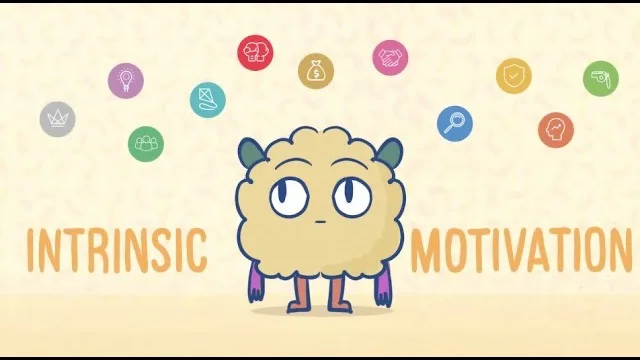
We do not choose our motivations. They are formed by our experiences. That is why treating a colleague's priorities as a character flaw makes so little sense. This 5-minute video explains intrinsic versus extrinsic motivation, the layer underneath most workplace disagreement.
“Conflicts don’t mark the absence of values, but rather a difference in what each person values most. We call that difference an interpersonal motivator gap.”Better Conflict, Attuned
We call that difference an interpersonal motivator gap. It is the most useful thing you can know about a disagreement, because it converts a vague personality clash into a specific, discussable mismatch. Humans largely share the same set of values. Which ones take precedence depends on individual experience, and we do not get to choose ours.
Mónica Guzmán cites the academic David Smith, who studies disagreements, with a question worth keeping in a drawer: "Which do you value more: the truth or your own beliefs? Because they're not synonymous." Guzmán also names the reason curiosity dies: "If you think you know, you won't ask." Once you have decided you know what motivates someone else, you stop investigating, and the assumption hardens into a fact you never checked.
Mónica Guzmán, I Never Thought of It That Way (2022)In Talking to Strangers, Malcolm Gladwell warns about the easy trap of believing we have mastered another person. "We think we can easily see into the hearts of others based on the flimsiest clues. We jump at the chance to judge strangers. We would never do that to ourselves, of course. We are nuanced and complex and enigmatic. But the stranger is easy." Measuring a motivator gap tells you where a difference sits. It does not hand you the whole person.
Malcolm Gladwell, Talking to Strangers (2019)Attuned uses a 55-question assessment to measure how strongly each person is driven by 11 key motivators identified by our team of psychologists, then scores each from 0 to 100. Mapping two colleagues against each other produces a picture of both the opposing motivations and the common ground.
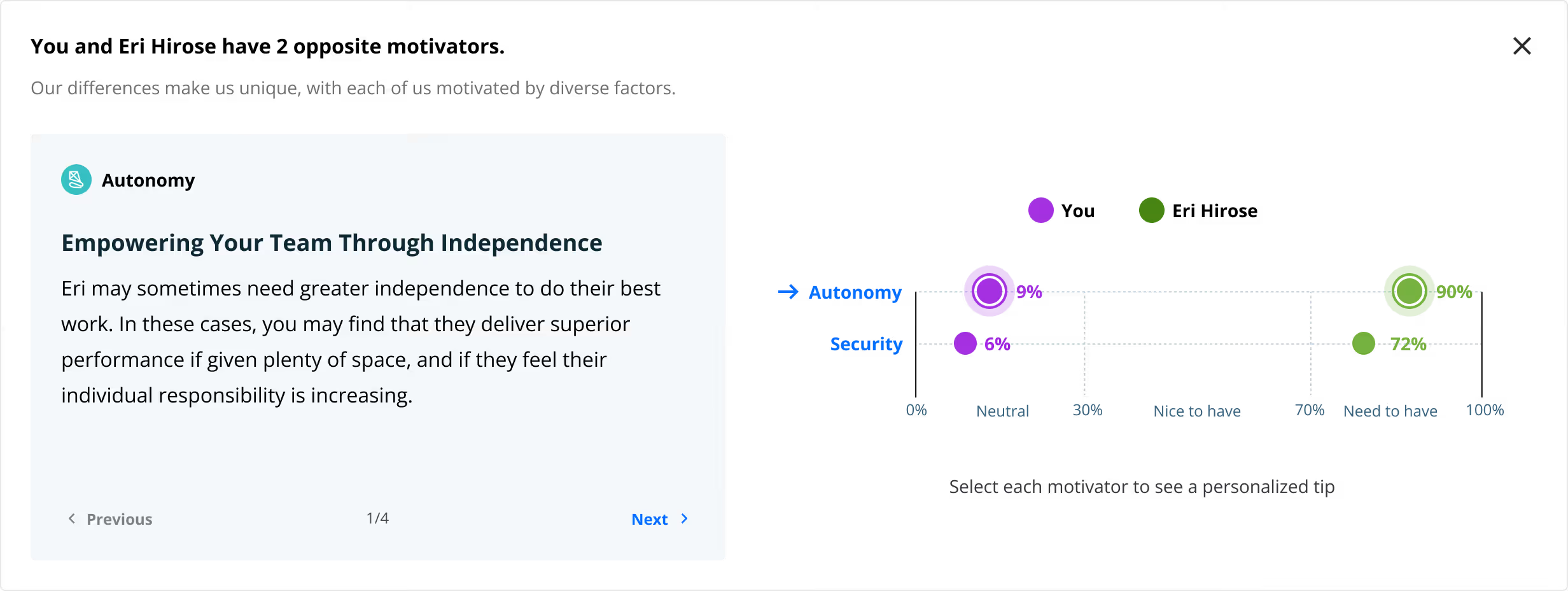
You might discover that where you are strongly driven by Social Relationships, Security and Altruism, your colleague is barely driven by those at all. Once both of you can see that, understanding and empathy follow, and you're free to have more frank conversations, inquire about their point of view, and understand the limits of your own. It works alongside our guide to giving difficult feedback for the conversation itself.
Ripley has a phrase for the thing under the argument: in many conflicts "we have only the flimsiest grasp of our understory." Most of us have caught ourselves in that gap, snapping at someone in the certainty they wronged us, only to work out later that the headache we had been nursing all day had finally got the better of us.
Understanding what each of these means, and the behaviors they are associated with, lets colleagues identify and navigate potential causes of conflict while also recognizing where they already agree.
Each person's combination of these 11 is unique. That is why the same disagreement means different things to different people.
See the assessment →Companies can bust bad conflict before it occurs by building a workplace that is unfriendly to the destructive kind. Six habits do most of the work.
People can learn to state a position and the motivation behind it in the same breath. "I think we're spending too much on this project. I'll be evaluated on how the budget looks at year end, and I have a responsibility to keep us in the black." The second sentence is what stops the first from sounding like obstruction.
Groups can be a good thing, and sometimes their very existence foments us-versus-them thinking (Ripley, 2021). Before you create groups at work, ask how necessary they are and what purpose they serve. Binary groups are the most susceptible of all to us-versus-them battles.
Tools like Slack can replicate what social media does to us. Meaning is lost without mannerisms and tone, and conversations are often visible to colleagues, so people find it harder to be honest and may try to "win" instead. Purely virtual groups are more prone to conflict than groups who share proximity (Folger, 2021), so facilitate face-to-face contact where you suspect friction.
Do not underestimate the much-derided team-building activity. Psychologists describe a magic ratio in marriage of five good interactions for every bad one, a finding originating with John Gottman (via Golden, 2022), and work relationships behave similarly. Coleman and Ferguson call the balance an emotional reservoir: "Like a bank account, if there are frequent deposits that add value, occasional withdrawals are less significant."
Repeat back what someone told you, in your own words, until they confirm you have it. It is the cheapest conflict-prevention habit available and it works before a disagreement exists, not only during one.
People are not one-note. If a driver runs a stop sign it is easy to conclude they are careless and indifferent to others. It is just as likely they are having a rough day: a bad diagnosis, a death in the family, a burst pipe. Giving others the benefit of the doubt is what stops you turning them into enemies.
How a team goes from personality clashes nobody can act on to a named motivator gap two colleagues can talk about without it becoming personal.
No rollout plan. No IT project. Each person answers 55 questions, and Attuned calculates their profile across 11 intrinsic motivators, scored 0 to 100. Most teams are up and running within a week of signing up.
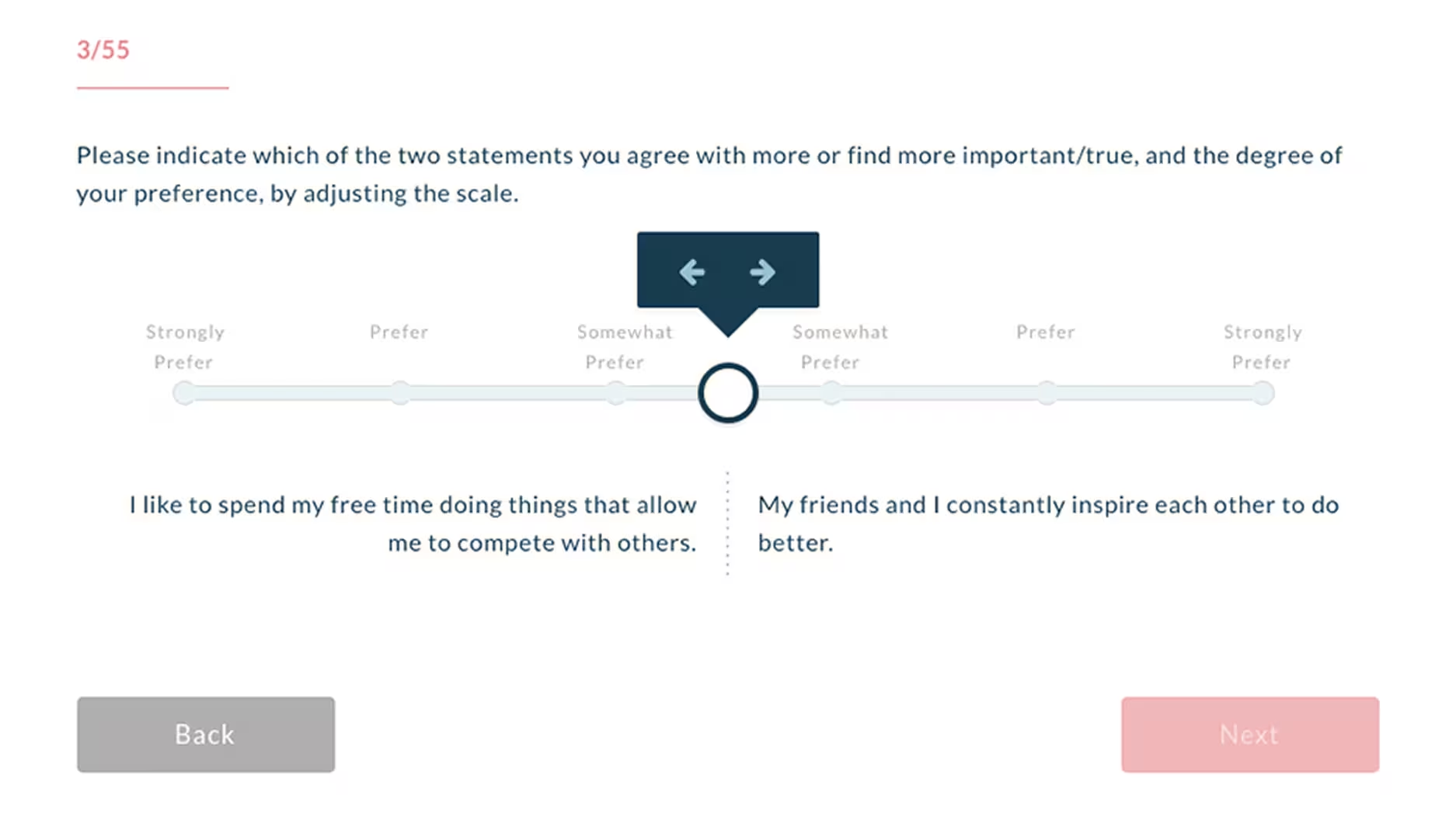
Slider-based questions, ~10 min
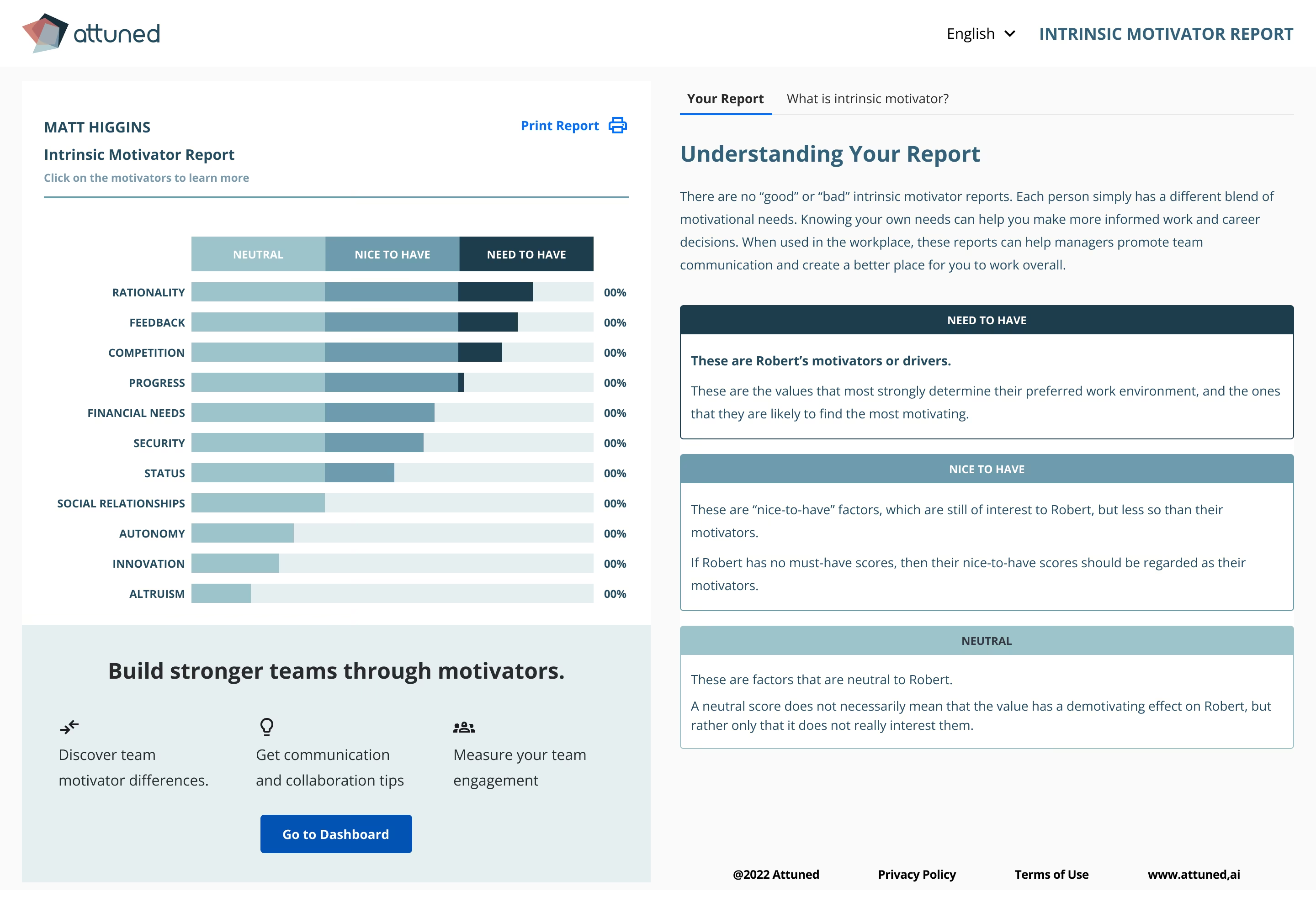
Step one of resolving any conflict is knowing what drives you, because being blind to your own values is the reliable route into a blind values conflict. Each person gets their own Intrinsic Motivation Report. People tend to find that part uncomfortable and useful in equal measure.
Attuned maps one person's motivators against a colleague's, so the interpersonal motivator gap becomes a picture you can point at. You see the opposing drivers and the shared ones at the same time, which is what turns "we clash" into "you lead with Innovation, I lead with Security, and we both care about Progress."
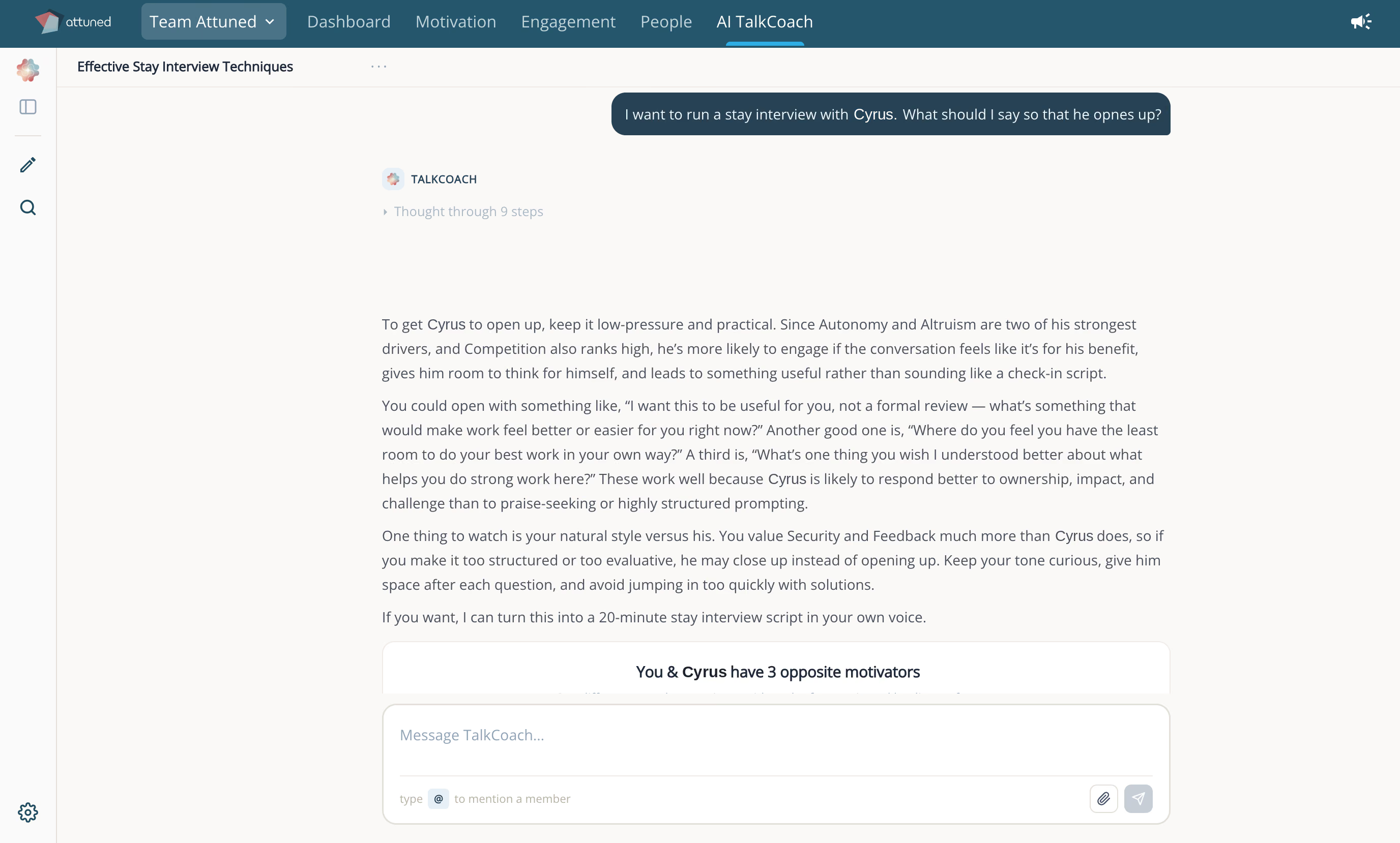
The AI TalkCoach converts each profile into what to ask, how to frame it and what to steer around. For a manager mediating between two people, that means arriving with the difference already named and a way into it that does not put either person on the defensive.
The three scenarios above are illustrative. This one is a real customer. Azon Recruitment Group grew from a small team into an award-winning business, and used motivator data to understand what each person valued, where before they had guesswork.
An award-winning Irish recruitment firm that scaled from a handful of people to multiple specialist teams.
Azon hit the problem every scaling company hits: once there are several teams and several managers, leadership can no longer read the mood of the place by walking through it, and differences between individuals stop being visible. Attuned gave their managers a shared, individual view of what each person valued. That is the same raw material that makes a disagreement legible instead of personal.
"Being able to get to the nub of people's underlying motivations at the start of a process and see what really drives and motivates people in the workplace has been very helpful, and we've seen a dramatic increase in the numbers of people we hire that we feel we've gotten right, and that are a right fit for the business." Kevin Halligan, Associate Director, Azon
"I would recommend Attuned to any company that is fast-growing, wants to make the right decisions from the outset, wants a harmonious work environment, and is bringing in the best talent, as well as retaining and developing their existing team." Ronan Colleran, CEO, Azon Recruitment Group
Most of this page draws on our Better Conflict paper. The paper is free to download, and everything else here is the adjacent reading.
The complete research by Emily McCrary-Ruiz-Esparza, covering bad and good conflict, the path out through understanding, the challenge of parity, and how to prevent the destructive kind. The chapter outline and the download form sit on the same page. A good thing to send to the manager who told two people to sort it out between themselves.
Download the paper →Once the gap is named, someone still has to say the hard thing out loud. This covers doing that without breaking the relationship.
Read the guide →Whether anyone raises a conflict at all is a psychological safety question first. Itzchakov's research found that seeking to understand others raises it directly.
Get the workbook →The 55-question assessment behind the 11 motivators, and the thing that makes a motivator gap measurable.
See the assessment →Practical ways to create the conditions where people say the real thing, in the meetings where conflict usually surfaces first.
Read the post →Acas (2021). Estimating the Costs of Workplace Conflict, by R. Saundry & P. Urwin. · Coleman, P. & Ferguson, R. (2014). Making Conflict Work: Harnessing the Power of Disagreement. Mariner Books. · Folger, J.P., Poole, M.S. & Stutman, R.K. (2021). Working Through Conflict. Taylor & Francis. · Gladwell, M. (2019). Talking to Strangers. Little, Brown. · Golden, G. (2022). The Gottman Ratio for Happy Relationships at Work. Psychology Today. · Guzmán, M. (2022). I Never Thought of It That Way. BenBella Books. · Ripley, A. (2021). High Conflict: Why We Get Trapped and How We Get Out. Simon & Schuster. · Shonk, K. (2023). 3 Types of Conflict and How to Address Them. Harvard Law School Program on Negotiation. · Itzchakov, G. & Kluger, A.N. (2017). The Listening Circle: A Simple Tool to Enhance Listening and Reduce Extremism Among Employees. Organizational Dynamics.
The strategies are well documented and mostly correct. What no framework hands you is the specific difference between the two colleagues currently not speaking to each other. That is what Attuned measures, and it is the difference between a mediation that holds and one that resurfaces in a month.
A ~10-minute assessment. No IT project, no training required. Your whole team can be profiled within days.
Two profiles side by side turn "they're difficult" into a named, measured difference that both people can look at together.
The AI TalkCoach supplies what to ask and what to avoid, so the person mediating is not improvising.
Lawful basis, data minimization, individual access rights, and the right to be forgotten. Your people own their motivator data.
We measure what each person values most, then show you the gap between two colleagues and the ground they already share. It turns a personality clash into a conversation with somewhere to go.
We hold motivator data on more than 10,000 people across four generations, and we spend our days helping managers read it. It costs your team about ten minutes each to find out what the difference between them actually is.