Most advice on how to motivate your team hands you one list of tactics for a group of people who do not share a single driver between them. Recognition lifts one person and exposes the next. Below is the per-person method instead: the eleven intrinsic motivators, what each one needs, and a read you can run in your next one-on-one.
Status. Being named in front of the room is the reward.
Autonomy and Security. Praise raises expectations and scrutiny, which is exposure rather than reward.
Autonomy and Innovation. Space to choose the method is the whole point.
Security and Feedback. Removing structure removes the ground they were standing on and the signal they used to steer.
Competition and Progress. A number to beat and a level to reach.
Rationality and Security. A target with no stated reasoning reads as arbitrary pressure.
Social Relationships and Altruism. The shared thing is the reward.
Competition and Status. Averaging an individual result into a team total deletes the signal they run on.
Financial Needs, where it is genuinely the top driver.
Nothing, but it also fixes nothing else. Pay resolves one of eleven drivers and buys roughly a quarter before the real one resurfaces.
Every row is a tactic recommended by the top-ranking guides for this question. None of them are wrong. All of them are wrong for somebody on your team.
A team is not motivated by one thing. Each person is driven by their own ranking of eleven intrinsic motivators, and motivation rises when someone’s top drivers are being met by their actual work. Motivating a team therefore means diagnosing which driver is going unmet for which person, then changing that one thing. Generic tactics succeed only for the people whose drivers happen to match them.
If you manage a sales floor, the same logic applies with one extra wrinkle, and it has its own page: how to motivate your sales team, where the leaderboard is already doing half the work for two of your reps and quietly demotivating the rest. For the underlying model, see what intrinsic motivation is and the eleven motivators in full.
This is the part most guides skip. They open with the same universal levers: autonomy, mastery, purpose, recognition, celebrating progress. Those levers are real. What the lists leave out is that each one points in opposite directions depending on who is standing in front of you, which is why a manager can follow the advice carefully and still end up with a team where half the people are flat.
Everyone has all eleven. What differs is the order, and the order is what makes the advice unreliable. Pick a driver to see what it looks like when it is being met, what it looks like when it is starving, and the one thing to do about it.
Wants the work to help someone.
Talks about the customer or the colleague before the metric. Volunteers for the unglamorous thing that unblocks other people.
Goes quiet when the work turns into numbers with no human on the other end, and starts asking who this is actually for.
Show them the person their work landed on. Forward the support thread, name the team they unblocked.
Framing their goal purely as a revenue number. It reads as a reason the work does not matter.
Wants control over how the work gets done.
Ships in their own way and their own order, and is happiest when you hand over the outcome and leave.
Bristles at new process, asks why a step exists, and quietly routes around approvals that feel like supervision.
Give them the outcome and the constraints, then stay out of the method. Agree the check-in cadence up front so it stops feeling like surveillance.
Adding a status update to fix a problem that was never about visibility.
Wants to win, measurably, against someone.
Asks where they rank. Raises their own target the moment they hit the one you set.
Goes flat when everything is a shared team goal with no scoreboard and no one to measure against.
Give them a comparison that is fair and visible: a benchmark, a personal best, a peer number they can see.
Averaging their result into a team total. It removes the only signal they were running on.
Wants to know where they stand.
Asks how that went, more than once. Reads silence as a verdict, usually a bad one.
Spirals in the gap between check-ins and starts hedging their work to avoid being wrong.
Tell them specifically and often, including when it is fine. Short and frequent beats considered and quarterly.
Saving it for the review. By then they have already written their own worse version.
Wants pay to be secure and fair.
Reads the comp policy properly. Asks about bands, timing and what triggers a change.
Disengages when a raise is implied and never dated, or when they suspect the band is not being applied evenly.
Be concrete about numbers, timing and the criteria. Where you cannot move, say so with the reason and the date you can revisit.
Answering a pay question with a culture answer. It reads as a no you are unwilling to say.
Wants to make something that did not exist.
Pitches the different approach. Gets restless once a problem is solved and the work turns into maintenance.
Fades on the third month of the same process and starts inventing problems worth solving.
Hand them the unshaped problem, early, before anyone has decided the answer. Give a small budget to try the odd idea.
Handing them a finished spec to execute. The interesting part is already gone.
Wants to be further along than last year.
Talks in terms of the next level, the next skill, the next scope. Measures the job against where it leads.
Stalls when the ladder is unclear or a promotion case goes quiet, and starts taking recruiter calls.
Name the next step and what specifically closes the gap. A dated, honest plan beats an encouraging vague one.
Praising their current performance without ever mentioning what comes after it.
Wants the decision to make sense.
Asks why. Then asks why again, about the answer. Accepts hard news readily if the logic holds.
Withdraws when a decision is announced without reasoning, and treats the next one as arbitrary too.
Show the reasoning and the trade-off you accepted, including what you gave up. They can hold a decision they disagree with if it is coherent.
Reassurance in place of an explanation. It reads as evasion, and it costs you their trust on the next call.
Wants to know the ground is stable.
Asks what happens next and plans against it. Values a predictable cadence more than an exciting one.
Tenses through reorgs and hiring freezes, and reads ambiguity as a threat even when nothing is wrong.
Give them the plan, the dates and the parts that are settled. A provisional answer with a review date beats silence.
Waiting until you have certainty before you say anything. The gap is where the worst version gets written.
Wants to like the people they work with.
Does their best work alongside someone. Is the reason the team knows each other.
Deflates in isolation, on solo assignments and in fully async stretches, and quietly loses interest.
Pair them deliberately. Protect the small rituals that look like overhead and are not.
Rewarding them with a solo project. To them it reads as removal, not promotion.
Wants their standing to be visible.
Notices titles, invite lists and who was in the room. Wants the contribution attributed.
Sours when their work is presented without their name on it, or when a peer is elevated past them without explanation.
Attribute the work publicly and precisely. Put them in the room where the decision is made.
Anonymising the win into a team achievement when it was substantially theirs.
This runs inside the one-on-ones you already have. It takes about ten minutes per person to start and roughly one question per week to keep going.
Before you measure anything, guess. One or two motivators per person, from memory. This takes ten minutes and it is the control you will check yourself against later.
In your next one-on-one: what part of the last month did you actually enjoy, and what part did you push through? The enjoyable part points at a met motivator. The pushed-through part points at the gap.
Turn what you heard into one sentence of the form: this person needs more X and is currently getting Y. If you cannot write that sentence, you have a feeling rather than a read.
Pick the smallest change that feeds the driver you named, and make it this week. That usually means one of three things: attribution for work that went out unnamed, a dated plan where there was only encouragement, or an outcome handed over without the method attached. One change, one person.
Motivators are stable. Satisfaction moves. Three weeks later, ask whether the thing you changed made a difference. If nothing moved, your read was wrong, and that is useful.
One per person. Plain text on purpose, so it survives being pasted into whatever you keep your notes in.
PER-PERSON MOTIVATOR READ Person: Date: Top driver I believe they run on: Second driver: Evidence (something they said or did, not a vibe): THE GAP They need more: They are currently getting: THE ONE CHANGE I CONTROL What I will change: By when: How I will know it worked: WHAT TO STOP The thing I do that starves their second driver: REVIEW Check back on: Did it move:
Keep this one to yourself. It records your read of somebody, and a read you are still testing should never arrive in their inbox as a conclusion.
Each of these is a common, well-intentioned management habit that reliably costs you somebody.
A team average hides the two people at the edges, and they are the ones who leave. Nobody on your team is the average.
The single most common error is projecting your own top motivator onto the room. A Progress-driven manager builds career ladders for a team that wanted stability.
Pay answers one driver. Reaching for it when you cannot diagnose the real one buys a quarter of quiet and teaches the person that the answer to dissatisfaction is a number.
The same weekly all-hands feeds Social Relationships and taxes Autonomy. Rituals need an opt-out before they need a redesign.
An annual score tells you the temperature of a group nine months after the fact. It will not tell you which person needs what on Monday.
If the job structurally cannot supply someone's top two drivers, technique will not fix it. Name it early and move them.
“Being able to get to the nub of people’s underlying motivations has been very helpful.”
Kevin Halligan, Associate Director, Azon Recruitment GroupAzon grew from a handful of people into an award-winning talent business. Once there were several teams and several managers, the leadership could no longer take the temperature of the place by walking through it. Attuned mapped every member across the eleven motivators, so managers could see what mattered to each individual rather than an averaged team score.
We hold motivator data on more than 10,000 people across four generations. The eleven drivers combine into roughly 1.7 million distinct profiles, which is the arithmetic reason a single list of team tactics was never going to work.
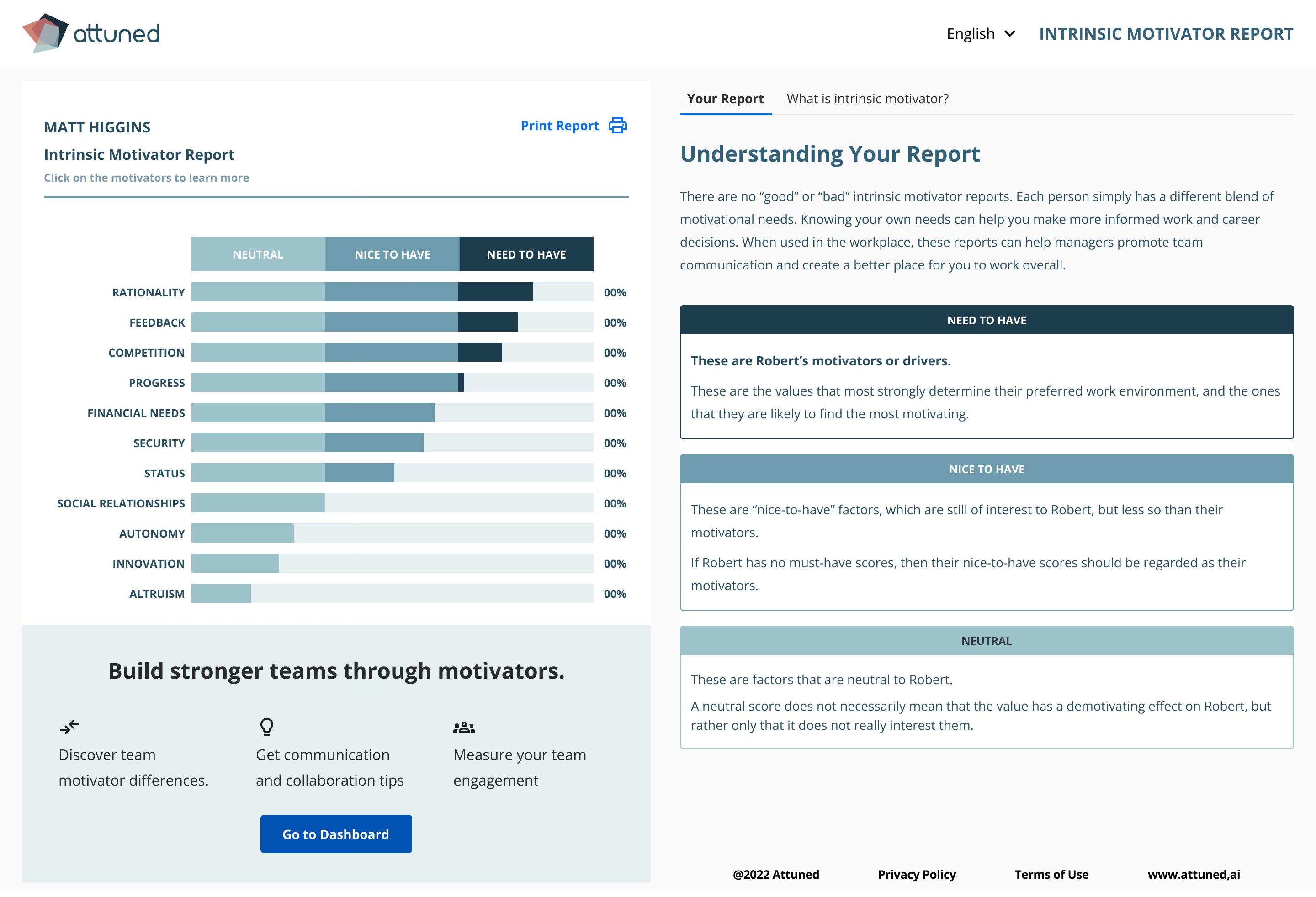
One person’s ranking. The manager’s job is the top three and the gap underneath them.
Stop treating it as one problem. A flat team is usually several different unmet motivators at once: one person has had no feedback in months, another has lost autonomy to a new process, a third has watched a promotion stall. Ask each person what has changed for them since they last felt motivated, and you will normally get three different answers. Fix them separately.
Money maps to one of the eleven intrinsic motivators, Financial Needs, and it is rarely the top driver for more than a fraction of a team. The other ten are free: autonomy over how the work gets done, feedback on where someone stands, visible progress, work that makes sense, a stable plan, a colleague they like working with. The constraint is knowing which one each person runs on.
Altruism, Autonomy, Competition, Feedback, Financial Needs, Innovation, Progress, Rationality, Security, Social Relationships and Status. Everyone has all eleven, ranked differently. The ranking is what makes generic motivation advice unreliable: the same action satisfies a high driver in one person and ignores it in the next.
Change hits Security and Rationality hardest, and those two are the ones most often left unaddressed. People high in Security need the plan and the dates, even provisional ones. People high in Rationality need the reasoning, not the reassurance. Telling a Rationality-driven person that it will be fine without explaining why reads as evasion.
Recognition satisfies Status. For someone low in Status and high in, say, Autonomy or Security, public praise is exposure rather than reward: it raises expectations, invites scrutiny and changes nothing they actually wanted. This is the clearest example of a standard tactic reversing on the wrong person.
Motivators are relatively stable, but satisfaction with them moves constantly. Check the profile roughly once a year and check satisfaction every quarter. What changes is rarely what someone wants; it is whether their current role is still giving it to them.
Not durably. If a role structurally cannot supply someone's top two motivators, no amount of management technique substitutes. That is a redesign or a move, and recognising it early is kinder than a year of tactics that were never going to work.
You describe a team that has gone flat, and we show you what the eleven-motivator read looks like against real people rather than a slide. If it turns out you already know what each person needs, we will tell you that and give you the half hour back.